
In physics, understanding the difference between scalar and vector quantities... Zobraziť viac
 Physics4 zobrazenia·Aktualizované May 8, 2026·6 stránky
Scalars and Vectors Explained: Learn the Basics
1 / 6
1
of 6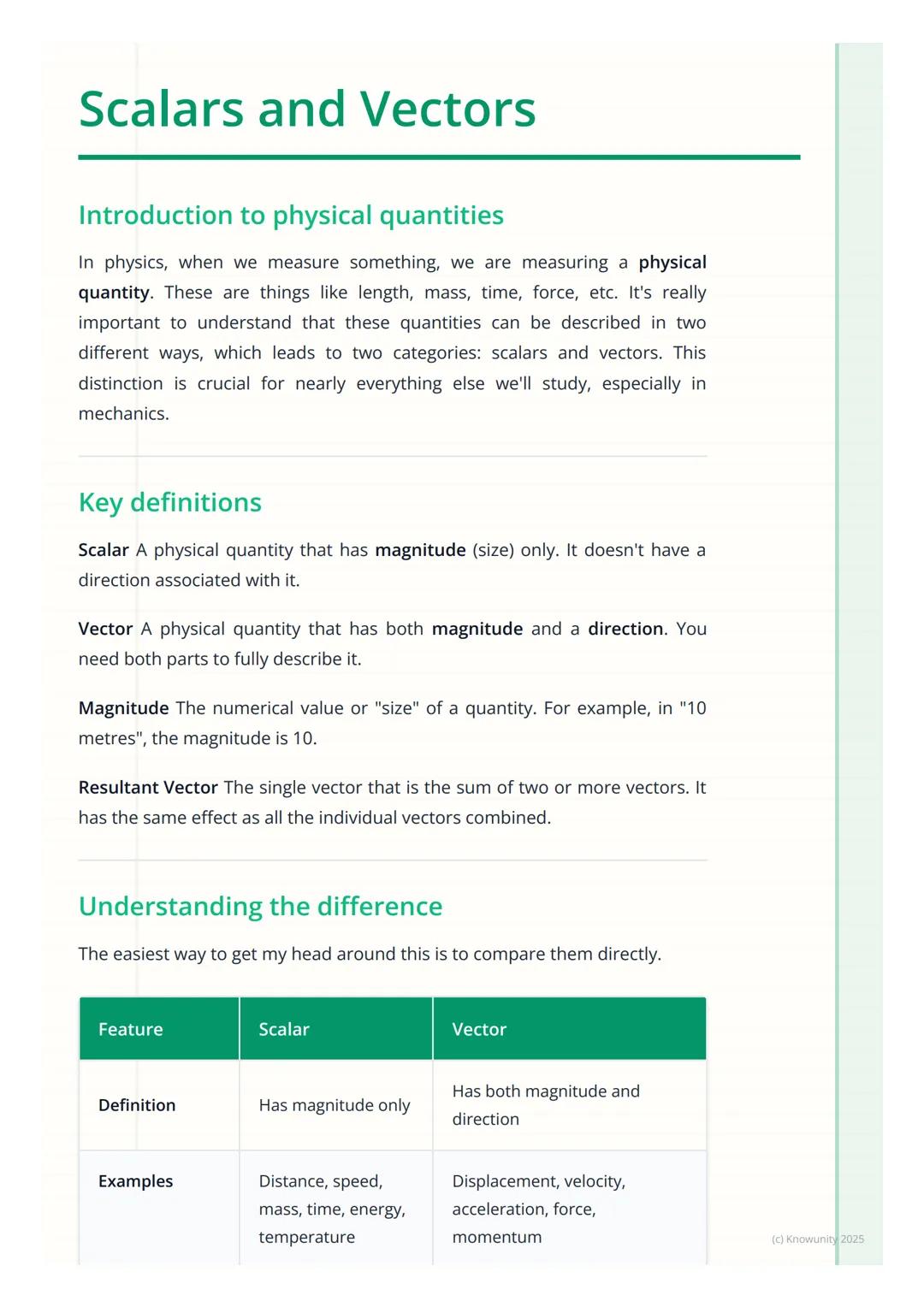
Scalars and Vectors: The Basics
Physical quantities in physics come in two distinct types. The difference between them is crucial to understand early on, as it affects everything from how we write them to how we calculate with them.
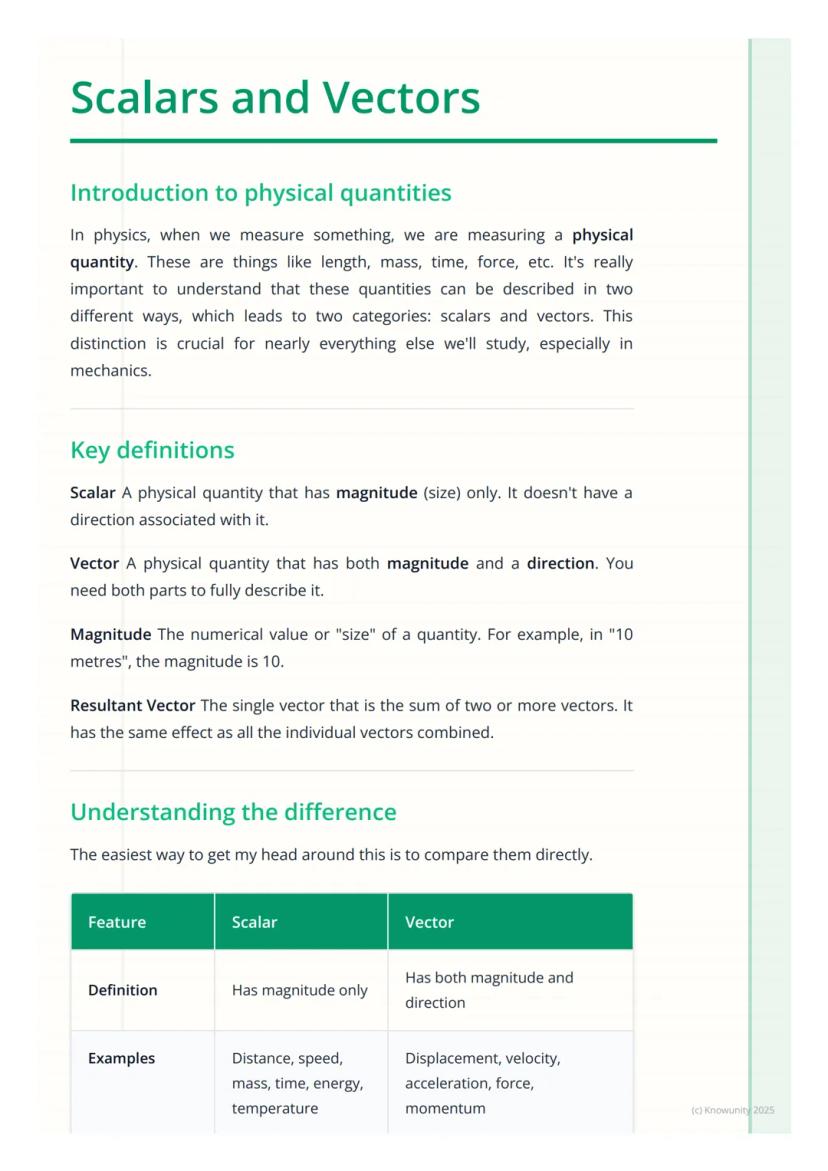
Scalars are physical quantities that have only magnitude (size). Think of magnitude as simply "how much" of something there is. Examples include distance, speed, mass, time, energy, and temperature. When dealing with scalars, you only need to specify the number and unit.
Vectors are more complex as they have both magnitude and direction. Both parts are essential to fully describe the quantity. Common examples include displacement, velocity, acceleration, force, and momentum. You haven't fully described a vector until you've specified both how large it is and which way it's pointing.
Quick Tip: If you can answer the question "how much?" but not "which way?" then you're dealing with a scalar. If both questions need answers, it's definitely a vector!
2
of 6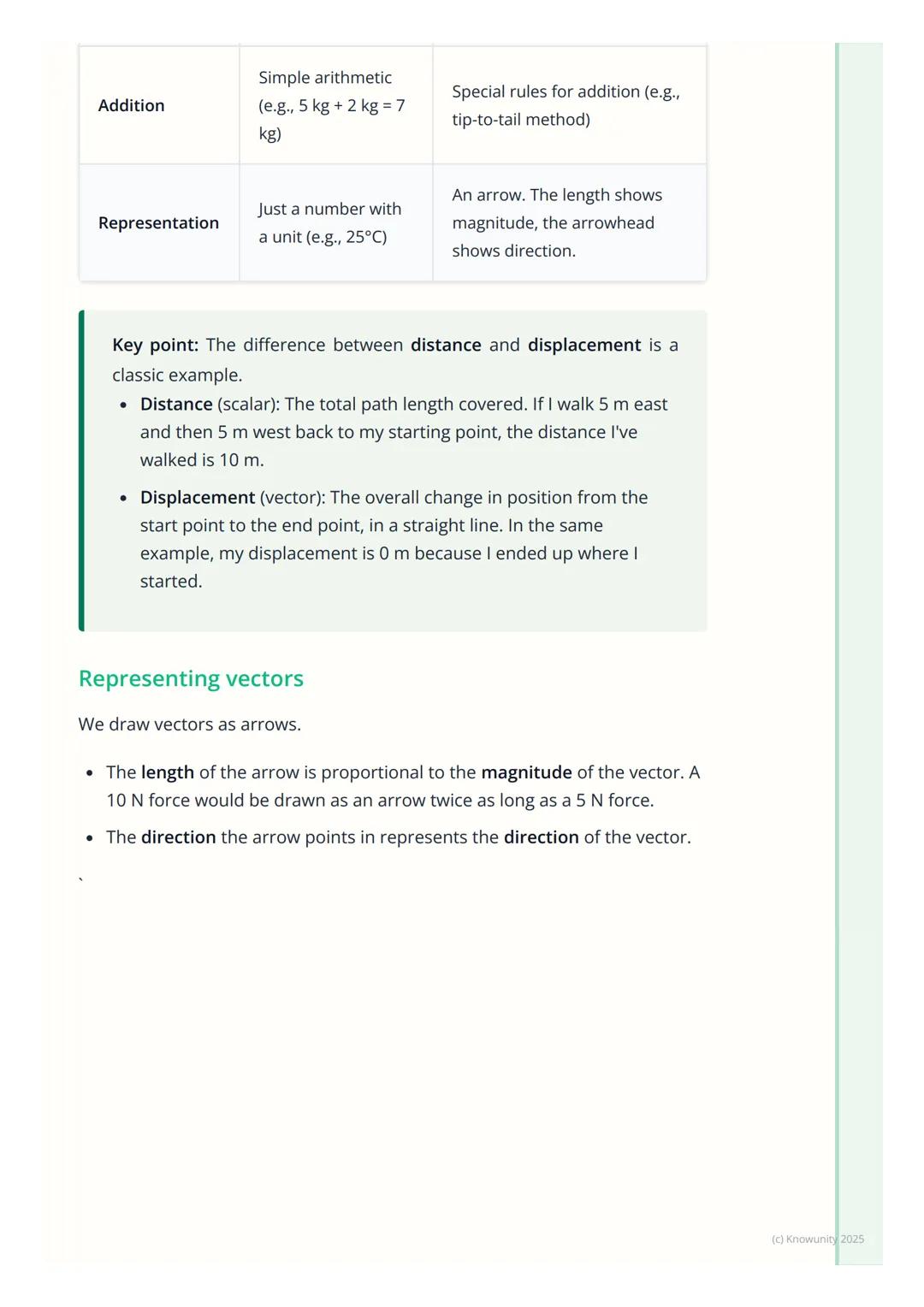
Distinguishing Vectors from Scalars
The classic example that shows this difference is comparing distance and displacement:
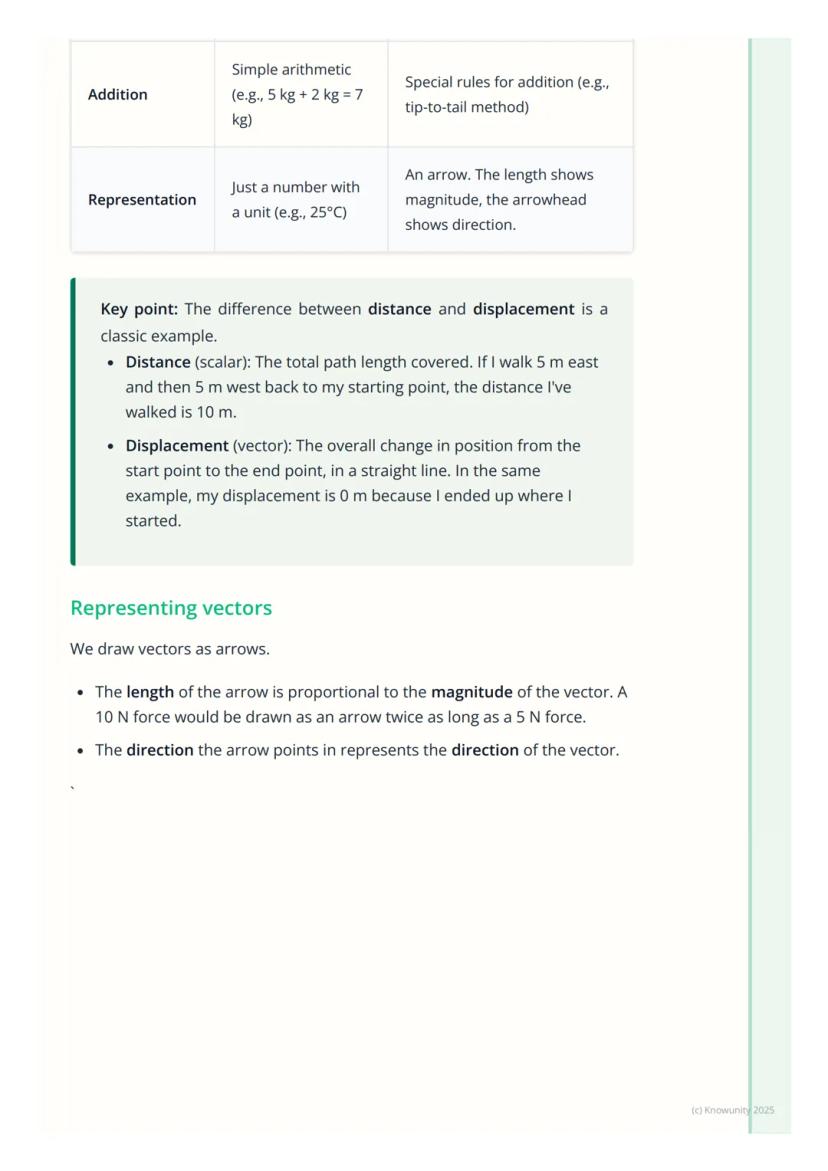
If you walk 5 metres east and then 5 metres west back to your starting point, your total distance (a scalar) is 10 metres. However, your displacement (a vector) is 0 metres because you ended up exactly where you started!
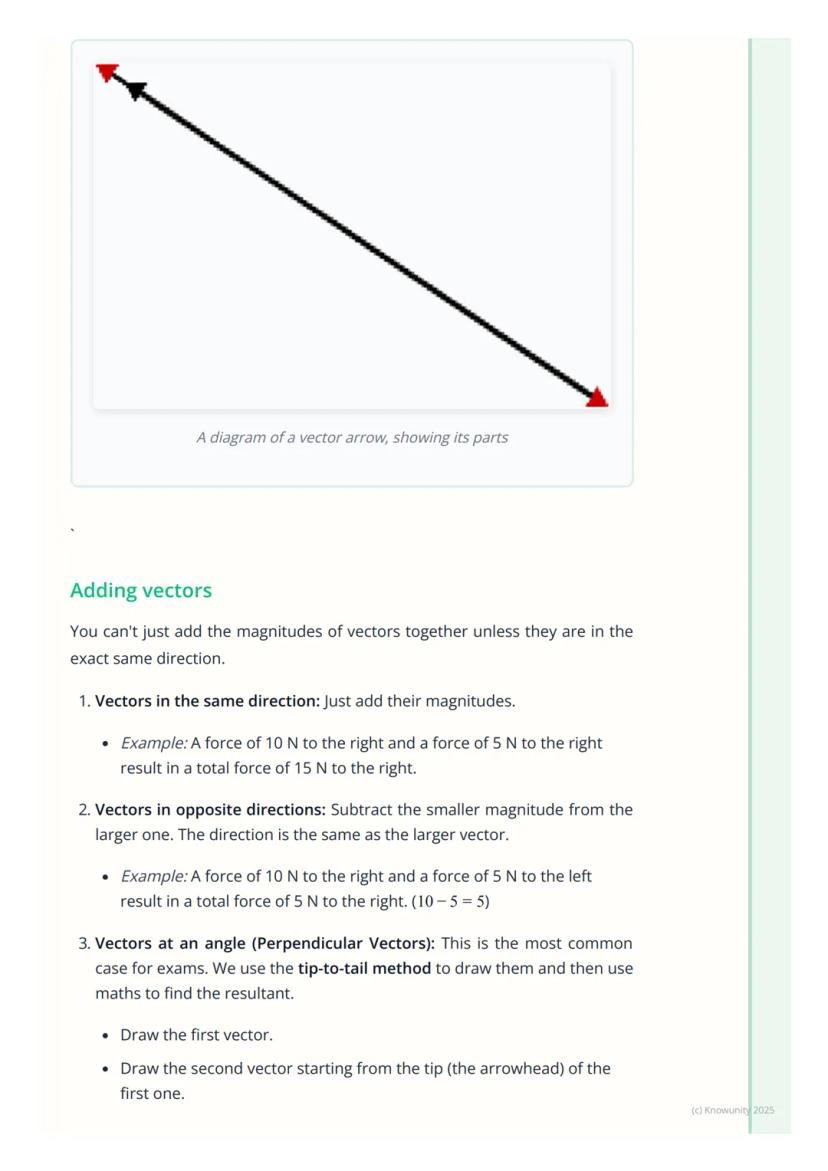
Vectors are represented as arrows in diagrams. The length of the arrow shows the magnitude (longer means bigger), while the direction the arrow points shows, well, the direction of the vector. It's a brilliantly simple visual system.
Adding vectors follows different rules than adding scalars. While scalar addition is straightforward arithmetic , vector addition requires considering direction. Vectors pointing in the same direction can be added directly, but vectors pointing in different directions require special methods.
Remember: When writing about vectors in your answers, always include both magnitude and direction. Writing "5 m/s east" for velocity will get you full marks, but just writing "5 m/s" will cost you points!
3
of 6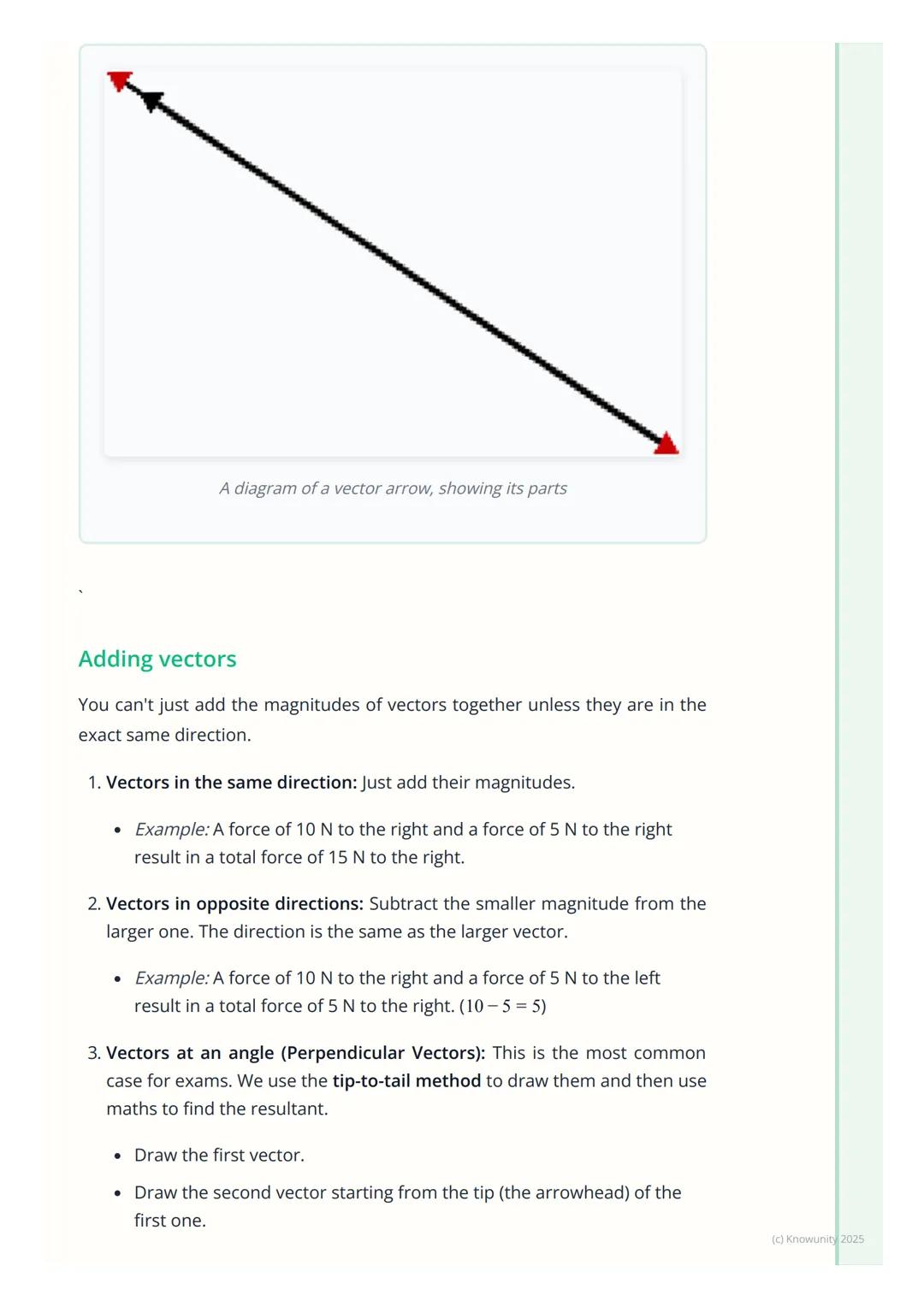
Adding Vectors
Vector addition isn't as straightforward as scalar addition because direction matters. There are three main cases you need to know:
For vectors in the same direction, just add their magnitudes. If forces of 10 N and 5 N both point right, the resultant force is 15 N right. Easy enough!
For vectors in opposite directions, subtract the smaller magnitude from the larger. If a 10 N force points right and a 5 N force points left, the resultant is a 5 N force to the right .
The trickiest case is vectors at an angle to each other. Here, we use the "tip-to-tail" method: draw the first vector, then draw the second vector starting from the arrowhead (tip) of the first. The resultant vector runs from the start of the first to the end of the second, forming a triangle.
Exam Alert: The most common exam questions involve perpendicular vectors . These are perfect for using Pythagoras' Theorem to find the resultant magnitude and trigonometry to find the angle!
4
of 6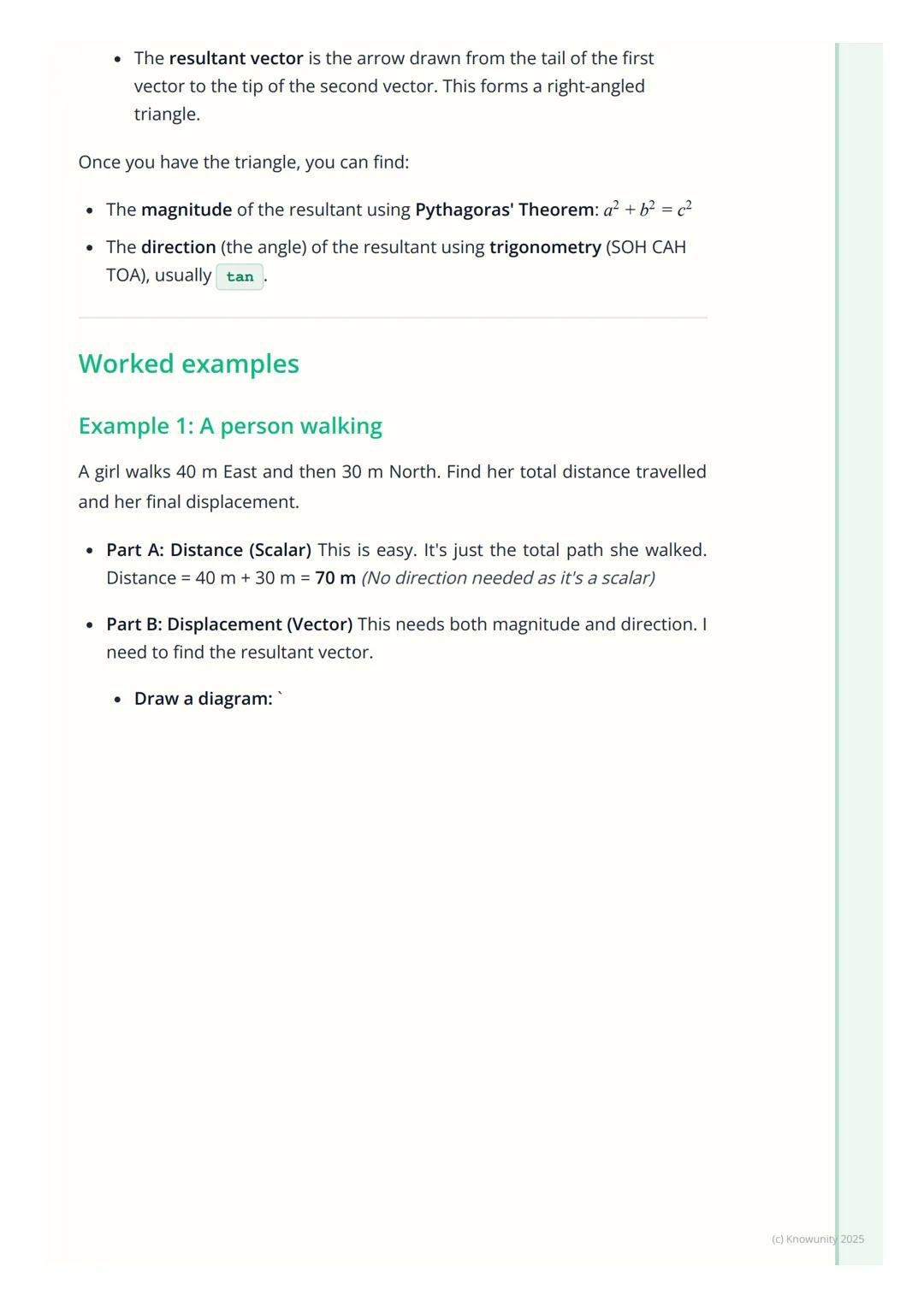
Finding Resultant Vectors
When vectors are at right angles, they form a right-angled triangle that's perfect for applying mathematical tools. The resultant vector is the hypotenuse of this triangle.
To find the magnitude of the resultant, use Pythagoras' Theorem: , where is the resultant vector's magnitude.
To find the direction (angle), use trigonometry, typically the tangent function: .
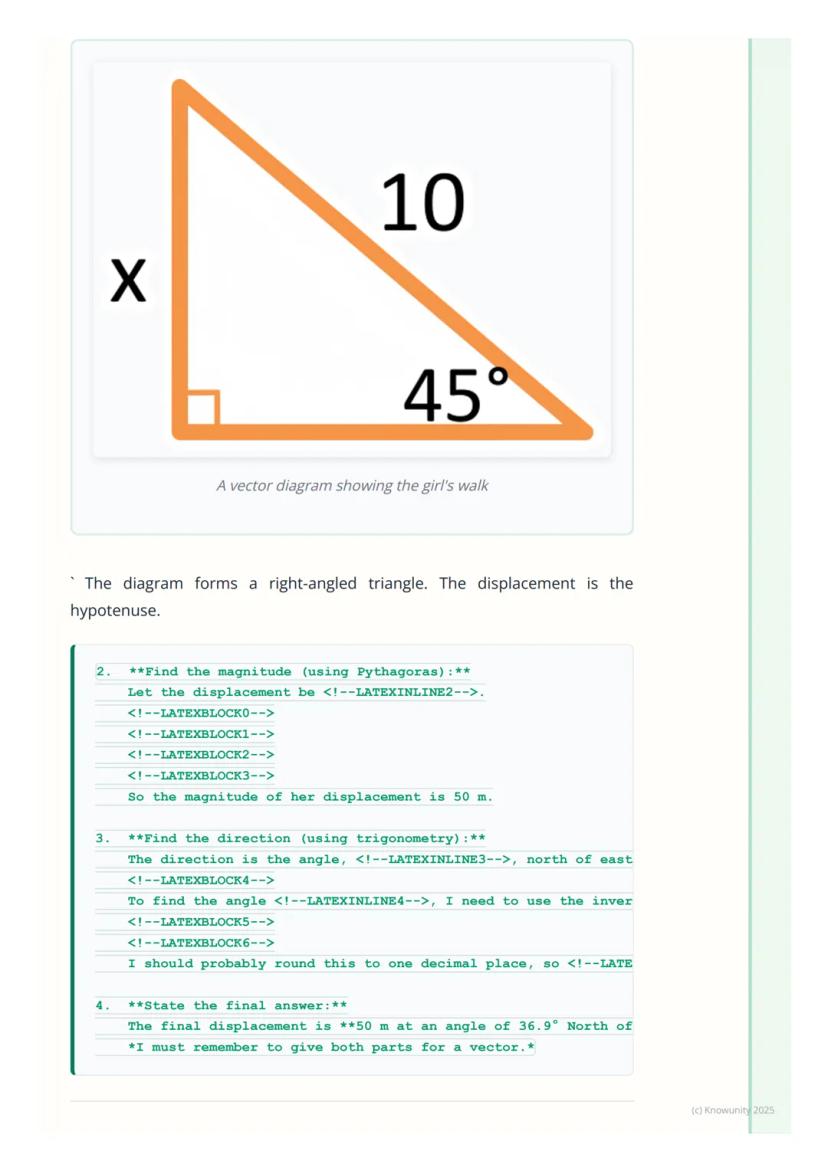
Let's look at a practical example: A girl walks 40 m East and then 30 m North. For her total distance travelled (scalar), simply add: 40 m + 30 m = 70 m. No direction needed since distance is a scalar.
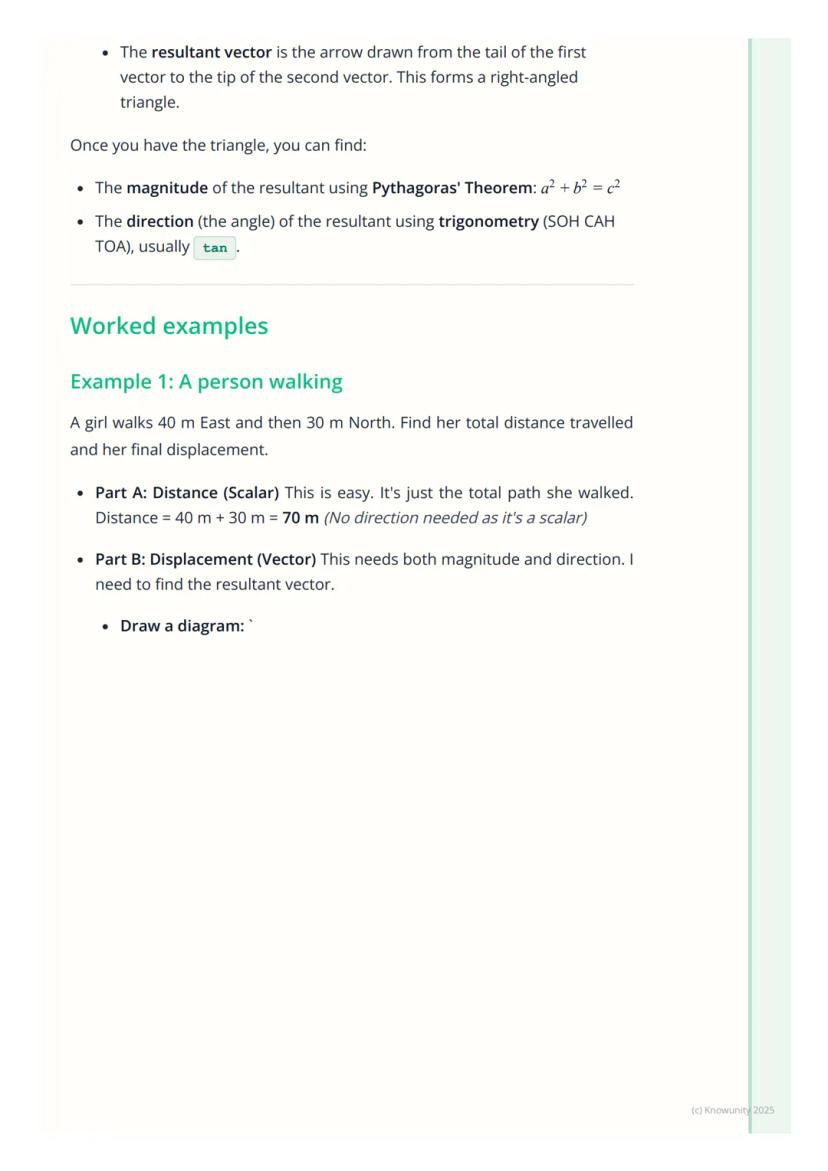
For her displacement (vector), we need the resultant of these two perpendicular vectors. Drawing this out shows a right-angled triangle with the displacement as the hypotenuse.
Study Hack: Always draw a clear diagram for vector problems! It makes the maths much easier to set up correctly and helps you visualize what's happening physically.
5
of 6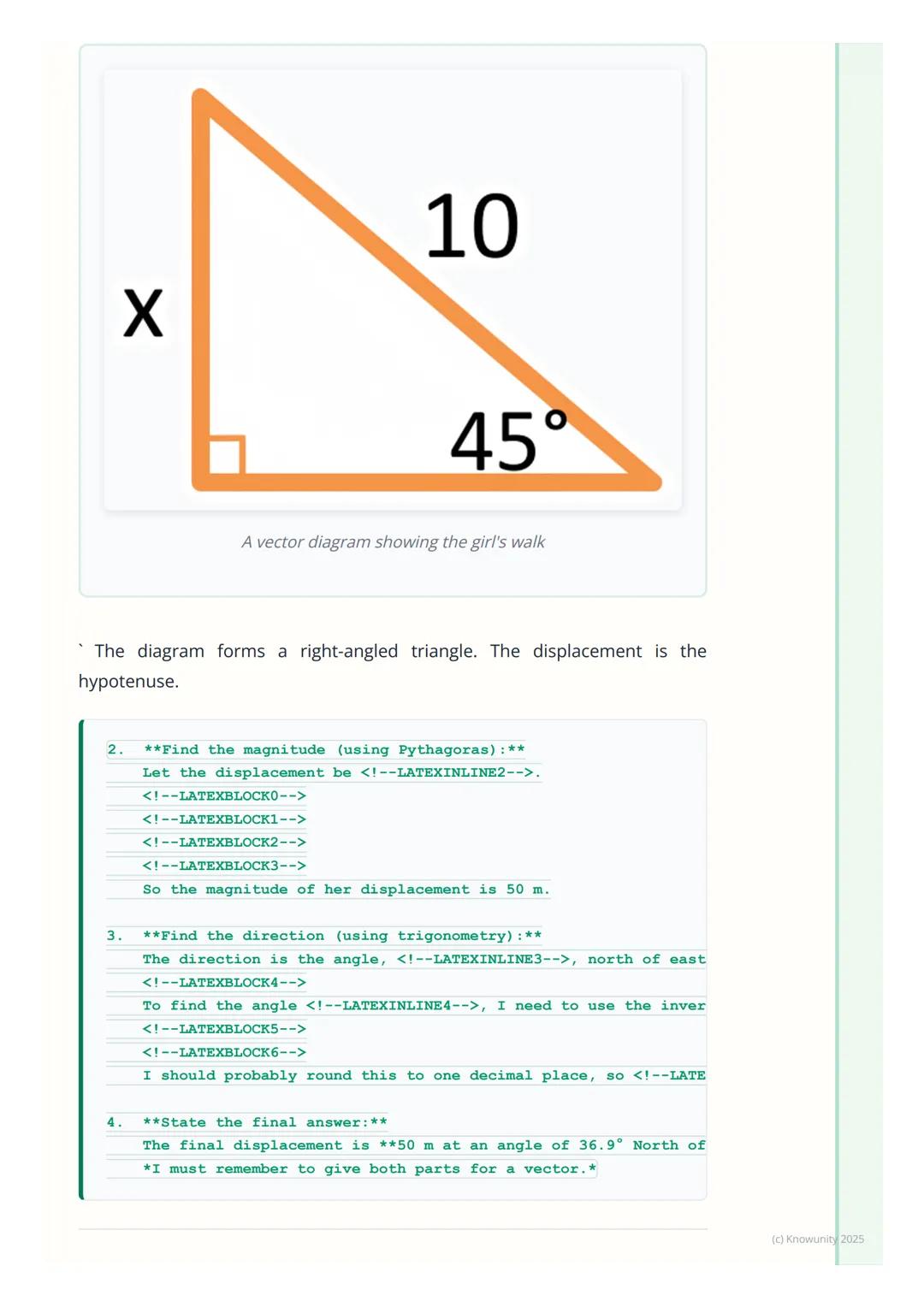
Calculating Vector Problems
Using our walking example, we can now complete the calculation. With legs of 40 m and 30 m, we can find the hypotenuse (displacement magnitude) using Pythagoras:
Displacement = m
Next, we find the direction using trigonometry. We want the angle north of east:
Therefore, the girl's final displacement is 50 m at an angle of 36.9° North of East.
Notice how the complete answer includes both magnitude (50 m) and direction (36.9° North of East). For vector quantities, you must include both parts in your answer.
Mind the Details: Always check your calculator is in degree mode (not radians) when solving these problems. A small setting mistake can lead to very wrong answers!
6
of 6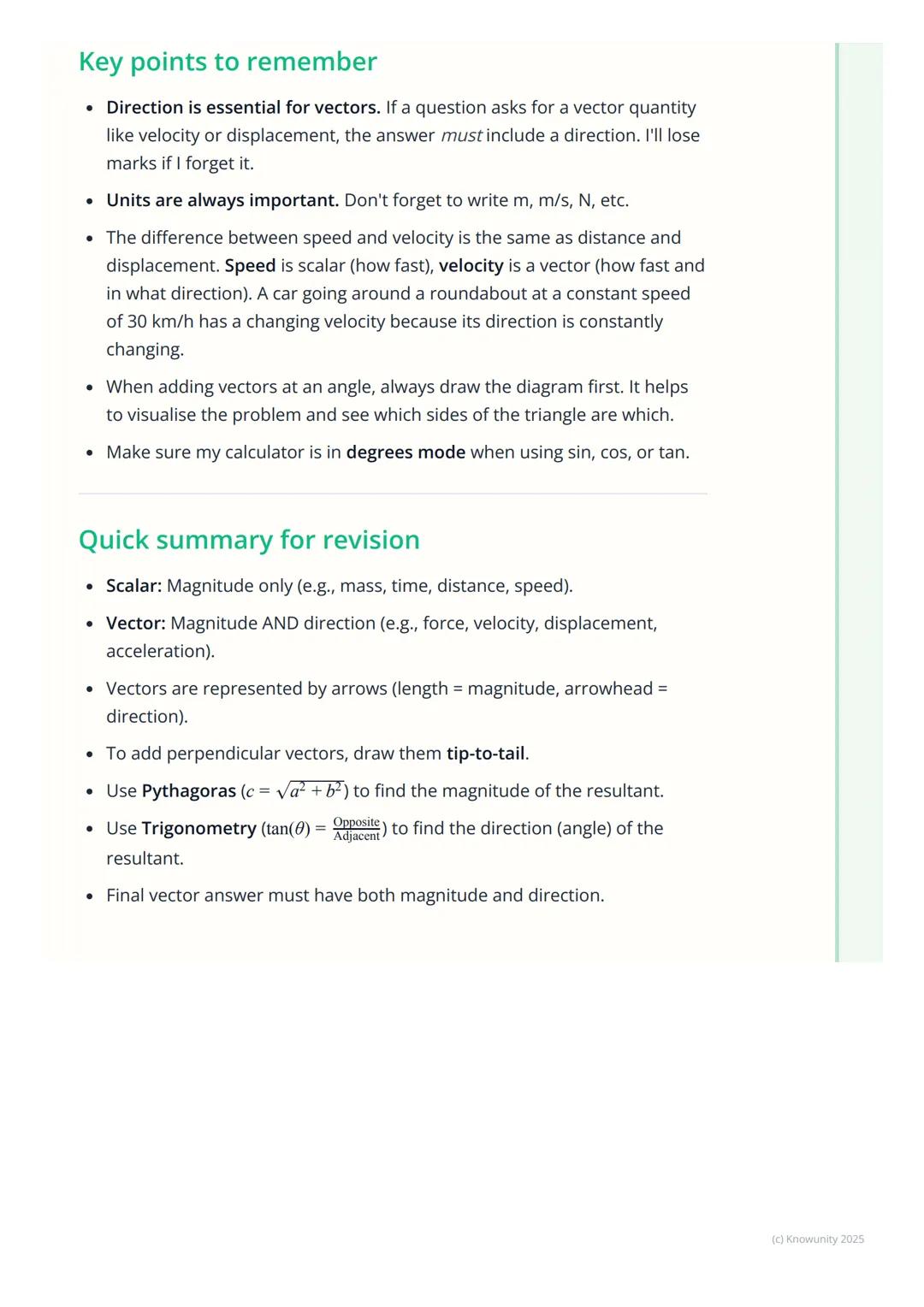
Key Points to Remember
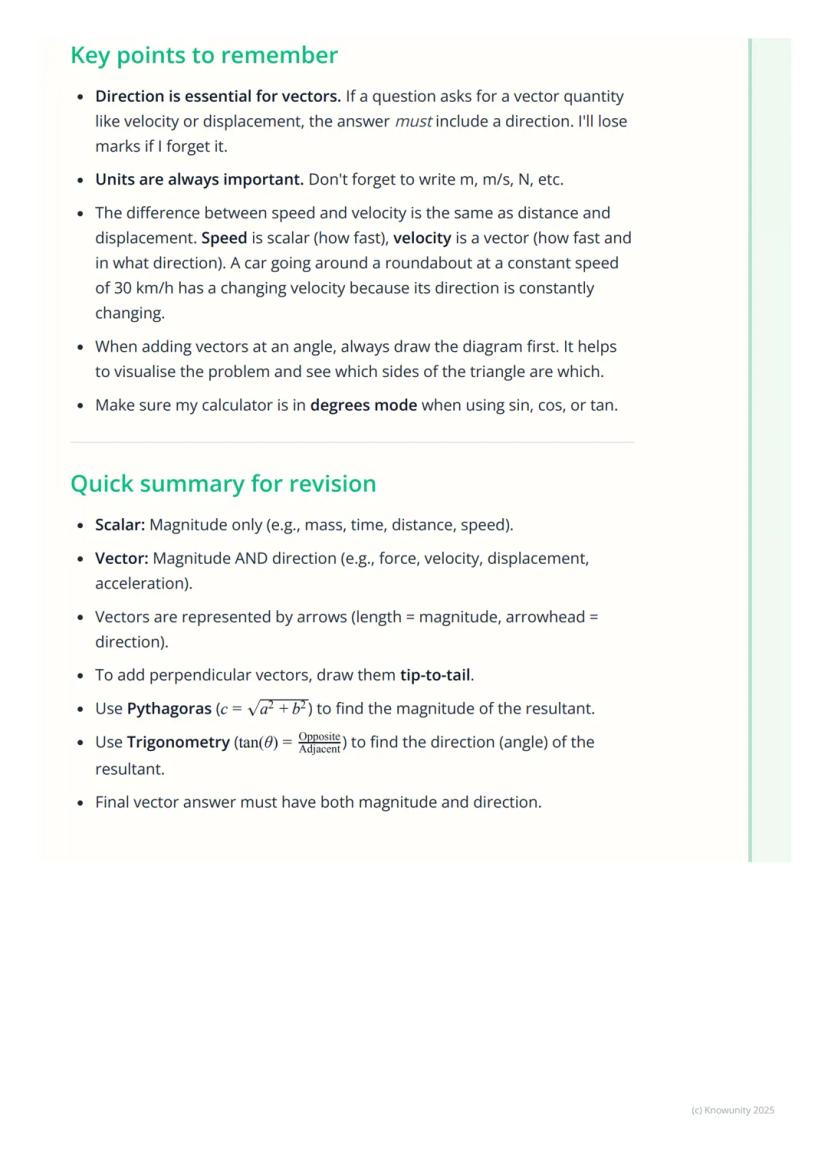
Understanding the scalar-vector distinction affects many related concepts. Speed (scalar) vs. velocity (vector) follows the same pattern as distance vs. displacement. A car driving around a roundabout at constant 30 km/h speed has a constantly changing velocity because its direction keeps changing.
When tackling vector problems, always draw a diagram first. It helps visualize the problem and identify which sides of the triangle correspond to which measurements. This simple step prevents many common mistakes.
For revision, remember these essentials:
- Scalars have magnitude only (mass, time, distance, speed)
- Vectors have both magnitude and direction (force, velocity, displacement)
- To add perpendicular vectors, use the tip-to-tail method
- Use Pythagoras to find the resultant magnitude
- Use trigonometry to find the direction angle
- Always include both magnitude and direction in your final vector answers
Exam Success Tip: Vector questions are common in exams because they test both your conceptual understanding and mathematical skills. Master these basics now, and you'll have a solid foundation for more complex physics topics!
Mysleli sme si, že sa už nikdy neopýtaš...
Čo je Knowunity AI companion?
Náš AI Companion je AI nástroj zameraný na študentov, ktorý ponúka viac ako len odpovede. Postavený na miliónoch zdrojov Knowunity poskytuje relevantné informácie, personalizované študijné plány, kvízy a obsah priamo v chate, prispôsobujúc sa tvojej individuálnej ceste učenia.
Kde si môžem stiahnuť aplikáciu Knowunity?
Aplikáciu si môžeš stiahnuť z Google Play Store a Apple App Store.
Je Knowunity naozaj zadarmo?
Presne tak! Užívaj si bezplatný prístup k študijnému obsahu, spájaj sa s ostatnými študentmi a získaj okamžitú pomoc – všetko na dosah ruky.
Najobľúbenejší obsah v predmete Physics
3PhysicsBalanced and Unbalanced Forces
Students will explore how balanced forces result in no change in motion, while unbalanced forces cause an object to accelerate or change direction.
2nd Year421
PhysicsTypes of Forces
Students will identify common forces such as gravity (pulling objects down), friction (opposing motion), and air resistance (slowing objects in the air).
2nd Year440
PhysicsSpeed, Distance, and Time
Students will learn the basic concepts of speed, distance, and time, and how they relate to each other in describing motion.
2nd Year100
Najobľúbenejší obsah
9 Irish
IrishIrish oral questions and answers
Questions and answers for the leaving cert oral
5th Year4254
IrishIrish oral questions
Outline of oral questions
5th Year2055
IrishGaeilge Grammar Office
All the basics you need to know on Irish grammar.
6th Year863
 English
Key Quotes : Sive
Key Quotes and explanations: Sive
6th Year2131
IrishAn Gaeilge Aiste
Irish Language essay
6th Year1250
IrishIrish poetry 2027
Iníon + Dínit an Bhróin
5th Year1123
IrishMé Féin & Mo Chlann (Myself & My Family)
Students will learn vocabulary to describe themselves, their family members, and daily routines. This helps in personal introductions and discussions.
TY291
IrishLC HL notes- Iníon (poem)
Includes poem in English and Irish, theme, key words & phrases
5th Year2234
 Geography
Territory, economic activities in Paris basin
essay
6th Year80
Nenašiel si, čo hľadáš? Preskúmaj iné predmety.
Študenti nás milujú — a ty budeš tiež.
4.6/5App Store
4.7/5Google Play
Appka je veľmi jednoduchá na používanie a má super dizajn. Zatiaľ som našiel všetko, čo som hľadal, a naučil sa veľa z prezentácií! Určite ju použijem na školskú úlohu! A samozrejme mi to aj veľmi pomáha ako inšpirácia.
Stefan SiOS používateľ
Táto appka je naozaj skvelá. Je tu toľko študijných poznámok a pomoci [...]. Môj problémový predmet je napríklad francúzština a appka má toľko možností pomoci. Vďaka tejto appke som si zlepšil francúzštinu. Odporúčal by som ju každému.
Samantha KlichAndroid používateľka
Wow, som naozaj ohromený. Vyskúšal som túto appku, lebo som ju videl mnohokrát inzerovať a bol som úplne ohromený. Táto appka je TÁ POMOC, ktorú chceš do školy a hlavne ponúka toľko vecí, ako cvičenia a faktové listy, ktoré mi osobne VEĽMI pomohli.
AnnaiOS používateľka
Physics4 zobrazenia·Aktualizované May 8, 2026·6 stránkyScalars and Vectors Explained: Learn the Basics
In physics, understanding the difference between scalar and vector quantities is fundamental to grasping nearly everything else you'll study. This distinction affects how we measure, calculate, and represent physical quantities throughout mechanics and beyond. Mastering these concepts now will make... Zobraziť viac
1
of 6Zaregistruj sa, aby si videl obsah. Je to zadarmo!
- Prístup ku všetkým dokumentom
- Zlepši si známky
- Pridaj sa k miliónom študentov
Scalars and Vectors: The Basics
Physical quantities in physics come in two distinct types. The difference between them is crucial to understand early on, as it affects everything from how we write them to how we calculate with them.
Scalars are physical quantities that have only magnitude (size). Think of magnitude as simply "how much" of something there is. Examples include distance, speed, mass, time, energy, and temperature. When dealing with scalars, you only need to specify the number and unit.
Vectors are more complex as they have both magnitude and direction. Both parts are essential to fully describe the quantity. Common examples include displacement, velocity, acceleration, force, and momentum. You haven't fully described a vector until you've specified both how large it is and which way it's pointing.
Quick Tip: If you can answer the question "how much?" but not "which way?" then you're dealing with a scalar. If both questions need answers, it's definitely a vector!
2
of 6Zaregistruj sa, aby si videl obsah. Je to zadarmo!
- Prístup ku všetkým dokumentom
- Zlepši si známky
- Pridaj sa k miliónom študentov
Distinguishing Vectors from Scalars
The classic example that shows this difference is comparing distance and displacement:
If you walk 5 metres east and then 5 metres west back to your starting point, your total distance (a scalar) is 10 metres. However, your displacement (a vector) is 0 metres because you ended up exactly where you started!
Vectors are represented as arrows in diagrams. The length of the arrow shows the magnitude (longer means bigger), while the direction the arrow points shows, well, the direction of the vector. It's a brilliantly simple visual system.
Adding vectors follows different rules than adding scalars. While scalar addition is straightforward arithmetic , vector addition requires considering direction. Vectors pointing in the same direction can be added directly, but vectors pointing in different directions require special methods.
Remember: When writing about vectors in your answers, always include both magnitude and direction. Writing "5 m/s east" for velocity will get you full marks, but just writing "5 m/s" will cost you points!
3
of 6Zaregistruj sa, aby si videl obsah. Je to zadarmo!
- Prístup ku všetkým dokumentom
- Zlepši si známky
- Pridaj sa k miliónom študentov
Adding Vectors
Vector addition isn't as straightforward as scalar addition because direction matters. There are three main cases you need to know:
For vectors in the same direction, just add their magnitudes. If forces of 10 N and 5 N both point right, the resultant force is 15 N right. Easy enough!
For vectors in opposite directions, subtract the smaller magnitude from the larger. If a 10 N force points right and a 5 N force points left, the resultant is a 5 N force to the right .
The trickiest case is vectors at an angle to each other. Here, we use the "tip-to-tail" method: draw the first vector, then draw the second vector starting from the arrowhead (tip) of the first. The resultant vector runs from the start of the first to the end of the second, forming a triangle.
Exam Alert: The most common exam questions involve perpendicular vectors . These are perfect for using Pythagoras' Theorem to find the resultant magnitude and trigonometry to find the angle!
4
of 6Zaregistruj sa, aby si videl obsah. Je to zadarmo!
- Prístup ku všetkým dokumentom
- Zlepši si známky
- Pridaj sa k miliónom študentov
Finding Resultant Vectors
When vectors are at right angles, they form a right-angled triangle that's perfect for applying mathematical tools. The resultant vector is the hypotenuse of this triangle.
To find the magnitude of the resultant, use Pythagoras' Theorem: , where is the resultant vector's magnitude.
To find the direction (angle), use trigonometry, typically the tangent function: .
Let's look at a practical example: A girl walks 40 m East and then 30 m North. For her total distance travelled (scalar), simply add: 40 m + 30 m = 70 m. No direction needed since distance is a scalar.
For her displacement (vector), we need the resultant of these two perpendicular vectors. Drawing this out shows a right-angled triangle with the displacement as the hypotenuse.
Study Hack: Always draw a clear diagram for vector problems! It makes the maths much easier to set up correctly and helps you visualize what's happening physically.
5
of 6Zaregistruj sa, aby si videl obsah. Je to zadarmo!
- Prístup ku všetkým dokumentom
- Zlepši si známky
- Pridaj sa k miliónom študentov
Calculating Vector Problems
Using our walking example, we can now complete the calculation. With legs of 40 m and 30 m, we can find the hypotenuse (displacement magnitude) using Pythagoras:
Displacement = m
Next, we find the direction using trigonometry. We want the angle north of east:
Therefore, the girl's final displacement is 50 m at an angle of 36.9° North of East.
Notice how the complete answer includes both magnitude (50 m) and direction (36.9° North of East). For vector quantities, you must include both parts in your answer.
Mind the Details: Always check your calculator is in degree mode (not radians) when solving these problems. A small setting mistake can lead to very wrong answers!
6
of 6Zaregistruj sa, aby si videl obsah. Je to zadarmo!
- Prístup ku všetkým dokumentom
- Zlepši si známky
- Pridaj sa k miliónom študentov
Key Points to Remember
Understanding the scalar-vector distinction affects many related concepts. Speed (scalar) vs. velocity (vector) follows the same pattern as distance vs. displacement. A car driving around a roundabout at constant 30 km/h speed has a constantly changing velocity because its direction keeps changing.
When tackling vector problems, always draw a diagram first. It helps visualize the problem and identify which sides of the triangle correspond to which measurements. This simple step prevents many common mistakes.
For revision, remember these essentials:
- Scalars have magnitude only (mass, time, distance, speed)
- Vectors have both magnitude and direction (force, velocity, displacement)
- To add perpendicular vectors, use the tip-to-tail method
- Use Pythagoras to find the resultant magnitude
- Use trigonometry to find the direction angle
- Always include both magnitude and direction in your final vector answers
Exam Success Tip: Vector questions are common in exams because they test both your conceptual understanding and mathematical skills. Master these basics now, and you'll have a solid foundation for more complex physics topics!
Mysleli sme si, že sa už nikdy neopýtaš...
Čo je Knowunity AI companion?
Náš AI Companion je AI nástroj zameraný na študentov, ktorý ponúka viac ako len odpovede. Postavený na miliónoch zdrojov Knowunity poskytuje relevantné informácie, personalizované študijné plány, kvízy a obsah priamo v chate, prispôsobujúc sa tvojej individuálnej ceste učenia.
Kde si môžem stiahnuť aplikáciu Knowunity?
Aplikáciu si môžeš stiahnuť z Google Play Store a Apple App Store.
Je Knowunity naozaj zadarmo?
Presne tak! Užívaj si bezplatný prístup k študijnému obsahu, spájaj sa s ostatnými študentmi a získaj okamžitú pomoc – všetko na dosah ruky.
Najobľúbenejší obsah v predmete Physics
3PhysicsBalanced and Unbalanced Forces
Students will explore how balanced forces result in no change in motion, while unbalanced forces cause an object to accelerate or change direction.
2nd Year421
PhysicsTypes of Forces
Students will identify common forces such as gravity (pulling objects down), friction (opposing motion), and air resistance (slowing objects in the air).
2nd Year440
PhysicsSpeed, Distance, and Time
Students will learn the basic concepts of speed, distance, and time, and how they relate to each other in describing motion.
2nd Year100
Najobľúbenejší obsah
9IrishIrish oral questions and answers
Questions and answers for the leaving cert oral
5th Year4254
IrishIrish oral questions
Outline of oral questions
5th Year2055
IrishGaeilge Grammar Office
All the basics you need to know on Irish grammar.
6th Year863
EnglishKey Quotes : Sive
Key Quotes and explanations: Sive
6th Year2131
IrishAn Gaeilge Aiste
Irish Language essay
6th Year1250
IrishIrish poetry 2027
Iníon + Dínit an Bhróin
5th Year1123
IrishMé Féin & Mo Chlann (Myself & My Family)
Students will learn vocabulary to describe themselves, their family members, and daily routines. This helps in personal introductions and discussions.
TY291
IrishLC HL notes- Iníon (poem)
Includes poem in English and Irish, theme, key words & phrases
5th Year2234
GeographyTerritory, economic activities in Paris basin
essay
6th Year80
Nenašiel si, čo hľadáš? Preskúmaj iné predmety.
Študenti nás milujú — a ty budeš tiež.
4.6/5App Store
4.7/5Google Play
Appka je veľmi jednoduchá na používanie a má super dizajn. Zatiaľ som našiel všetko, čo som hľadal, a naučil sa veľa z prezentácií! Určite ju použijem na školskú úlohu! A samozrejme mi to aj veľmi pomáha ako inšpirácia.
Stefan SiOS používateľ
Táto appka je naozaj skvelá. Je tu toľko študijných poznámok a pomoci [...]. Môj problémový predmet je napríklad francúzština a appka má toľko možností pomoci. Vďaka tejto appke som si zlepšil francúzštinu. Odporúčal by som ju každému.
Samantha KlichAndroid používateľka
Wow, som naozaj ohromený. Vyskúšal som túto appku, lebo som ju videl mnohokrát inzerovať a bol som úplne ohromený. Táto appka je TÁ POMOC, ktorú chceš do školy a hlavne ponúka toľko vecí, ako cvičenia a faktové listy, ktoré mi osobne VEĽMI pomohli.
AnnaiOS používateľka