
Lenses are everywhere - in your phone camera, glasses, and... Zobraziť viac
 Physics
 Irish
Irish English
Zaregistruj sa, aby si videl obsahJe to zadarmo!
Prístup ku všetkým dokumentom
Zlepši si známky
Pridaj sa k miliónom študentov
Knowunity AI
Predmety
Triangle Congruence and Similarity Theorems
Triangle Properties and Classification
Linear Equations and Graphs
Geometric Angle Relationships
Trigonometric Functions and Identities
Equation Solving Techniques
Circle Geometry Fundamentals
Division Operations and Methods
Basic Differentiation Rules
Exponent and Logarithm Properties
Zobraziť všetky témy
Human Organ Systems
Reproductive Cell Cycles
Biological Sciences Subdisciplines
Cellular Energy Metabolism
Autotrophic Energy Processes
Inheritance Patterns and Principles
Biomolecular Structure and Organization
Cell Cycle and Division Mechanics
Cellular Organization and Development
Biological Structural Organization
Zobraziť všetky témy
Chemical Sciences and Applications
Atomic Structure and Composition
Molecular Electron Structure Representation
Atomic Electron Behavior
Matter Properties and Water
Mole Concept and Calculations
Gas Laws and Behavior
Periodic Table Organization
Chemical Thermodynamics Fundamentals
Chemical Bond Types and Properties
Zobraziť všetky témy
European Renaissance and Enlightenment
European Cultural Movements 800-1920
American Revolution Era 1763-1797
American Civil War 1861-1865
Global Imperial Systems
Mongol and Chinese Dynasties
U.S. Presidents and World Leaders
Historical Sources and Documentation
World Wars Era and Impact
World Religious Systems
Zobraziť všetky témy
Classic and Contemporary Novels
Literary Character Analysis
Rhetorical Theory and Practice
Classic Literary Narratives
Reading Analysis and Interpretation
Narrative Structure and Techniques
English Language Components
Influential English-Language Authors
Basic Sentence Structure
Narrative Voice and Perspective
Zobraziť všetky témy
5
•
Aktualizované May 3, 2026
•
Lenses are everywhere - in your phone camera, glasses, and... Zobraziť viac
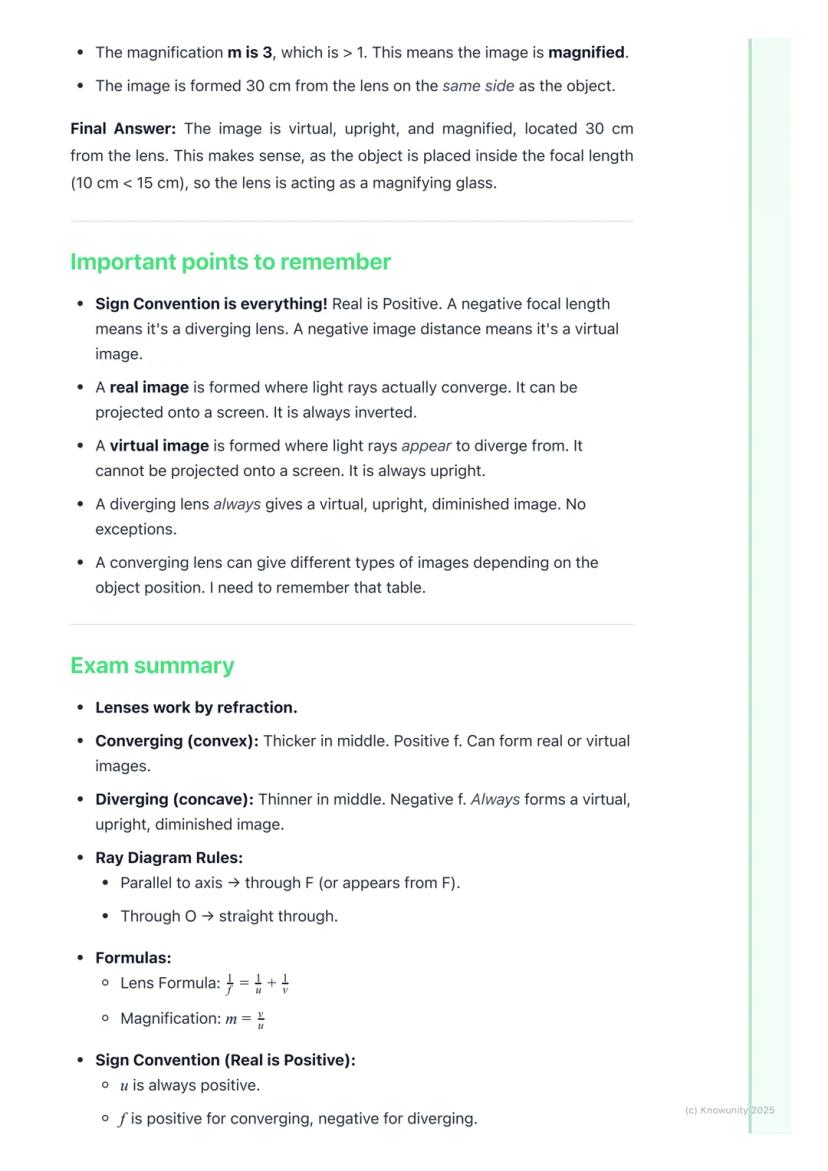

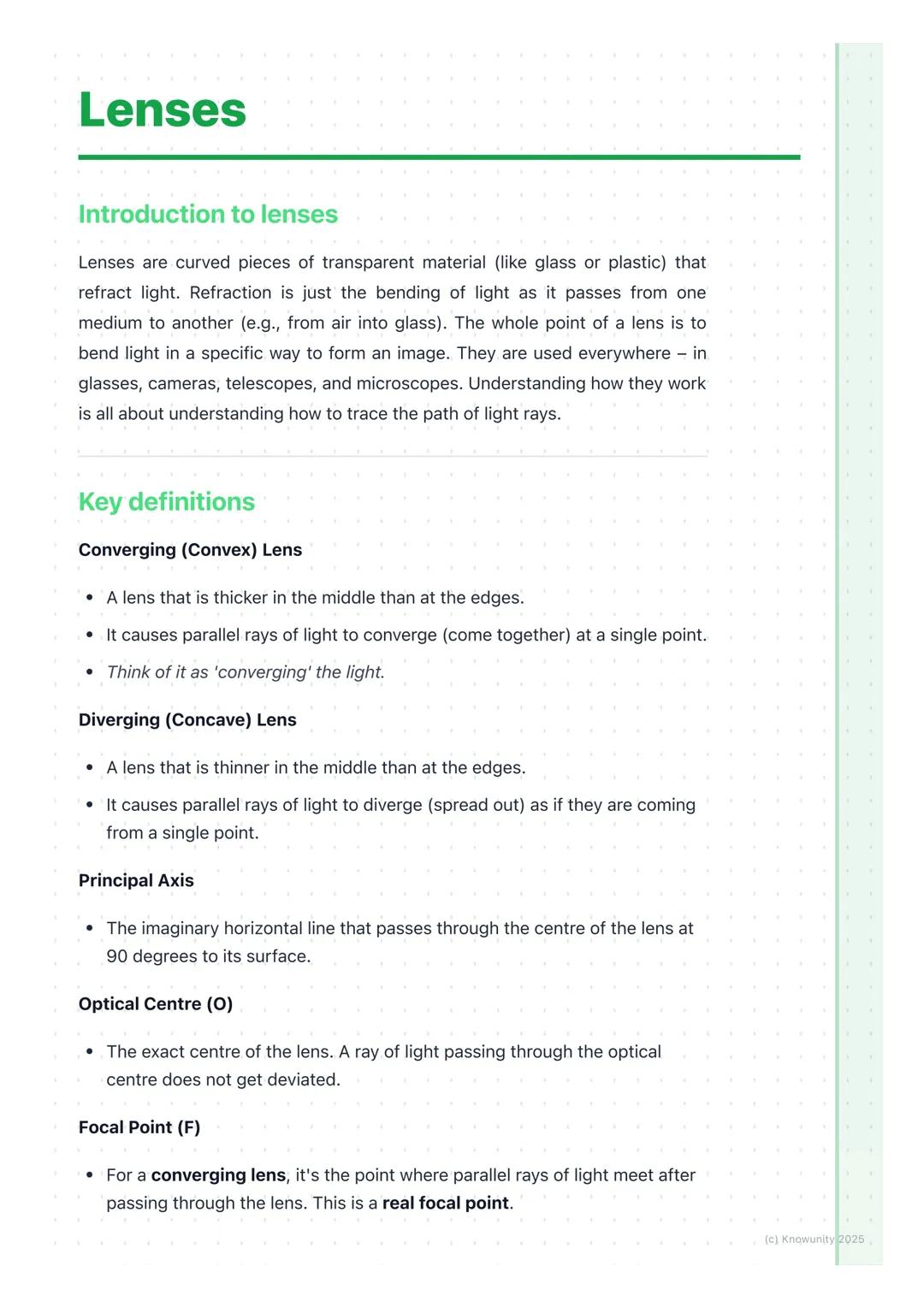
Ever wondered how your camera focuses or how glasses help you see clearly? It's all about refraction - the bending of light as it passes through different materials.
Converging (convex) lenses are thicker in the middle and bring light rays together at a focal point. Think of a magnifying glass - that's a converging lens. Diverging (concave) lenses are thinner in the middle and spread light rays apart.
The optical centre (O) is the middle of the lens where light passes straight through. The focal point (F) is where parallel light rays meet (or appear to come from), and the focal length (f) is the distance from the centre to this point.
Quick Tip: Remember "thick middle = converging, thin middle = diverging" to never mix them up!
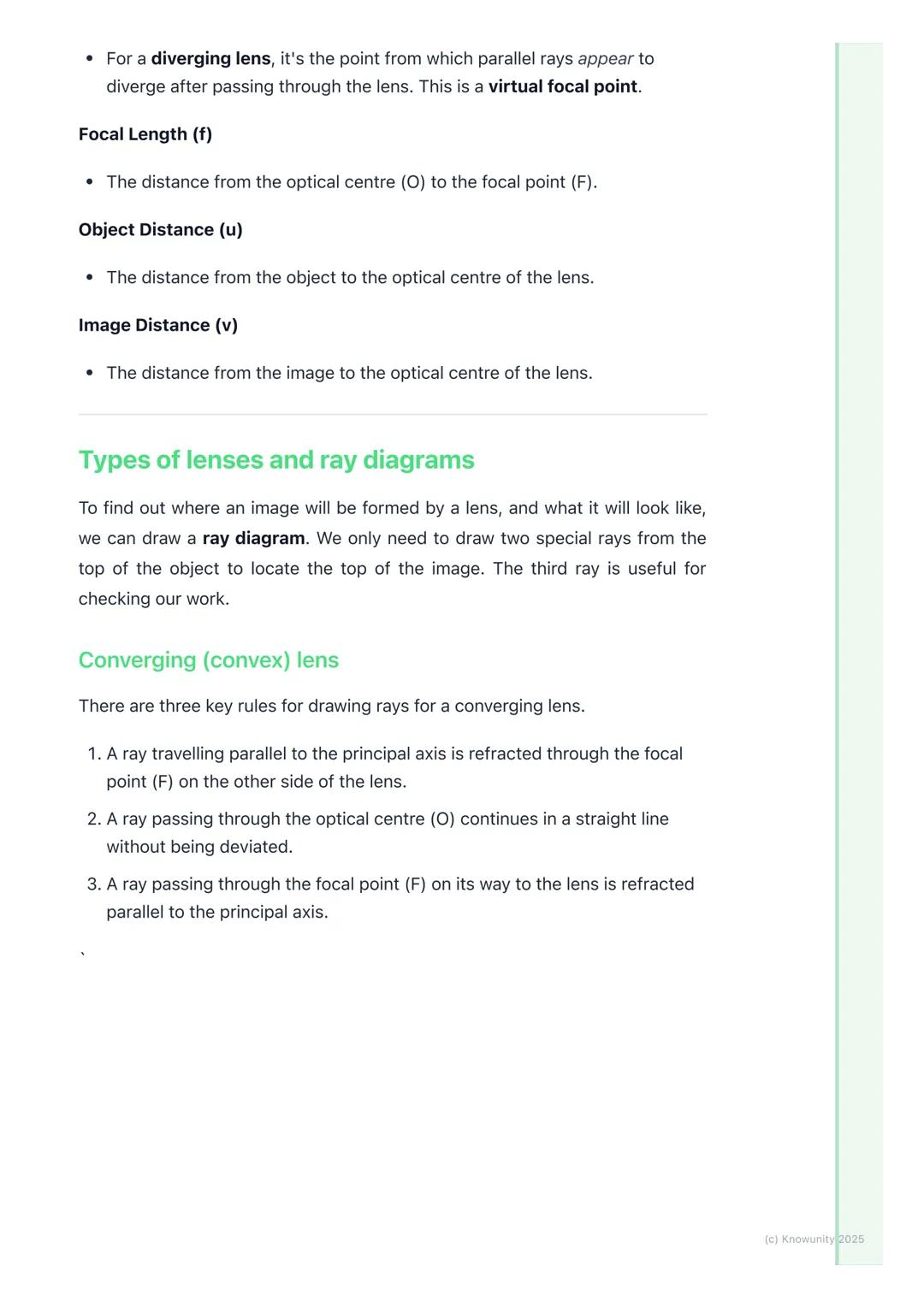
Drawing ray diagrams is like creating a map for light! You only need two special rays to find where an image forms.
For converging lenses, follow these three rules: 1) A ray parallel to the axis bends through the focal point, 2) A ray through the optical centre goes straight, and 3) A ray through the focal point becomes parallel to the axis.
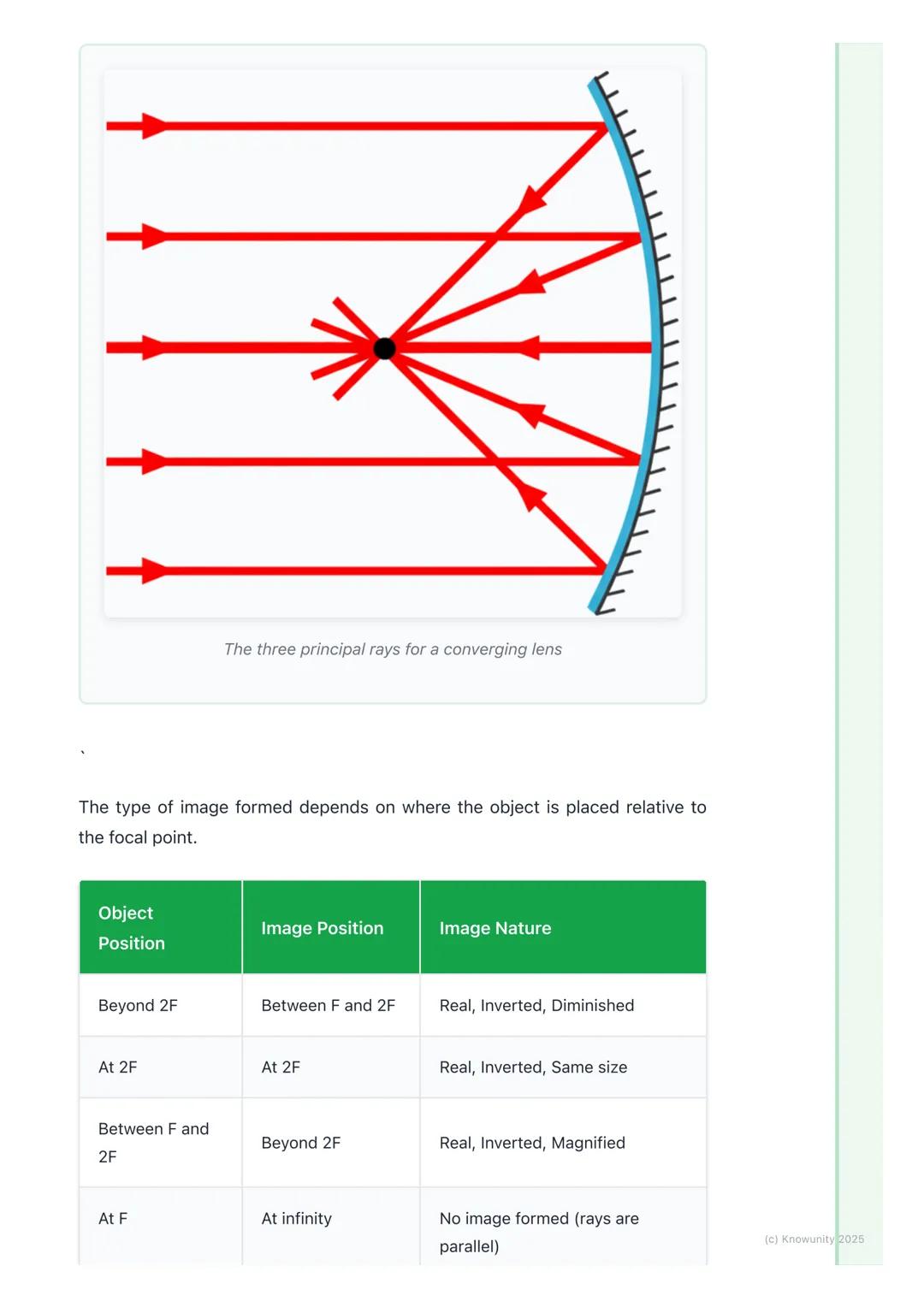
The image you get depends entirely on where you place the object. If it's beyond 2F, you get a real, inverted, smaller image. Between F and 2F? Real, inverted, but magnified. Place it inside the focal length and boom - you've got a magnifying glass with a virtual, upright, enlarged image!
Exam Success: Learn the object position table by heart - it's a guaranteed marks winner!
Here's where converging lenses get interesting - the image changes dramatically based on object placement!
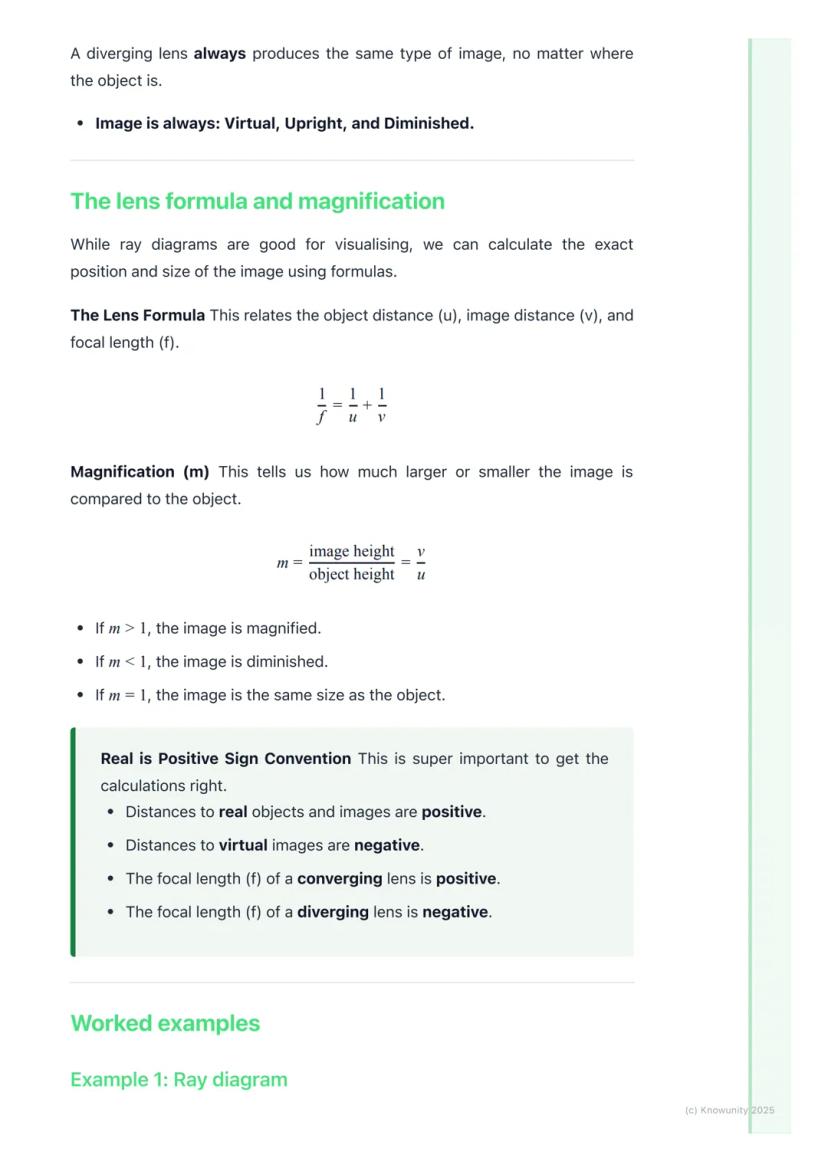
When your object sits beyond 2F, you get a real, inverted, diminished image between F and 2F. This is exactly how camera lenses work. At exactly 2F, the image appears at 2F on the other side, same size but upside down.
Place the object between F and 2F, and suddenly your image jumps beyond 2F, becoming real, inverted, but magnified. Put it right at F and no image forms - the rays become parallel. The magic happens inside F where you get a virtual, upright, magnified image.
Memory Trick: "Real images flip, virtual images don't" - real images are always inverted, virtual ones stay upright!
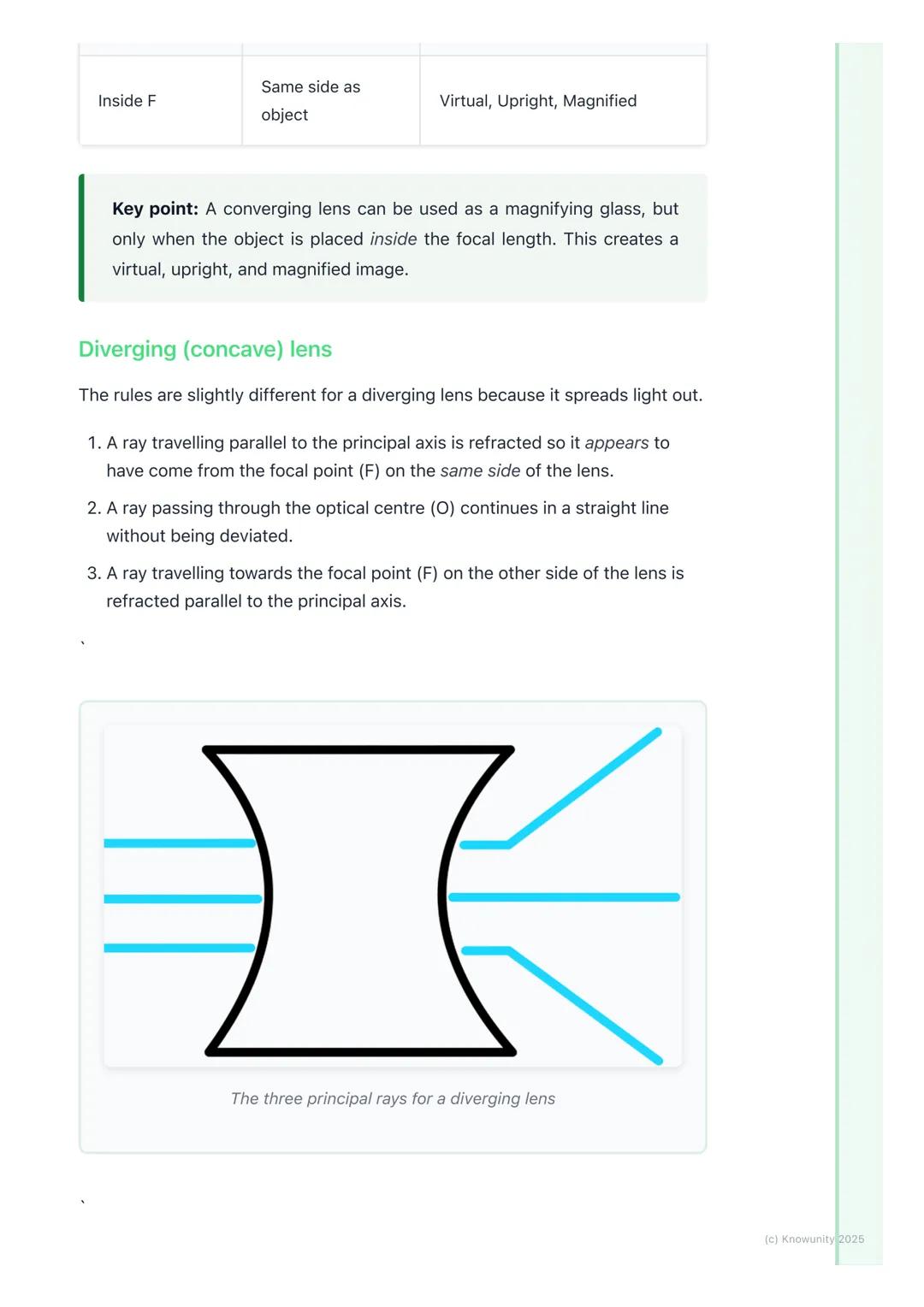
Diverging lenses are the reliable ones - they always produce the same type of image, no matter where you put the object!
The ray rules are similar but with a twist: parallel rays appear to come from the focal point on the same side as the object. A ray towards the far focal point gets bent parallel to the axis.
No matter what you do with a diverging lens, you'll always get a virtual, upright, diminished image. Always. This makes them perfect for things like peepholes in doors or certain types of glasses for short-sightedness.
Study Smart: Since diverging lenses are predictable, focus your revision time on the trickier converging lens scenarios!
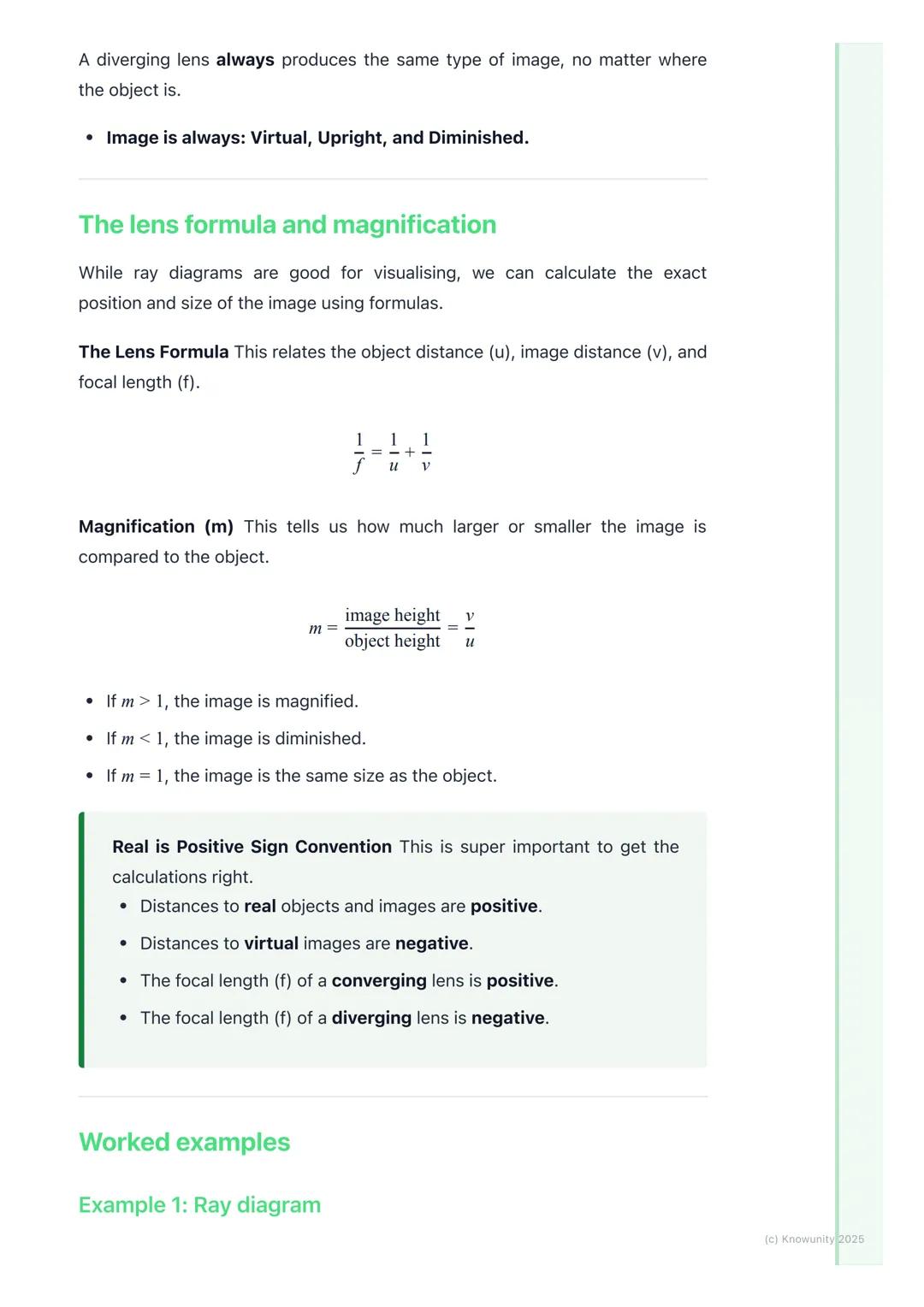
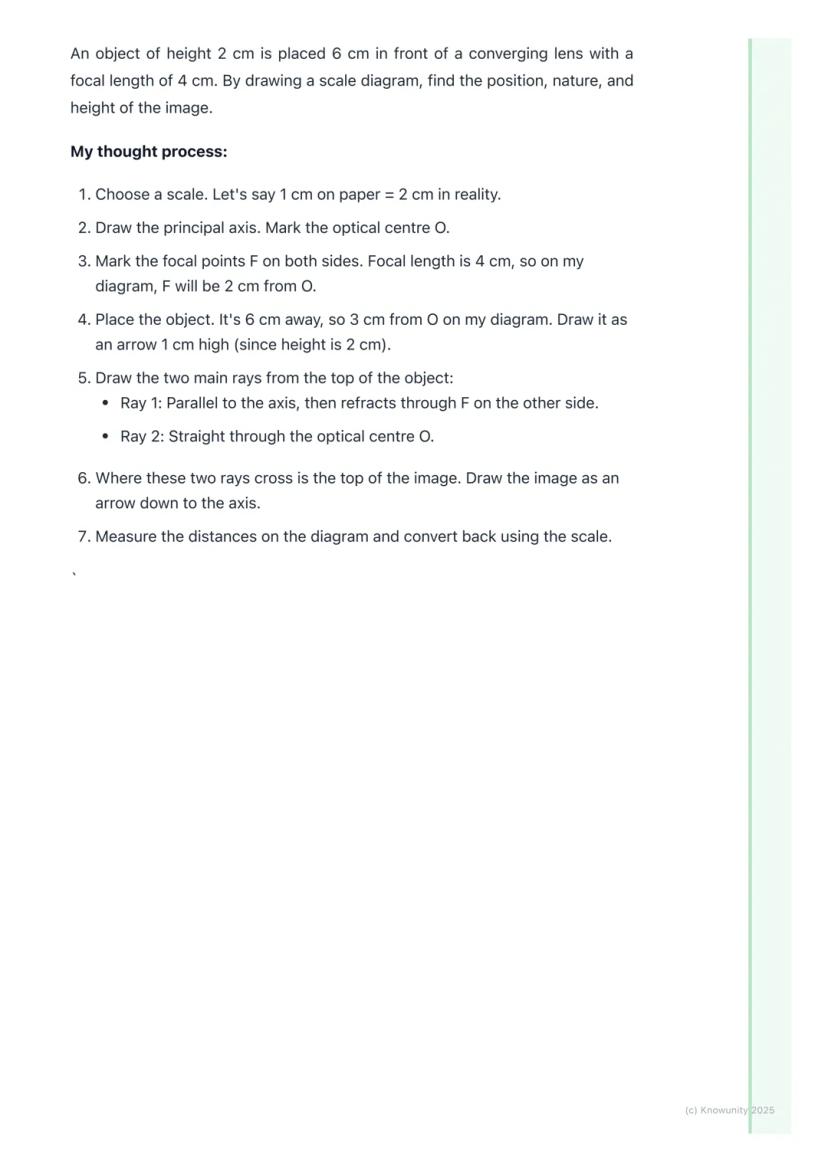
Time to put numbers to your diagrams! The lens formula connects everything: 1/f = 1/u + 1/v, where f is focal length, u is object distance, and v is image distance.
Magnification tells you how much bigger or smaller your image is: m = v/u. If m > 1, your image is magnified. If m < 1, it's diminished. Simple!
The sign convention is crucial: "Real is Positive" means real objects and images get positive distances, virtual images get negative distances. Converging lenses have positive focal lengths, diverging ones negative.
Calculation Confidence: Practice the sign convention until it's automatic - getting signs wrong will mess up your entire answer!
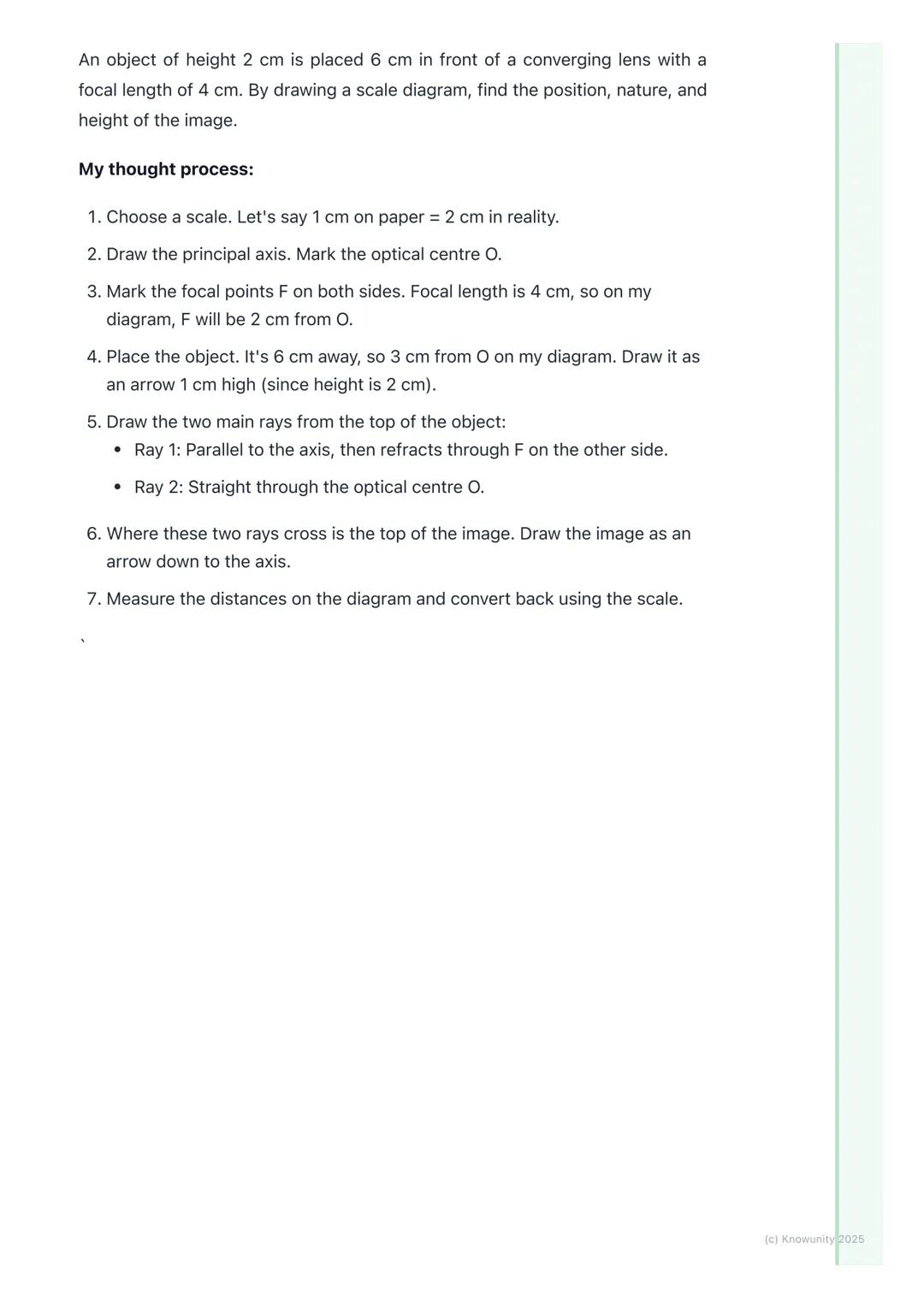
Let's solve a real problem! An object (2 cm tall) sits 6 cm from a converging lens with focal length 4 cm.
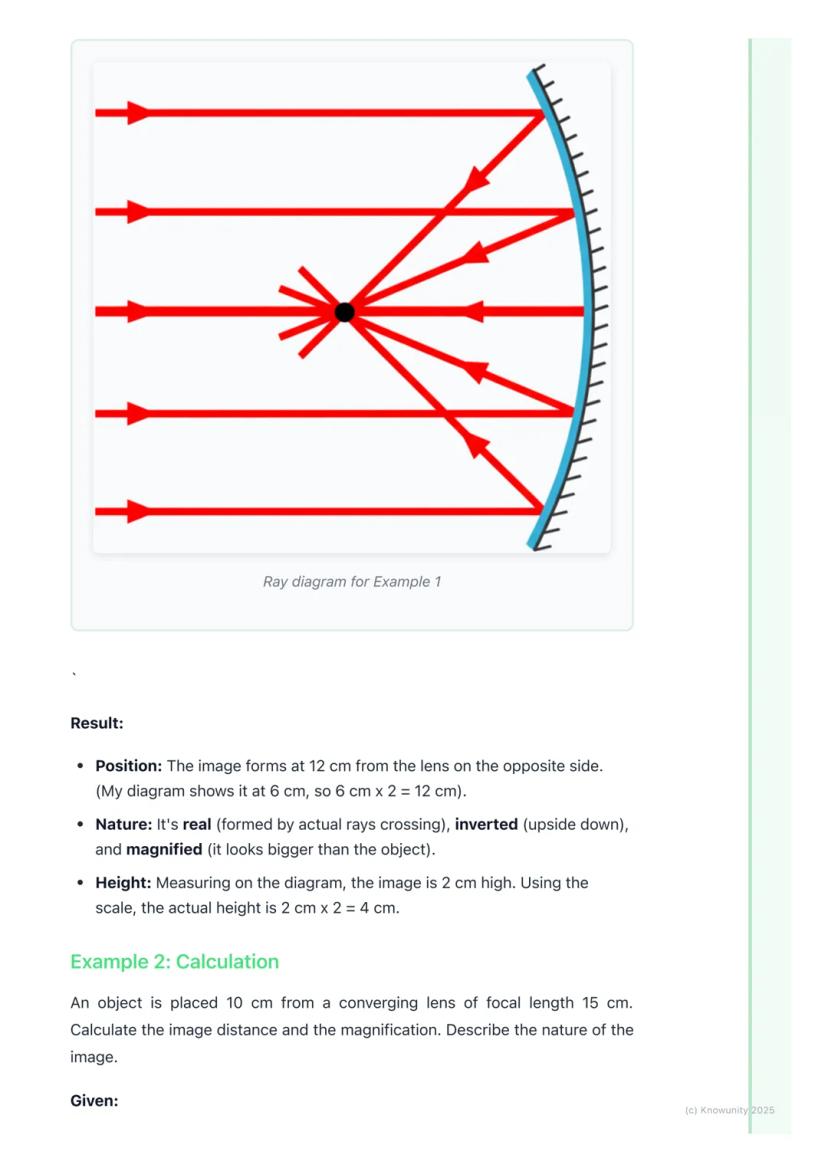
First, choose your scale - say 1 cm on paper = 2 cm reality. Draw your axis, mark the optical centre O, then place focal points F at 2 cm from O on your diagram.
Place your object 3 cm from O (representing 6 cm) and draw it 1 cm tall. Now trace your two main rays: one parallel to the axis (bends through F), another straight through O. Where they cross is your image!
Measuring gives us an image 6 cm from O on the diagram (12 cm in reality), 2 cm tall on diagram (4 cm reality). It's real, inverted, and magnified.
Diagram Success: Always use a ruler and draw large, clear diagrams - messy drawings lead to wrong answers!
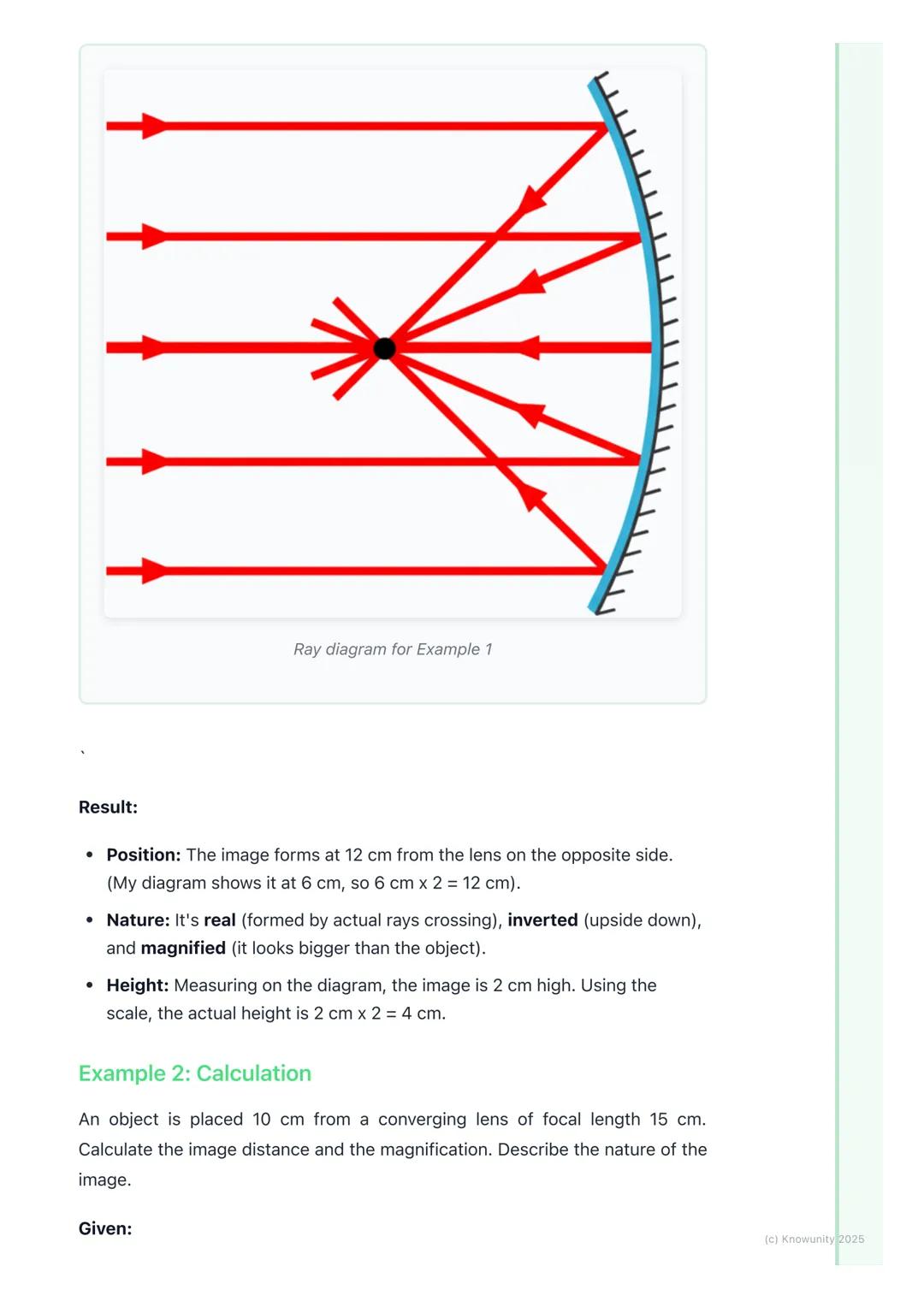
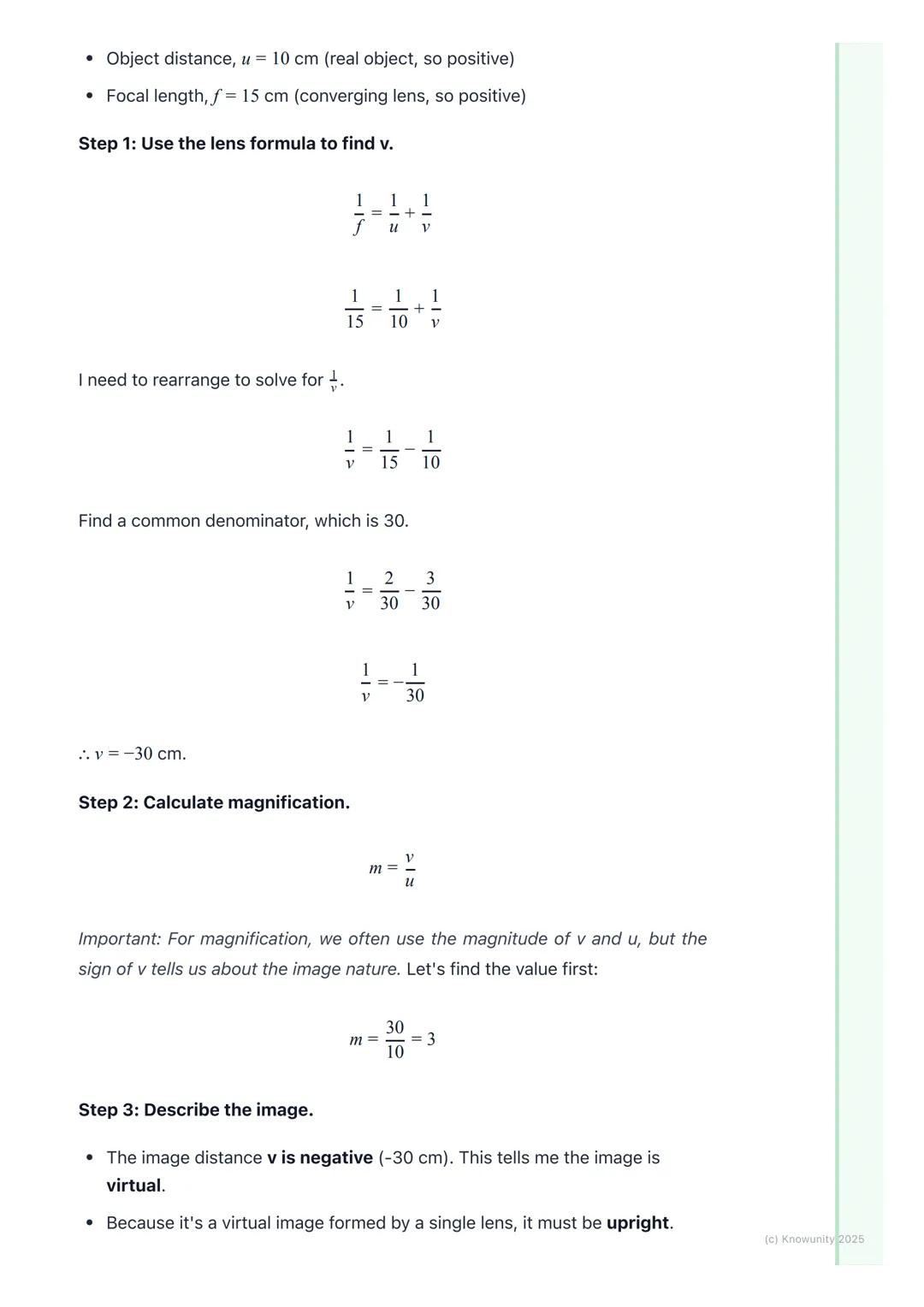
Now let's use pure maths! Object at 10 cm from a converging lens with focal length 15 cm.
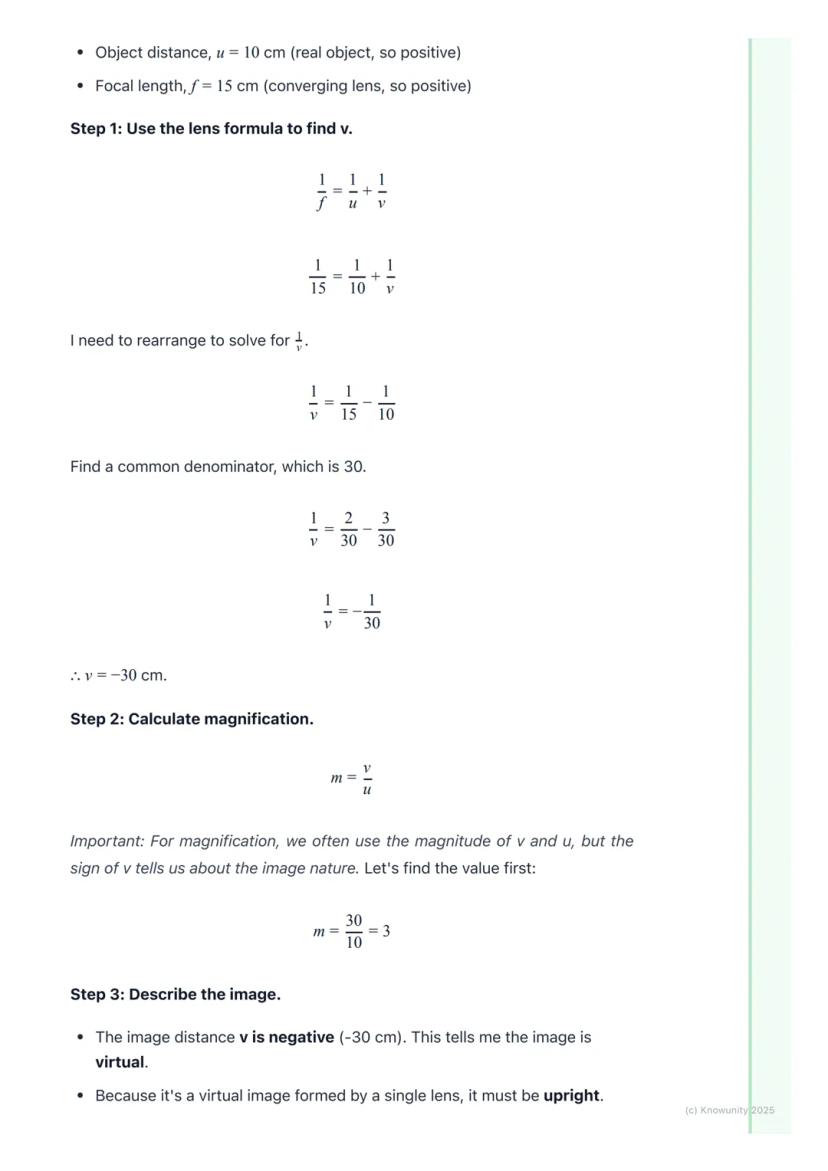
Using 1/f = 1/u + 1/v: 1/15 = 1/10 + 1/v. Rearranging: 1/v = 1/15 - 1/10 = 2/30 - 3/30 = -1/30. Therefore v = -30 cm.
The negative v means a virtual image! Magnification m = v/u = 30/10 = 3, so it's magnified threefold.
Since the object is inside the focal length (10 < 15), this makes perfect sense - the lens acts as a magnifying glass, creating a virtual, upright, magnified image 30 cm from the lens.
Check Your Logic: Always verify your mathematical answer makes physical sense - it prevents silly mistakes!
Getting signs right separates the top students from the rest! The golden rule is "Real is Positive".
Object distance u is always positive (real objects). Focal length f is positive for converging lenses, negative for diverging ones. Image distance v is positive for real images, negative for virtual images.
When calculating magnification, use m = v/u with the actual values (including signs). The sign of v tells you if the image is real (positive) or virtual (negative).
A negative image distance always means virtual, upright image. A positive image distance means real, inverted image. Master this and you'll never get confused again!
Sign Mastery: Write "Real = +" at the top of every lens problem - it's your safety net!
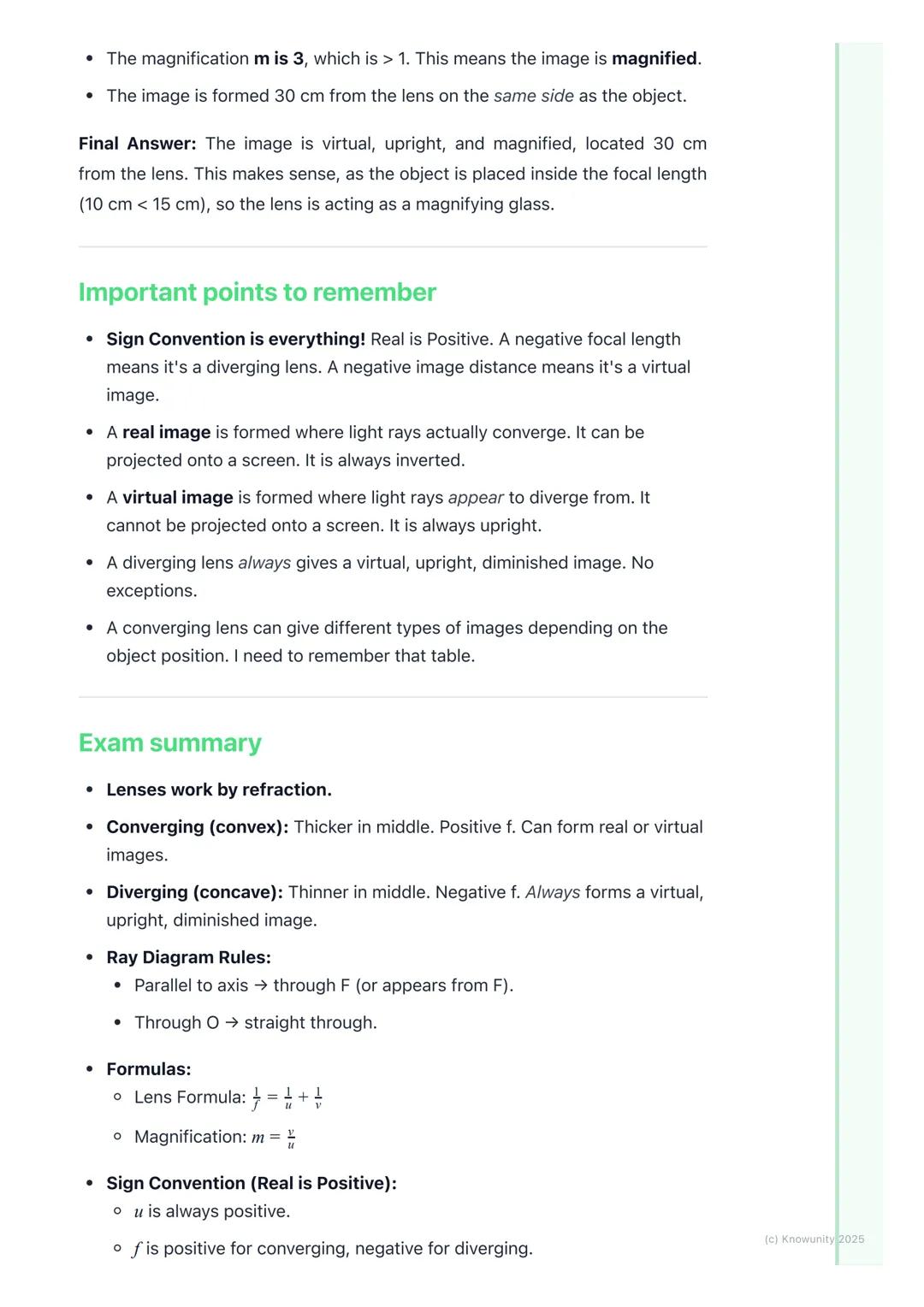
Here's what you absolutely must remember for exams: lenses work by refraction, converging lenses have positive focal lengths and can form various image types, while diverging lenses have negative focal lengths and always form virtual, upright, diminished images.
For ray diagrams, know your three rules inside out. For calculations, master the lens formula and magnification .
The sign convention is your best friend - real is positive, virtual images have negative distances. A real image can be projected on a screen and is always inverted. A virtual image cannot be projected and is always upright.
Exam Strategy: Practice both ray diagrams and calculations for the same scenario - understanding both methods deeply will boost your confidence massively!

Náš AI Companion je AI nástroj zameraný na študentov, ktorý ponúka viac ako len odpovede. Postavený na miliónoch zdrojov Knowunity poskytuje relevantné informácie, personalizované študijné plány, kvízy a obsah priamo v chate, prispôsobujúc sa tvojej individuálnej ceste učenia.
Aplikáciu si môžeš stiahnuť z Google Play Store a Apple App Store.
Presne tak! Užívaj si bezplatný prístup k študijnému obsahu, spájaj sa s ostatnými študentmi a získaj okamžitú pomoc – všetko na dosah ruky.
App Store
Google Play
Appka je veľmi jednoduchá na používanie a má super dizajn. Zatiaľ som našiel všetko, čo som hľadal, a naučil sa veľa z prezentácií! Určite ju použijem na školskú úlohu! A samozrejme mi to aj veľmi pomáha ako inšpirácia.
Stefan S
iOS používateľ
Táto appka je naozaj skvelá. Je tu toľko študijných poznámok a pomoci [...]. Môj problémový predmet je napríklad francúzština a appka má toľko možností pomoci. Vďaka tejto appke som si zlepšil francúzštinu. Odporúčal by som ju každému.
Samantha Klich
Android používateľka
Wow, som naozaj ohromený. Vyskúšal som túto appku, lebo som ju videl mnohokrát inzerovať a bol som úplne ohromený. Táto appka je TÁ POMOC, ktorú chceš do školy a hlavne ponúka toľko vecí, ako cvičenia a faktové listy, ktoré mi osobne VEĽMI pomohli.
Anna
iOS používateľka
Najlepšia aplikácia na svete! Nemám slová, lebo je príliš dobrá
Thomas R
iOS užívateľ
Jednoducho úžasná. Vďaka nej sa učím 10x lepšie, táto appka je jasná 10/10. Veľmi ju odporúčam každému. Môžem si pozerať a vyhľadávať poznámky. Môžem si ich uložiť do priečinka predmetu. Môžem si ich zopakovať kedykoľvek, keď sa vrátim. Ak si túto appku ešte neskúsil, naozaj si o veľa prichádzaš.
Basil
Android užívateľ
Táto appka mi dodala oveľa viac sebavedomia pri príprave na skúšky, nielen vďaka tomu, že posilnila moju vlastnú sebadôveru cez funkcie, ktoré ti umožňujú spojiť sa s ostatnými a necítiť sa osamelý, ale aj kvôli tomu, ako je samotná appka zameraná na to, aby si sa cítil lepšie. Ľahko sa v nej orientuješ, je zábavná na používanie a pomáha každému, kto sa trápí úplne s čímkoľvek.
David K
iOS užívateľ
Appka je super! Stačí zadať tému do vyhľadávača a hneď dostanem odpoveď. Nemusím pozerať 10 YouTube videí, aby som niečo pochopil, takže šetrím čas. Rozhodne odporúčam!
Sudenaz Ocak
používateľ Androidu
V škole som bol fakt slabý z matiky, ale vďaka tejto appke sa mi už darí lepšie. Som tak vďačný, že ste ju vytvorili.
Greenlight Bonnie
používateľ Androidu
veľmi spoľahlivá appka, ktorá ti pomôže a rozšíri tvoje znalosti z matiky, angličtiny a ďalších súvisiacich tém vo tvojej práci. prosím používaj túto appku ak sa trápiš v nejakých oblastiach, táto appka je na to kľúčová. škoda že som nenapísal recenziu skôr. a je aj zadarmo takže si s tým nemusíš robiť starosti.
Rohan U
Android užívateľ
Viem, že veľa appiek používa falošné účty na to, aby si vylepšili recenzie, ale táto appka si všetko zaslúži. Pôvodne som dostávala 4 z angličtiny a tentoraz som mala 7. O tejto appke som sa dozvedela len 3 dni pred skúškou a pomohla mi VEĽMI. Prosím naozaj mi ver a použi ju, som si istá, že aj ty uvidíš pokrok.
Xander S
iOS užívateľ
KVÍZY A KARTIČKY SÚ SUPER UŽITOČNÉ A MILUJEM Knowunity AI. JE TO AKO CHATGPT ALE CHYTREJŠÍ!! POMOHOL MI AJ S PROBLÉMAMI S MASCAROU!! A SAMOZREJME AJ S NORMÁLNYMI PREDMETMI! JASNÉ 😍😁😲🤑💗✨🎀😮
Elisha
iOS užívateľ
Táto appka je naozaj top. Opakovanie mi príde strašne nudné, ale táto appka to robí tak ľahké organizovať to všetko a potom si môžeš nechať bezplatné AI otestovať sa, čo je super a môžeš jednoducho nahrať svoje vlastné veci. veľmi odporúčam ako niekto kto má práve skúšobné testy
Paul T
iOS užívateľ
Appka je veľmi jednoduchá na používanie a má super dizajn. Zatiaľ som našiel všetko, čo som hľadal, a naučil sa veľa z prezentácií! Určite ju použijem na školskú úlohu! A samozrejme mi to aj veľmi pomáha ako inšpirácia.
Stefan S
iOS používateľ
Táto appka je naozaj skvelá. Je tu toľko študijných poznámok a pomoci [...]. Môj problémový predmet je napríklad francúzština a appka má toľko možností pomoci. Vďaka tejto appke som si zlepšil francúzštinu. Odporúčal by som ju každému.
Samantha Klich
Android používateľka
Wow, som naozaj ohromený. Vyskúšal som túto appku, lebo som ju videl mnohokrát inzerovať a bol som úplne ohromený. Táto appka je TÁ POMOC, ktorú chceš do školy a hlavne ponúka toľko vecí, ako cvičenia a faktové listy, ktoré mi osobne VEĽMI pomohli.
Anna
iOS používateľka
Najlepšia aplikácia na svete! Nemám slová, lebo je príliš dobrá
Thomas R
iOS užívateľ
Jednoducho úžasná. Vďaka nej sa učím 10x lepšie, táto appka je jasná 10/10. Veľmi ju odporúčam každému. Môžem si pozerať a vyhľadávať poznámky. Môžem si ich uložiť do priečinka predmetu. Môžem si ich zopakovať kedykoľvek, keď sa vrátim. Ak si túto appku ešte neskúsil, naozaj si o veľa prichádzaš.
Basil
Android užívateľ
Táto appka mi dodala oveľa viac sebavedomia pri príprave na skúšky, nielen vďaka tomu, že posilnila moju vlastnú sebadôveru cez funkcie, ktoré ti umožňujú spojiť sa s ostatnými a necítiť sa osamelý, ale aj kvôli tomu, ako je samotná appka zameraná na to, aby si sa cítil lepšie. Ľahko sa v nej orientuješ, je zábavná na používanie a pomáha každému, kto sa trápí úplne s čímkoľvek.
David K
iOS užívateľ
Appka je super! Stačí zadať tému do vyhľadávača a hneď dostanem odpoveď. Nemusím pozerať 10 YouTube videí, aby som niečo pochopil, takže šetrím čas. Rozhodne odporúčam!
Sudenaz Ocak
používateľ Androidu
V škole som bol fakt slabý z matiky, ale vďaka tejto appke sa mi už darí lepšie. Som tak vďačný, že ste ju vytvorili.
Greenlight Bonnie
používateľ Androidu
veľmi spoľahlivá appka, ktorá ti pomôže a rozšíri tvoje znalosti z matiky, angličtiny a ďalších súvisiacich tém vo tvojej práci. prosím používaj túto appku ak sa trápiš v nejakých oblastiach, táto appka je na to kľúčová. škoda že som nenapísal recenziu skôr. a je aj zadarmo takže si s tým nemusíš robiť starosti.
Rohan U
Android užívateľ
Viem, že veľa appiek používa falošné účty na to, aby si vylepšili recenzie, ale táto appka si všetko zaslúži. Pôvodne som dostávala 4 z angličtiny a tentoraz som mala 7. O tejto appke som sa dozvedela len 3 dni pred skúškou a pomohla mi VEĽMI. Prosím naozaj mi ver a použi ju, som si istá, že aj ty uvidíš pokrok.
Xander S
iOS užívateľ
KVÍZY A KARTIČKY SÚ SUPER UŽITOČNÉ A MILUJEM Knowunity AI. JE TO AKO CHATGPT ALE CHYTREJŠÍ!! POMOHOL MI AJ S PROBLÉMAMI S MASCAROU!! A SAMOZREJME AJ S NORMÁLNYMI PREDMETMI! JASNÉ 😍😁😲🤑💗✨🎀😮
Elisha
iOS užívateľ
Táto appka je naozaj top. Opakovanie mi príde strašne nudné, ale táto appka to robí tak ľahké organizovať to všetko a potom si môžeš nechať bezplatné AI otestovať sa, čo je super a môžeš jednoducho nahrať svoje vlastné veci. veľmi odporúčam ako niekto kto má práve skúšobné testy
Paul T
iOS užívateľ
Lenses are everywhere - in your phone camera, glasses, and even your eyes! They're simply curved pieces of glass or plastic that bend light to create images. Understanding how they work is all about tracking light rays and knowing a... Zobraziť viac
Prístup ku všetkým dokumentom
Zlepši si známky
Pridaj sa k miliónom študentov
Ever wondered how your camera focuses or how glasses help you see clearly? It's all about refraction - the bending of light as it passes through different materials.
Converging (convex) lenses are thicker in the middle and bring light rays together at a focal point. Think of a magnifying glass - that's a converging lens. Diverging (concave) lenses are thinner in the middle and spread light rays apart.
The optical centre (O) is the middle of the lens where light passes straight through. The focal point (F) is where parallel light rays meet (or appear to come from), and the focal length (f) is the distance from the centre to this point.
Quick Tip: Remember "thick middle = converging, thin middle = diverging" to never mix them up!
Prístup ku všetkým dokumentom
Zlepši si známky
Pridaj sa k miliónom študentov
Drawing ray diagrams is like creating a map for light! You only need two special rays to find where an image forms.
For converging lenses, follow these three rules: 1) A ray parallel to the axis bends through the focal point, 2) A ray through the optical centre goes straight, and 3) A ray through the focal point becomes parallel to the axis.
The image you get depends entirely on where you place the object. If it's beyond 2F, you get a real, inverted, smaller image. Between F and 2F? Real, inverted, but magnified. Place it inside the focal length and boom - you've got a magnifying glass with a virtual, upright, enlarged image!
Exam Success: Learn the object position table by heart - it's a guaranteed marks winner!
Prístup ku všetkým dokumentom
Zlepši si známky
Pridaj sa k miliónom študentov
Here's where converging lenses get interesting - the image changes dramatically based on object placement!
When your object sits beyond 2F, you get a real, inverted, diminished image between F and 2F. This is exactly how camera lenses work. At exactly 2F, the image appears at 2F on the other side, same size but upside down.
Place the object between F and 2F, and suddenly your image jumps beyond 2F, becoming real, inverted, but magnified. Put it right at F and no image forms - the rays become parallel. The magic happens inside F where you get a virtual, upright, magnified image.
Memory Trick: "Real images flip, virtual images don't" - real images are always inverted, virtual ones stay upright!
Prístup ku všetkým dokumentom
Zlepši si známky
Pridaj sa k miliónom študentov
Diverging lenses are the reliable ones - they always produce the same type of image, no matter where you put the object!
The ray rules are similar but with a twist: parallel rays appear to come from the focal point on the same side as the object. A ray towards the far focal point gets bent parallel to the axis.
No matter what you do with a diverging lens, you'll always get a virtual, upright, diminished image. Always. This makes them perfect for things like peepholes in doors or certain types of glasses for short-sightedness.
Study Smart: Since diverging lenses are predictable, focus your revision time on the trickier converging lens scenarios!
Prístup ku všetkým dokumentom
Zlepši si známky
Pridaj sa k miliónom študentov
Time to put numbers to your diagrams! The lens formula connects everything: 1/f = 1/u + 1/v, where f is focal length, u is object distance, and v is image distance.
Magnification tells you how much bigger or smaller your image is: m = v/u. If m > 1, your image is magnified. If m < 1, it's diminished. Simple!
The sign convention is crucial: "Real is Positive" means real objects and images get positive distances, virtual images get negative distances. Converging lenses have positive focal lengths, diverging ones negative.
Calculation Confidence: Practice the sign convention until it's automatic - getting signs wrong will mess up your entire answer!
Prístup ku všetkým dokumentom
Zlepši si známky
Pridaj sa k miliónom študentov
Let's solve a real problem! An object (2 cm tall) sits 6 cm from a converging lens with focal length 4 cm.
First, choose your scale - say 1 cm on paper = 2 cm reality. Draw your axis, mark the optical centre O, then place focal points F at 2 cm from O on your diagram.
Place your object 3 cm from O (representing 6 cm) and draw it 1 cm tall. Now trace your two main rays: one parallel to the axis (bends through F), another straight through O. Where they cross is your image!
Measuring gives us an image 6 cm from O on the diagram (12 cm in reality), 2 cm tall on diagram (4 cm reality). It's real, inverted, and magnified.
Diagram Success: Always use a ruler and draw large, clear diagrams - messy drawings lead to wrong answers!
Prístup ku všetkým dokumentom
Zlepši si známky
Pridaj sa k miliónom študentov
Now let's use pure maths! Object at 10 cm from a converging lens with focal length 15 cm.
Using 1/f = 1/u + 1/v: 1/15 = 1/10 + 1/v. Rearranging: 1/v = 1/15 - 1/10 = 2/30 - 3/30 = -1/30. Therefore v = -30 cm.
The negative v means a virtual image! Magnification m = v/u = 30/10 = 3, so it's magnified threefold.
Since the object is inside the focal length (10 < 15), this makes perfect sense - the lens acts as a magnifying glass, creating a virtual, upright, magnified image 30 cm from the lens.
Check Your Logic: Always verify your mathematical answer makes physical sense - it prevents silly mistakes!
Prístup ku všetkým dokumentom
Zlepši si známky
Pridaj sa k miliónom študentov
Getting signs right separates the top students from the rest! The golden rule is "Real is Positive".
Object distance u is always positive (real objects). Focal length f is positive for converging lenses, negative for diverging ones. Image distance v is positive for real images, negative for virtual images.
When calculating magnification, use m = v/u with the actual values (including signs). The sign of v tells you if the image is real (positive) or virtual (negative).
A negative image distance always means virtual, upright image. A positive image distance means real, inverted image. Master this and you'll never get confused again!
Sign Mastery: Write "Real = +" at the top of every lens problem - it's your safety net!
Prístup ku všetkým dokumentom
Zlepši si známky
Pridaj sa k miliónom študentov
Here's what you absolutely must remember for exams: lenses work by refraction, converging lenses have positive focal lengths and can form various image types, while diverging lenses have negative focal lengths and always form virtual, upright, diminished images.
For ray diagrams, know your three rules inside out. For calculations, master the lens formula and magnification .
The sign convention is your best friend - real is positive, virtual images have negative distances. A real image can be projected on a screen and is always inverted. A virtual image cannot be projected and is always upright.
Exam Strategy: Practice both ray diagrams and calculations for the same scenario - understanding both methods deeply will boost your confidence massively!
Prístup ku všetkým dokumentom
Zlepši si známky
Pridaj sa k miliónom študentov
Náš AI Companion je AI nástroj zameraný na študentov, ktorý ponúka viac ako len odpovede. Postavený na miliónoch zdrojov Knowunity poskytuje relevantné informácie, personalizované študijné plány, kvízy a obsah priamo v chate, prispôsobujúc sa tvojej individuálnej ceste učenia.
Aplikáciu si môžeš stiahnuť z Google Play Store a Apple App Store.
Presne tak! Užívaj si bezplatný prístup k študijnému obsahu, spájaj sa s ostatnými študentmi a získaj okamžitú pomoc – všetko na dosah ruky.
0
Inteligentné nástroje NEW
Premeň túto poznámku na: ✓ 50+ cvičných otázok ✓ Interaktívne kartičky ✓ Kompletný skúšobný test ✓ Osnovy esejí
App Store
Google Play
Appka je veľmi jednoduchá na používanie a má super dizajn. Zatiaľ som našiel všetko, čo som hľadal, a naučil sa veľa z prezentácií! Určite ju použijem na školskú úlohu! A samozrejme mi to aj veľmi pomáha ako inšpirácia.
Stefan S
iOS používateľ
Táto appka je naozaj skvelá. Je tu toľko študijných poznámok a pomoci [...]. Môj problémový predmet je napríklad francúzština a appka má toľko možností pomoci. Vďaka tejto appke som si zlepšil francúzštinu. Odporúčal by som ju každému.
Samantha Klich
Android používateľka
Wow, som naozaj ohromený. Vyskúšal som túto appku, lebo som ju videl mnohokrát inzerovať a bol som úplne ohromený. Táto appka je TÁ POMOC, ktorú chceš do školy a hlavne ponúka toľko vecí, ako cvičenia a faktové listy, ktoré mi osobne VEĽMI pomohli.
Anna
iOS používateľka
Najlepšia aplikácia na svete! Nemám slová, lebo je príliš dobrá
Thomas R
iOS užívateľ
Jednoducho úžasná. Vďaka nej sa učím 10x lepšie, táto appka je jasná 10/10. Veľmi ju odporúčam každému. Môžem si pozerať a vyhľadávať poznámky. Môžem si ich uložiť do priečinka predmetu. Môžem si ich zopakovať kedykoľvek, keď sa vrátim. Ak si túto appku ešte neskúsil, naozaj si o veľa prichádzaš.
Basil
Android užívateľ
Táto appka mi dodala oveľa viac sebavedomia pri príprave na skúšky, nielen vďaka tomu, že posilnila moju vlastnú sebadôveru cez funkcie, ktoré ti umožňujú spojiť sa s ostatnými a necítiť sa osamelý, ale aj kvôli tomu, ako je samotná appka zameraná na to, aby si sa cítil lepšie. Ľahko sa v nej orientuješ, je zábavná na používanie a pomáha každému, kto sa trápí úplne s čímkoľvek.
David K
iOS užívateľ
Appka je super! Stačí zadať tému do vyhľadávača a hneď dostanem odpoveď. Nemusím pozerať 10 YouTube videí, aby som niečo pochopil, takže šetrím čas. Rozhodne odporúčam!
Sudenaz Ocak
používateľ Androidu
V škole som bol fakt slabý z matiky, ale vďaka tejto appke sa mi už darí lepšie. Som tak vďačný, že ste ju vytvorili.
Greenlight Bonnie
používateľ Androidu
veľmi spoľahlivá appka, ktorá ti pomôže a rozšíri tvoje znalosti z matiky, angličtiny a ďalších súvisiacich tém vo tvojej práci. prosím používaj túto appku ak sa trápiš v nejakých oblastiach, táto appka je na to kľúčová. škoda že som nenapísal recenziu skôr. a je aj zadarmo takže si s tým nemusíš robiť starosti.
Rohan U
Android užívateľ
Viem, že veľa appiek používa falošné účty na to, aby si vylepšili recenzie, ale táto appka si všetko zaslúži. Pôvodne som dostávala 4 z angličtiny a tentoraz som mala 7. O tejto appke som sa dozvedela len 3 dni pred skúškou a pomohla mi VEĽMI. Prosím naozaj mi ver a použi ju, som si istá, že aj ty uvidíš pokrok.
Xander S
iOS užívateľ
KVÍZY A KARTIČKY SÚ SUPER UŽITOČNÉ A MILUJEM Knowunity AI. JE TO AKO CHATGPT ALE CHYTREJŠÍ!! POMOHOL MI AJ S PROBLÉMAMI S MASCAROU!! A SAMOZREJME AJ S NORMÁLNYMI PREDMETMI! JASNÉ 😍😁😲🤑💗✨🎀😮
Elisha
iOS užívateľ
Táto appka je naozaj top. Opakovanie mi príde strašne nudné, ale táto appka to robí tak ľahké organizovať to všetko a potom si môžeš nechať bezplatné AI otestovať sa, čo je super a môžeš jednoducho nahrať svoje vlastné veci. veľmi odporúčam ako niekto kto má práve skúšobné testy
Paul T
iOS užívateľ
Appka je veľmi jednoduchá na používanie a má super dizajn. Zatiaľ som našiel všetko, čo som hľadal, a naučil sa veľa z prezentácií! Určite ju použijem na školskú úlohu! A samozrejme mi to aj veľmi pomáha ako inšpirácia.
Stefan S
iOS používateľ
Táto appka je naozaj skvelá. Je tu toľko študijných poznámok a pomoci [...]. Môj problémový predmet je napríklad francúzština a appka má toľko možností pomoci. Vďaka tejto appke som si zlepšil francúzštinu. Odporúčal by som ju každému.
Samantha Klich
Android používateľka
Wow, som naozaj ohromený. Vyskúšal som túto appku, lebo som ju videl mnohokrát inzerovať a bol som úplne ohromený. Táto appka je TÁ POMOC, ktorú chceš do školy a hlavne ponúka toľko vecí, ako cvičenia a faktové listy, ktoré mi osobne VEĽMI pomohli.
Anna
iOS používateľka
Najlepšia aplikácia na svete! Nemám slová, lebo je príliš dobrá
Thomas R
iOS užívateľ
Jednoducho úžasná. Vďaka nej sa učím 10x lepšie, táto appka je jasná 10/10. Veľmi ju odporúčam každému. Môžem si pozerať a vyhľadávať poznámky. Môžem si ich uložiť do priečinka predmetu. Môžem si ich zopakovať kedykoľvek, keď sa vrátim. Ak si túto appku ešte neskúsil, naozaj si o veľa prichádzaš.
Basil
Android užívateľ
Táto appka mi dodala oveľa viac sebavedomia pri príprave na skúšky, nielen vďaka tomu, že posilnila moju vlastnú sebadôveru cez funkcie, ktoré ti umožňujú spojiť sa s ostatnými a necítiť sa osamelý, ale aj kvôli tomu, ako je samotná appka zameraná na to, aby si sa cítil lepšie. Ľahko sa v nej orientuješ, je zábavná na používanie a pomáha každému, kto sa trápí úplne s čímkoľvek.
David K
iOS užívateľ
Appka je super! Stačí zadať tému do vyhľadávača a hneď dostanem odpoveď. Nemusím pozerať 10 YouTube videí, aby som niečo pochopil, takže šetrím čas. Rozhodne odporúčam!
Sudenaz Ocak
používateľ Androidu
V škole som bol fakt slabý z matiky, ale vďaka tejto appke sa mi už darí lepšie. Som tak vďačný, že ste ju vytvorili.
Greenlight Bonnie
používateľ Androidu
veľmi spoľahlivá appka, ktorá ti pomôže a rozšíri tvoje znalosti z matiky, angličtiny a ďalších súvisiacich tém vo tvojej práci. prosím používaj túto appku ak sa trápiš v nejakých oblastiach, táto appka je na to kľúčová. škoda že som nenapísal recenziu skôr. a je aj zadarmo takže si s tým nemusíš robiť starosti.
Rohan U
Android užívateľ
Viem, že veľa appiek používa falošné účty na to, aby si vylepšili recenzie, ale táto appka si všetko zaslúži. Pôvodne som dostávala 4 z angličtiny a tentoraz som mala 7. O tejto appke som sa dozvedela len 3 dni pred skúškou a pomohla mi VEĽMI. Prosím naozaj mi ver a použi ju, som si istá, že aj ty uvidíš pokrok.
Xander S
iOS užívateľ
KVÍZY A KARTIČKY SÚ SUPER UŽITOČNÉ A MILUJEM Knowunity AI. JE TO AKO CHATGPT ALE CHYTREJŠÍ!! POMOHOL MI AJ S PROBLÉMAMI S MASCAROU!! A SAMOZREJME AJ S NORMÁLNYMI PREDMETMI! JASNÉ 😍😁😲🤑💗✨🎀😮
Elisha
iOS užívateľ
Táto appka je naozaj top. Opakovanie mi príde strašne nudné, ale táto appka to robí tak ľahké organizovať to všetko a potom si môžeš nechať bezplatné AI otestovať sa, čo je super a môžeš jednoducho nahrať svoje vlastné veci. veľmi odporúčam ako niekto kto má práve skúšobné testy
Paul T
iOS užívateľ