
Ever wondered why some algebra equations seem trickier than others? ... Zobraziť viac
 Mathematics3 zobrazenia·Aktualizované Jun 8, 2026·5 stránky
Mastering Quadratic Equations: Factorization and Formula Techniques
1 / 5
1
of 5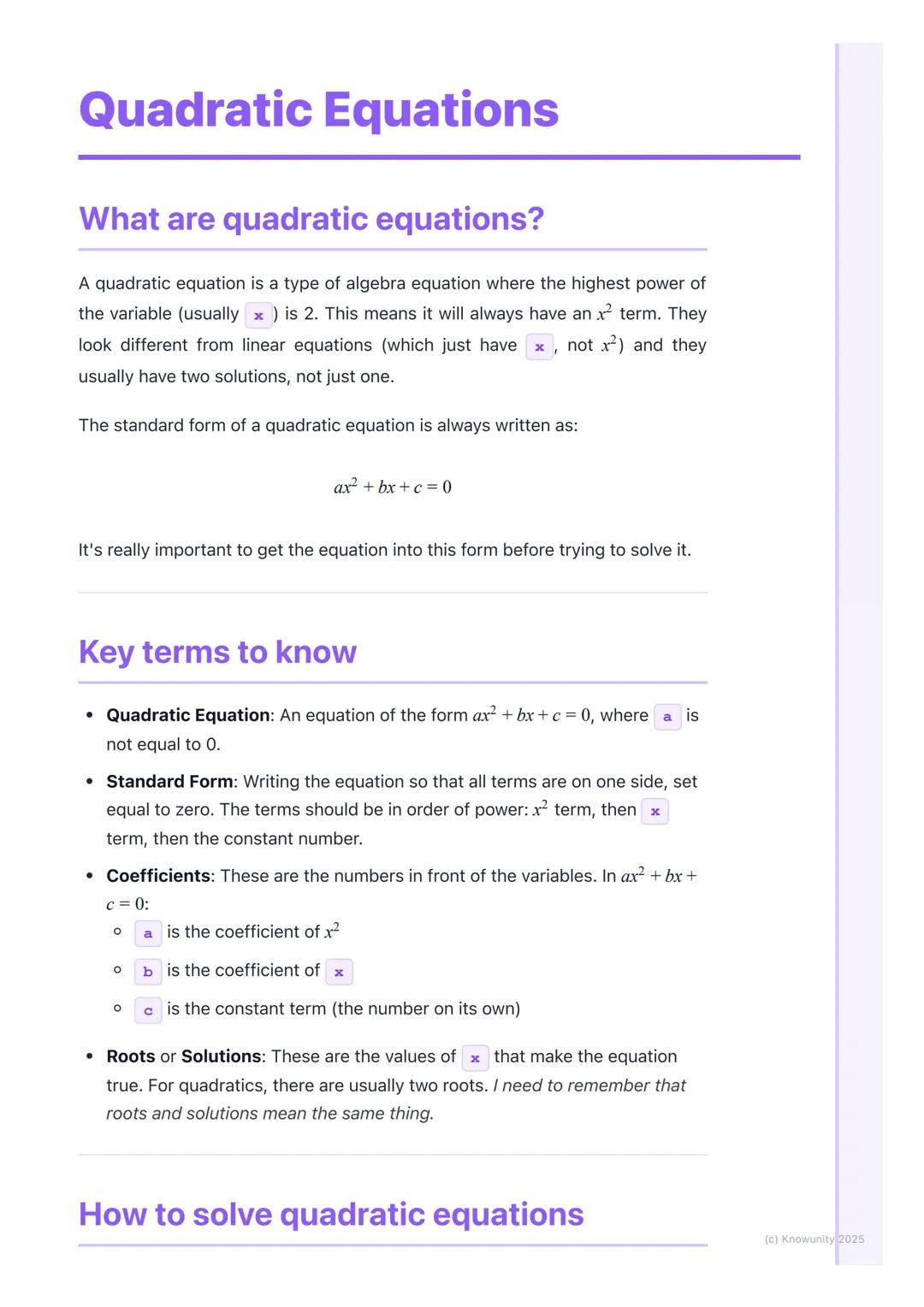
What Are Quadratic Equations?
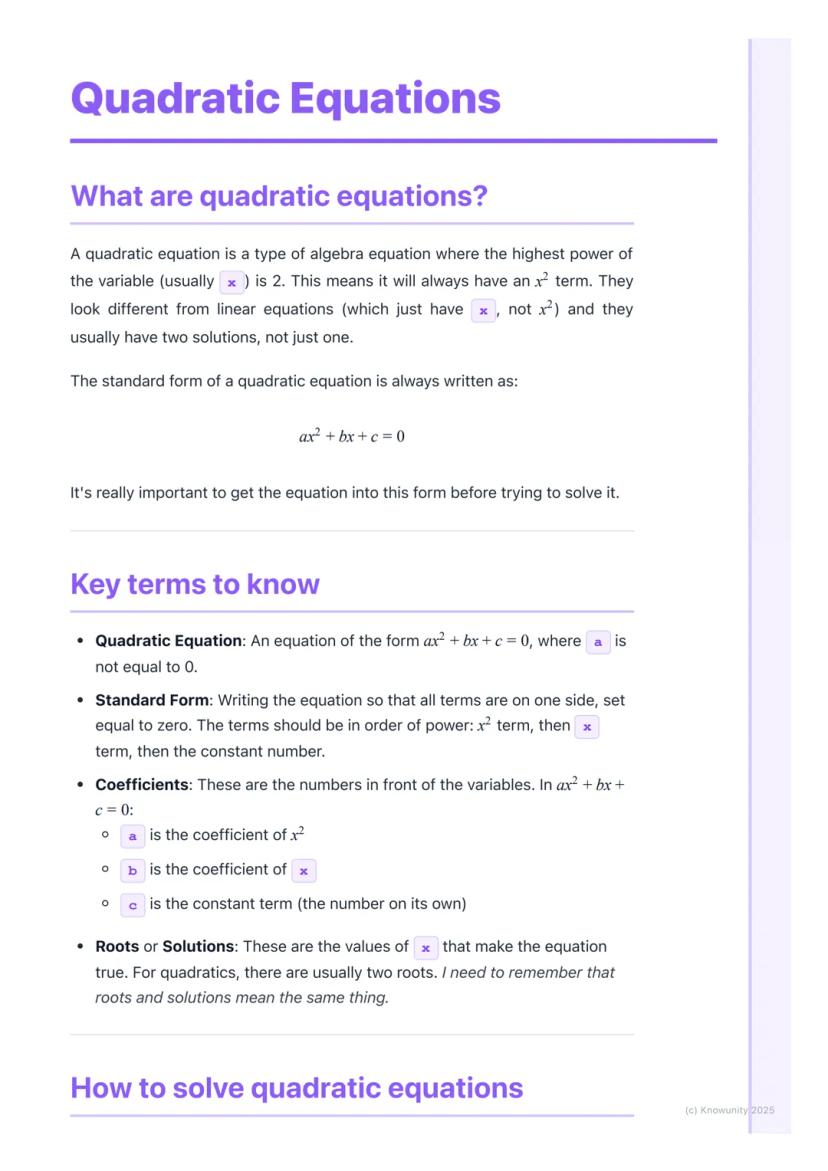
Think of quadratic equations as algebra's next level challenge. Unlike simple linear equations that only have x, these always include an x² term, making them more interesting to solve. The highest power is always 2, which is what makes them "quadratic".
Every quadratic equation follows the same pattern: ax² + bx + c = 0. Getting your equation into this standard form is absolutely crucial before you start solving - it's like organising your desk before starting homework.
The letters a, b, and c are called coefficients - they're just the numbers in front of each term. Remember that 'a' can never be zero (otherwise it wouldn't be quadratic anymore!). Most quadratics have two solutions called roots, which are the x-values that make the equation true.
Quick tip: Roots and solutions mean exactly the same thing - don't let different terminology throw you off in exams!
2
of 5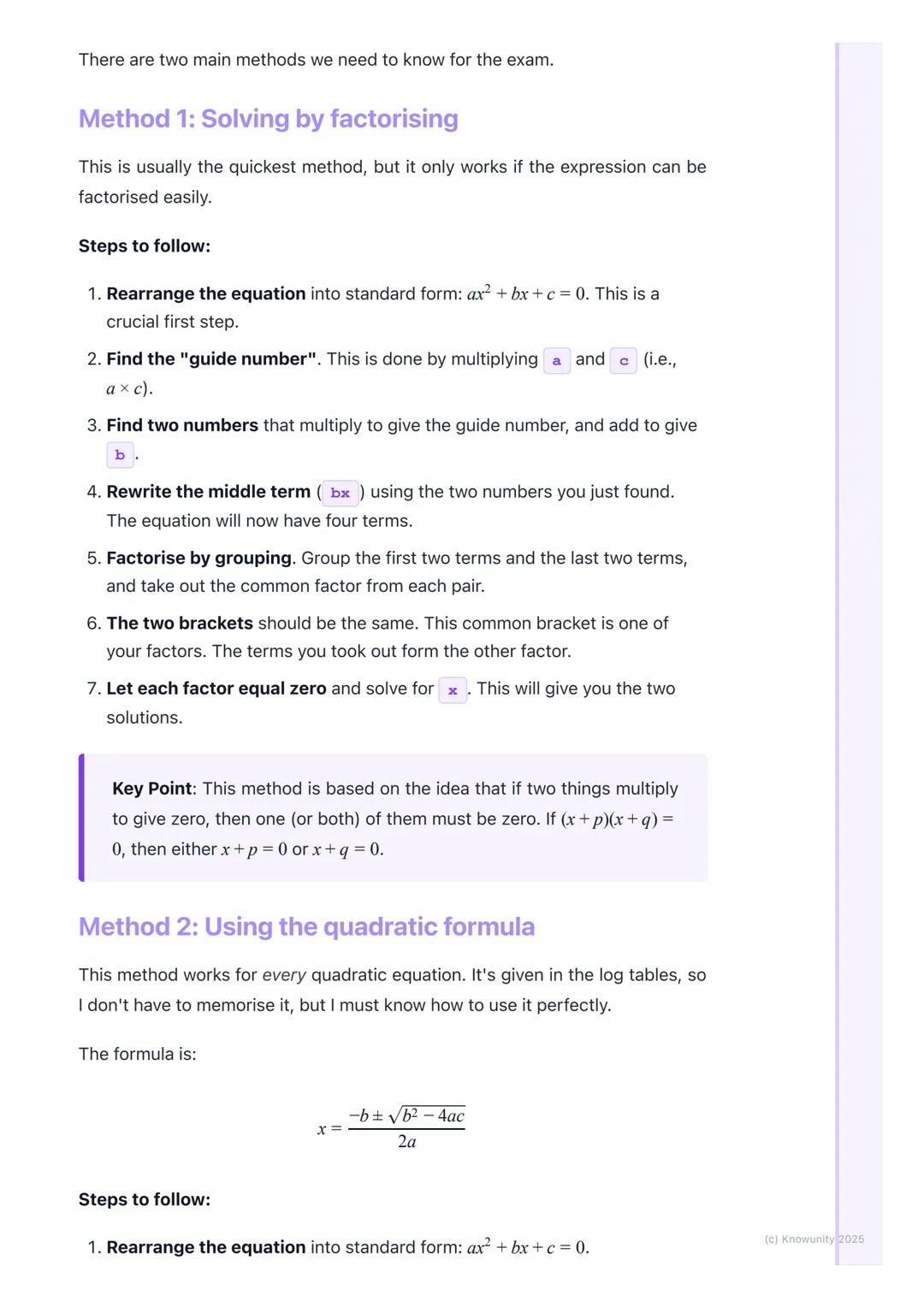
Method 1: Solving by Factorising
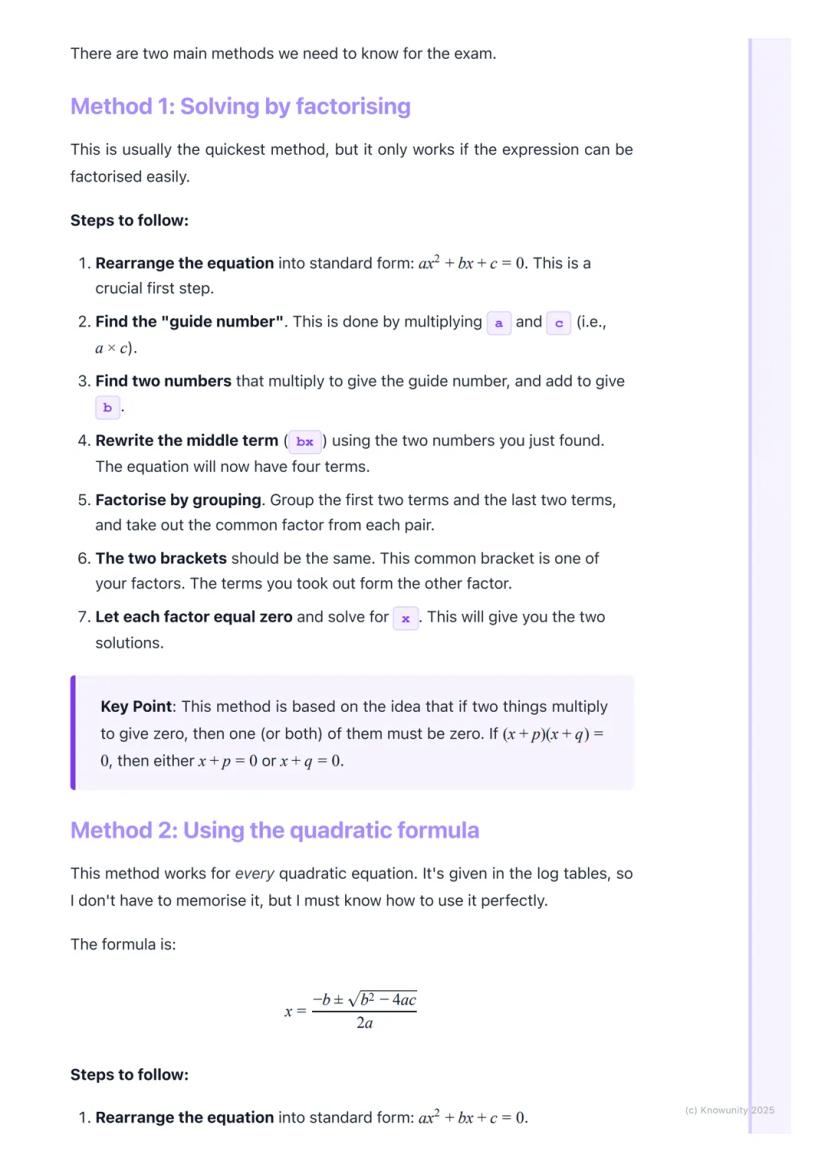
This is often the fastest method, but only works when the quadratic can be factorised neatly. Think of it like breaking down a complex problem into smaller, manageable pieces.
Start by rearranging into standard form, then find the "guide number" by multiplying a and c together. You need two numbers that multiply to give this guide number AND add up to give b. Once you find them, rewrite the middle term using these numbers.
Now comes the clever bit: factorising by grouping. Group the first two terms and last two terms separately, take out common factors from each pair, and you should end up with matching brackets. Set each factor equal to zero and solve - that's your two solutions!
The key principle here is simple: if two things multiply to give zero, then one (or both) must be zero. So if = 0, then either x + 3 = 0 or x - 2 = 0.
Remember: This method is based on the zero product property - if the product equals zero, at least one factor must be zero.
3
of 5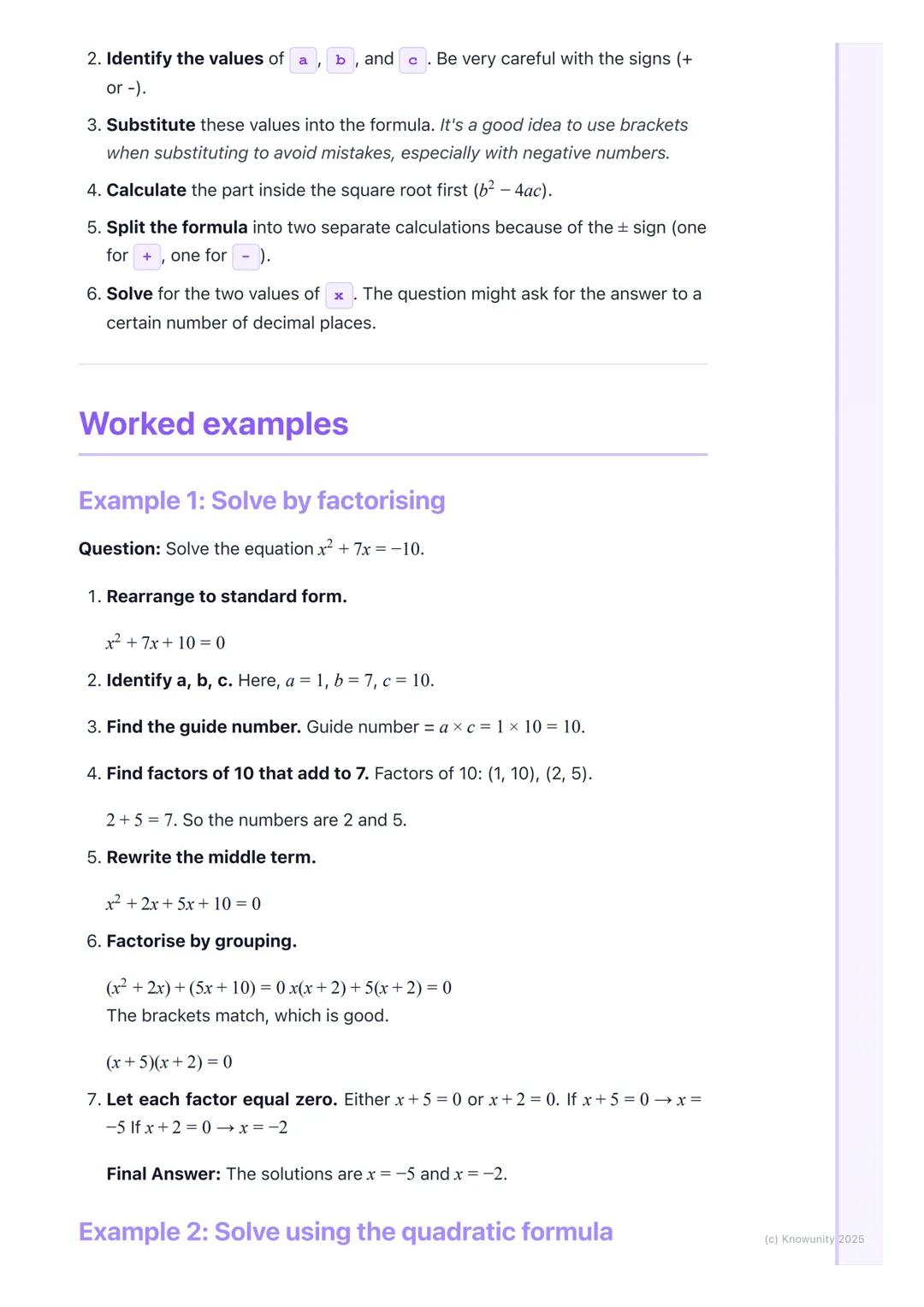
Method 2: The Quadratic Formula
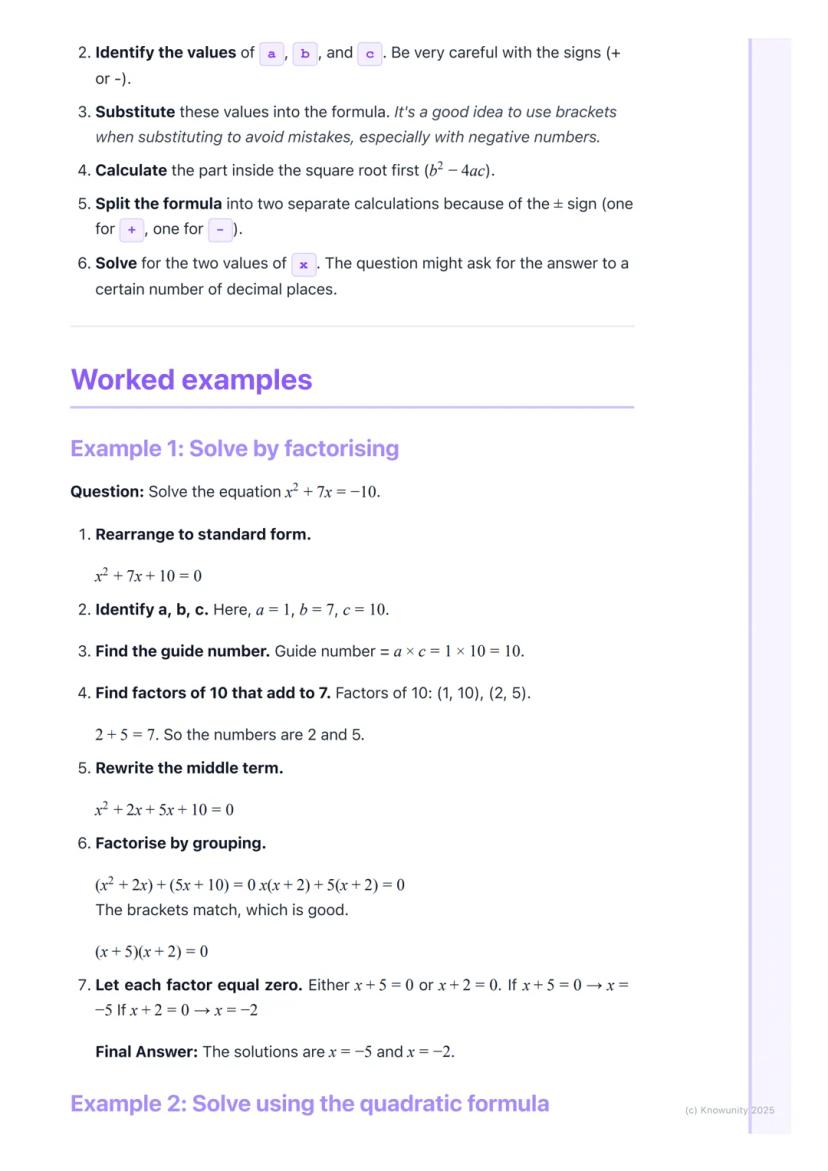
When factorising gets messy or impossible, the quadratic formula is your reliable backup. It works for every single quadratic equation, no exceptions. The best part? It's in your log tables, so you don't need to memorise it!
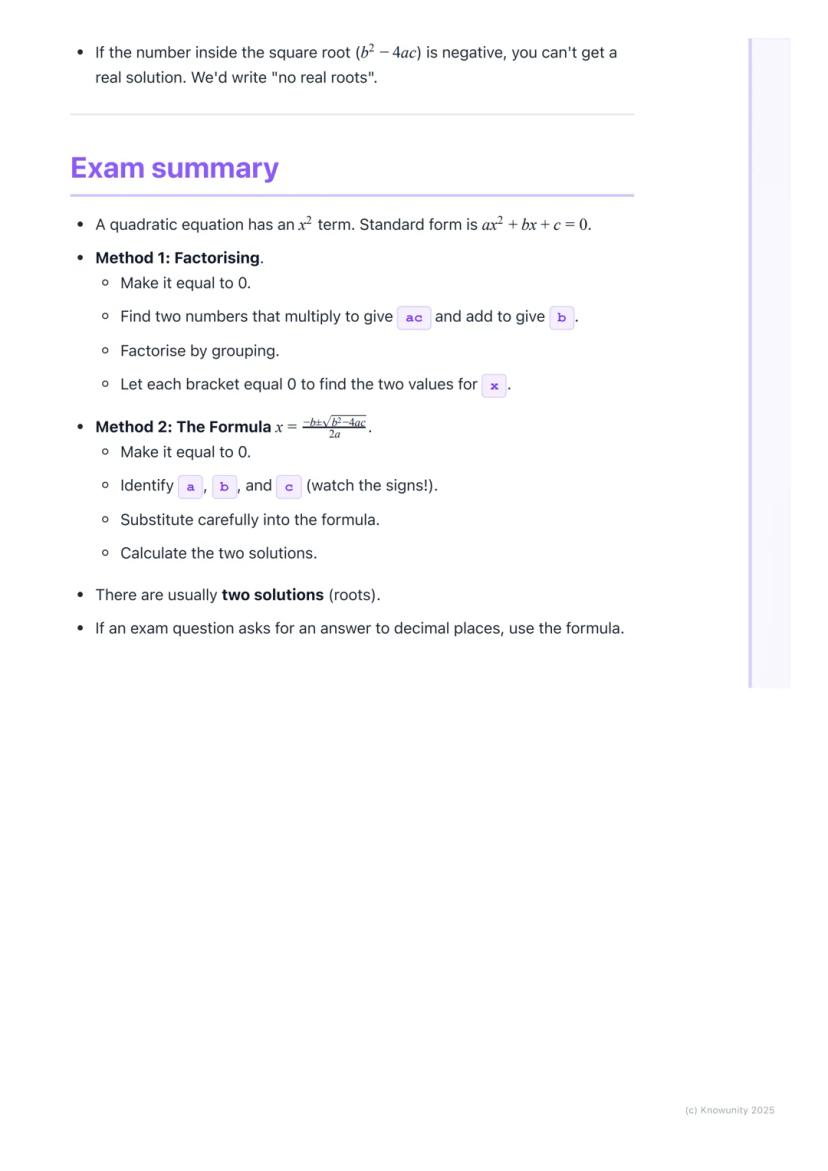
The formula is: x = / 2a. First, identify your a, b, and c values carefully - negative signs are especially tricky here. Substitute these into the formula using brackets to avoid sign errors.
Calculate the bit under the square root first, then split the calculation because of the ± symbol. You'll get two separate answers, which gives you both solutions. Watch out for questions asking for decimal places - that's usually a hint to use the formula!
The part under the square root is quite important. If it's negative, you can't find real solutions, so you'd write "no real roots" as your answer.
Exam tip: If a question asks for decimal places, it's almost always telling you to use the formula rather than factorising.
4
of 5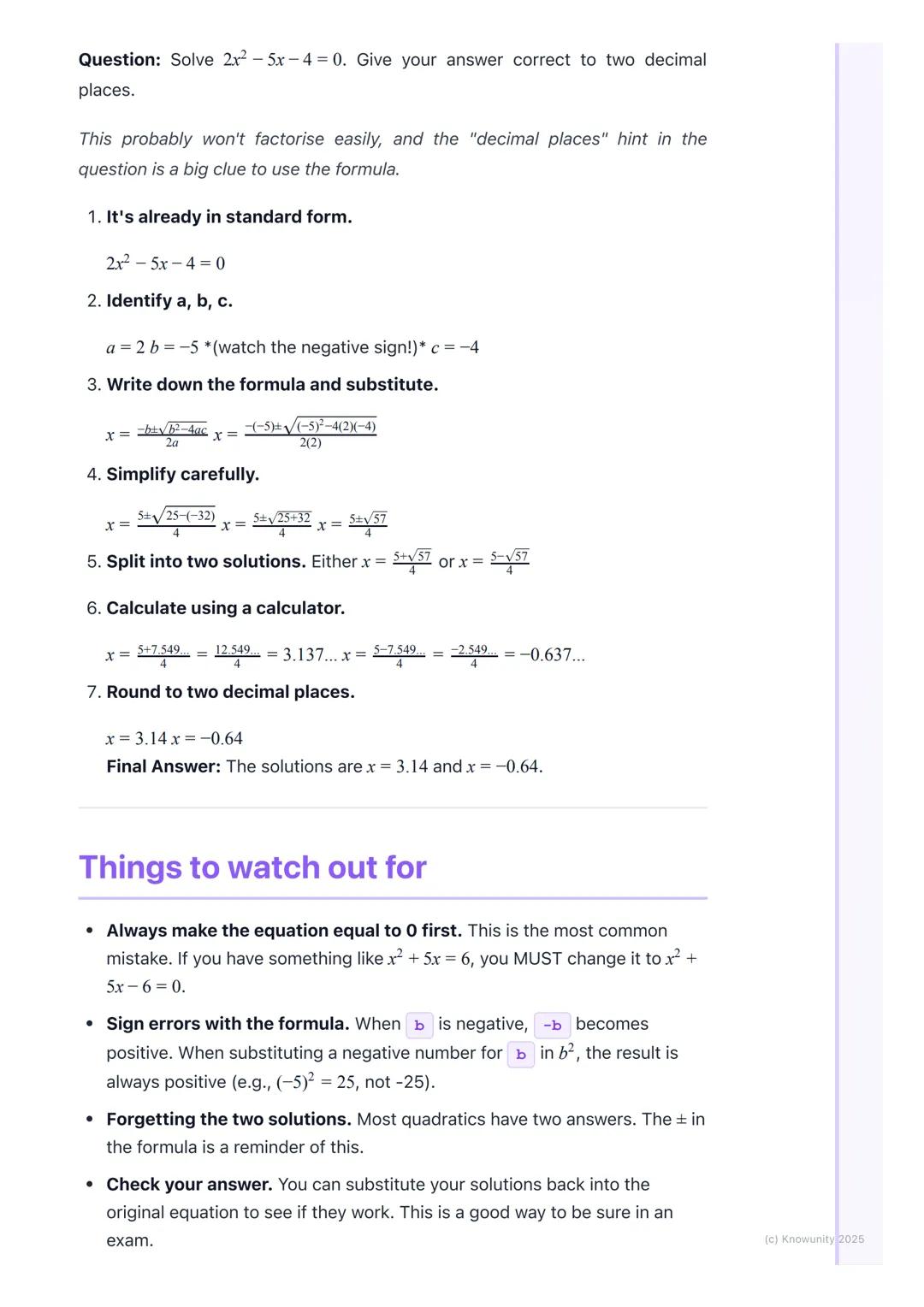
Worked Examples in Action
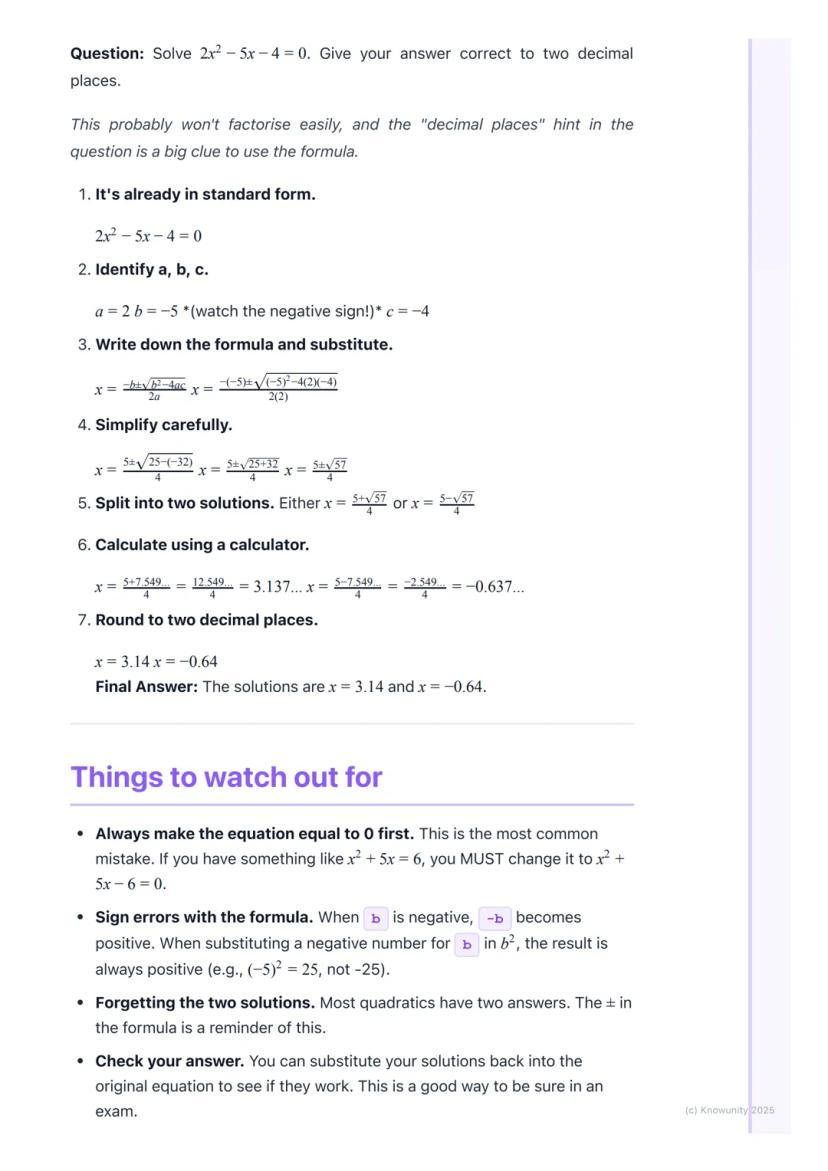
Let's see these methods in practice with real examples you might face in exams. For x² + 7x = -10, first rearrange to get x² + 7x + 10 = 0. The guide number is 1 × 10 = 10, and we need factors that add to 7.
Since 2 + 5 = 7 and 2 × 5 = 10, we rewrite as x² + 2x + 5x + 10 = 0. Grouping gives us x + 5 = 0, which factors to = 0. So x = -5 or x = -2.
For 2x² - 5x - 4 = 0, the decimal places hint tells us to use the formula. With a = 2, b = -5, c = -4, we substitute carefully: x = (5 ± √(25 + 32)) / 4 = (5 ± √57) / 4.
This gives us x = 3.14 and x = -0.64 (to two decimal places). Notice how the formula handles the messy numbers that would make factorising nearly impossible.
Pro tip: Always substitute your answers back into the original equation to check they work - it's a great way to catch mistakes!
5
of 5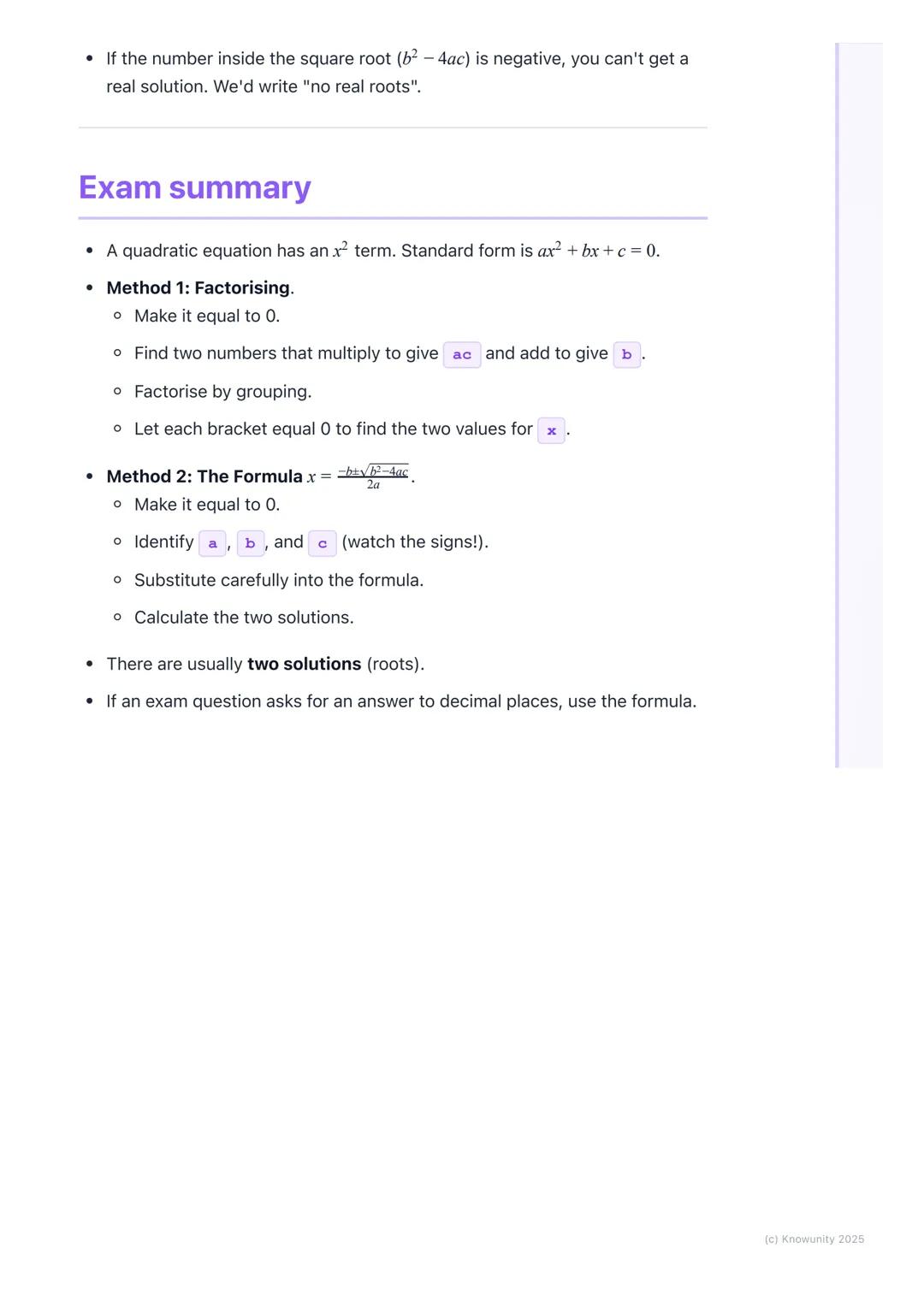
Common Mistakes and Exam Strategy
The biggest mistake? Forgetting to rearrange to standard form first. If you see x² + 5x = 6, you MUST change it to x² + 5x - 6 = 0 before doing anything else. This trips up loads of students in exams.
Sign errors are another classic problem, especially with the formula. When b is negative, -b becomes positive. And remember (-5)² = 25, not -25! Take your time with substitution and use brackets to stay organised.
Don't forget that most quadratics have two solutions. The ± in the formula is there for a reason, and factorising should give you two brackets to solve. Missing a solution loses you marks.
Choose your method wisely: if the question asks for decimal places, use the formula. If the numbers look neat and simple, try factorising first. You can always switch methods if one isn't working out.
Final reminder: Check your answers by substituting back into the original equation - it only takes a minute and could save you valuable marks!
Mysleli sme si, že sa už nikdy neopýtaš...
Čo je Knowunity AI companion?
Náš AI Companion je AI nástroj zameraný na študentov, ktorý ponúka viac ako len odpovede. Postavený na miliónoch zdrojov Knowunity poskytuje relevantné informácie, personalizované študijné plány, kvízy a obsah priamo v chate, prispôsobujúc sa tvojej individuálnej ceste učenia.
Kde si môžem stiahnuť aplikáciu Knowunity?
Aplikáciu si môžeš stiahnuť z Google Play Store a Apple App Store.
Je Knowunity naozaj zadarmo?
Presne tak! Užívaj si bezplatný prístup k študijnému obsahu, spájaj sa s ostatnými študentmi a získaj okamžitú pomoc – všetko na dosah ruky.
Najobľúbenejší obsah v predmete Mathematics
8Najobľúbenejší obsah
9Nenašiel si, čo hľadáš? Preskúmaj iné predmety.
Študenti nás milujú — a ty budeš tiež.
4.6/5App Store
4.7/5Google Play
Appka je veľmi jednoduchá na používanie a má super dizajn. Zatiaľ som našiel všetko, čo som hľadal, a naučil sa veľa z prezentácií! Určite ju použijem na školskú úlohu! A samozrejme mi to aj veľmi pomáha ako inšpirácia.
Stefan SiOS používateľ
Táto appka je naozaj skvelá. Je tu toľko študijných poznámok a pomoci [...]. Môj problémový predmet je napríklad francúzština a appka má toľko možností pomoci. Vďaka tejto appke som si zlepšil francúzštinu. Odporúčal by som ju každému.
Samantha KlichAndroid používateľka
Wow, som naozaj ohromený. Vyskúšal som túto appku, lebo som ju videl mnohokrát inzerovať a bol som úplne ohromený. Táto appka je TÁ POMOC, ktorú chceš do školy a hlavne ponúka toľko vecí, ako cvičenia a faktové listy, ktoré mi osobne VEĽMI pomohli.
AnnaiOS používateľka
Mathematics3 zobrazenia·Aktualizované Jun 8, 2026·5 stránkyMastering Quadratic Equations: Factorization and Formula Techniques
Ever wondered why some algebra equations seem trickier than others? Quadratic equationsare the next step up from linear equations - they include an x² term and usually have two solutions instead of just one. Master these and you'll be... Zobraziť viac
1
of 5Zaregistruj sa, aby si videl obsah. Je to zadarmo!
- Prístup ku všetkým dokumentom
- Zlepši si známky
- Pridaj sa k miliónom študentov
What Are Quadratic Equations?
Think of quadratic equations as algebra's next level challenge. Unlike simple linear equations that only have x, these always include an x² term, making them more interesting to solve. The highest power is always 2, which is what makes them "quadratic".
Every quadratic equation follows the same pattern: ax² + bx + c = 0. Getting your equation into this standard form is absolutely crucial before you start solving - it's like organising your desk before starting homework.
The letters a, b, and c are called coefficients - they're just the numbers in front of each term. Remember that 'a' can never be zero (otherwise it wouldn't be quadratic anymore!). Most quadratics have two solutions called roots, which are the x-values that make the equation true.
Quick tip: Roots and solutions mean exactly the same thing - don't let different terminology throw you off in exams!
2
of 5Zaregistruj sa, aby si videl obsah. Je to zadarmo!
- Prístup ku všetkým dokumentom
- Zlepši si známky
- Pridaj sa k miliónom študentov
Method 1: Solving by Factorising
This is often the fastest method, but only works when the quadratic can be factorised neatly. Think of it like breaking down a complex problem into smaller, manageable pieces.
Start by rearranging into standard form, then find the "guide number" by multiplying a and c together. You need two numbers that multiply to give this guide number AND add up to give b. Once you find them, rewrite the middle term using these numbers.
Now comes the clever bit: factorising by grouping. Group the first two terms and last two terms separately, take out common factors from each pair, and you should end up with matching brackets. Set each factor equal to zero and solve - that's your two solutions!
The key principle here is simple: if two things multiply to give zero, then one (or both) must be zero. So if = 0, then either x + 3 = 0 or x - 2 = 0.
Remember: This method is based on the zero product property - if the product equals zero, at least one factor must be zero.
3
of 5Zaregistruj sa, aby si videl obsah. Je to zadarmo!
- Prístup ku všetkým dokumentom
- Zlepši si známky
- Pridaj sa k miliónom študentov
Method 2: The Quadratic Formula
When factorising gets messy or impossible, the quadratic formula is your reliable backup. It works for every single quadratic equation, no exceptions. The best part? It's in your log tables, so you don't need to memorise it!
The formula is: x = / 2a. First, identify your a, b, and c values carefully - negative signs are especially tricky here. Substitute these into the formula using brackets to avoid sign errors.
Calculate the bit under the square root first, then split the calculation because of the ± symbol. You'll get two separate answers, which gives you both solutions. Watch out for questions asking for decimal places - that's usually a hint to use the formula!
The part under the square root is quite important. If it's negative, you can't find real solutions, so you'd write "no real roots" as your answer.
Exam tip: If a question asks for decimal places, it's almost always telling you to use the formula rather than factorising.
4
of 5Zaregistruj sa, aby si videl obsah. Je to zadarmo!
- Prístup ku všetkým dokumentom
- Zlepši si známky
- Pridaj sa k miliónom študentov
Worked Examples in Action
Let's see these methods in practice with real examples you might face in exams. For x² + 7x = -10, first rearrange to get x² + 7x + 10 = 0. The guide number is 1 × 10 = 10, and we need factors that add to 7.
Since 2 + 5 = 7 and 2 × 5 = 10, we rewrite as x² + 2x + 5x + 10 = 0. Grouping gives us x + 5 = 0, which factors to = 0. So x = -5 or x = -2.
For 2x² - 5x - 4 = 0, the decimal places hint tells us to use the formula. With a = 2, b = -5, c = -4, we substitute carefully: x = (5 ± √(25 + 32)) / 4 = (5 ± √57) / 4.
This gives us x = 3.14 and x = -0.64 (to two decimal places). Notice how the formula handles the messy numbers that would make factorising nearly impossible.
Pro tip: Always substitute your answers back into the original equation to check they work - it's a great way to catch mistakes!
5
of 5Zaregistruj sa, aby si videl obsah. Je to zadarmo!
- Prístup ku všetkým dokumentom
- Zlepši si známky
- Pridaj sa k miliónom študentov
Common Mistakes and Exam Strategy
The biggest mistake? Forgetting to rearrange to standard form first. If you see x² + 5x = 6, you MUST change it to x² + 5x - 6 = 0 before doing anything else. This trips up loads of students in exams.
Sign errors are another classic problem, especially with the formula. When b is negative, -b becomes positive. And remember (-5)² = 25, not -25! Take your time with substitution and use brackets to stay organised.
Don't forget that most quadratics have two solutions. The ± in the formula is there for a reason, and factorising should give you two brackets to solve. Missing a solution loses you marks.
Choose your method wisely: if the question asks for decimal places, use the formula. If the numbers look neat and simple, try factorising first. You can always switch methods if one isn't working out.
Final reminder: Check your answers by substituting back into the original equation - it only takes a minute and could save you valuable marks!
Mysleli sme si, že sa už nikdy neopýtaš...
Čo je Knowunity AI companion?
Náš AI Companion je AI nástroj zameraný na študentov, ktorý ponúka viac ako len odpovede. Postavený na miliónoch zdrojov Knowunity poskytuje relevantné informácie, personalizované študijné plány, kvízy a obsah priamo v chate, prispôsobujúc sa tvojej individuálnej ceste učenia.
Kde si môžem stiahnuť aplikáciu Knowunity?
Aplikáciu si môžeš stiahnuť z Google Play Store a Apple App Store.
Je Knowunity naozaj zadarmo?
Presne tak! Užívaj si bezplatný prístup k študijnému obsahu, spájaj sa s ostatnými študentmi a získaj okamžitú pomoc – všetko na dosah ruky.
Najobľúbenejší obsah v predmete Mathematics
8Najobľúbenejší obsah
9Nenašiel si, čo hľadáš? Preskúmaj iné predmety.
Študenti nás milujú — a ty budeš tiež.
4.6/5App Store
4.7/5Google Play
Appka je veľmi jednoduchá na používanie a má super dizajn. Zatiaľ som našiel všetko, čo som hľadal, a naučil sa veľa z prezentácií! Určite ju použijem na školskú úlohu! A samozrejme mi to aj veľmi pomáha ako inšpirácia.
Stefan SiOS používateľ
Táto appka je naozaj skvelá. Je tu toľko študijných poznámok a pomoci [...]. Môj problémový predmet je napríklad francúzština a appka má toľko možností pomoci. Vďaka tejto appke som si zlepšil francúzštinu. Odporúčal by som ju každému.
Samantha KlichAndroid používateľka
Wow, som naozaj ohromený. Vyskúšal som túto appku, lebo som ju videl mnohokrát inzerovať a bol som úplne ohromený. Táto appka je TÁ POMOC, ktorú chceš do školy a hlavne ponúka toľko vecí, ako cvičenia a faktové listy, ktoré mi osobne VEĽMI pomohli.
AnnaiOS používateľka