
Poetry analysis is a major component of your Leaving Cert...
 Irish2 zobrazenia·Aktualizované Jun 8, 2026·6 stránky
Eolas ar Fhilíocht: Dioscúrsa Téamaí agus Íomháineachas


1 / 6
1
of 6
Getting Started with Poetry Analysis
Poetry questions make up a significant chunk of Paper 2, so getting comfortable with analysis is absolutely crucial for your Leaving Cert success. The key shift you need to make is moving beyond simple translation to discussing ceardaíocht an fhile (the poet's craft).
Your job isn't just to say what the poem means, but to explore how the poet creates those meanings and emotions. Think of yourself as a detective uncovering the techniques that make a poem work.
You'll need to master essential téarmaí filíochta (poetic terms) like téama (theme), mothúcháin (emotions), and íomháineachas (imagery). But here's the crucial bit - simply spotting a meafar (metaphor) or samhail (simile) isn't enough.
Remember: Always explain the effect of each poetic device. What does that metaphor make the reader think or feel? How does it strengthen the poem's central theme?
2
of 6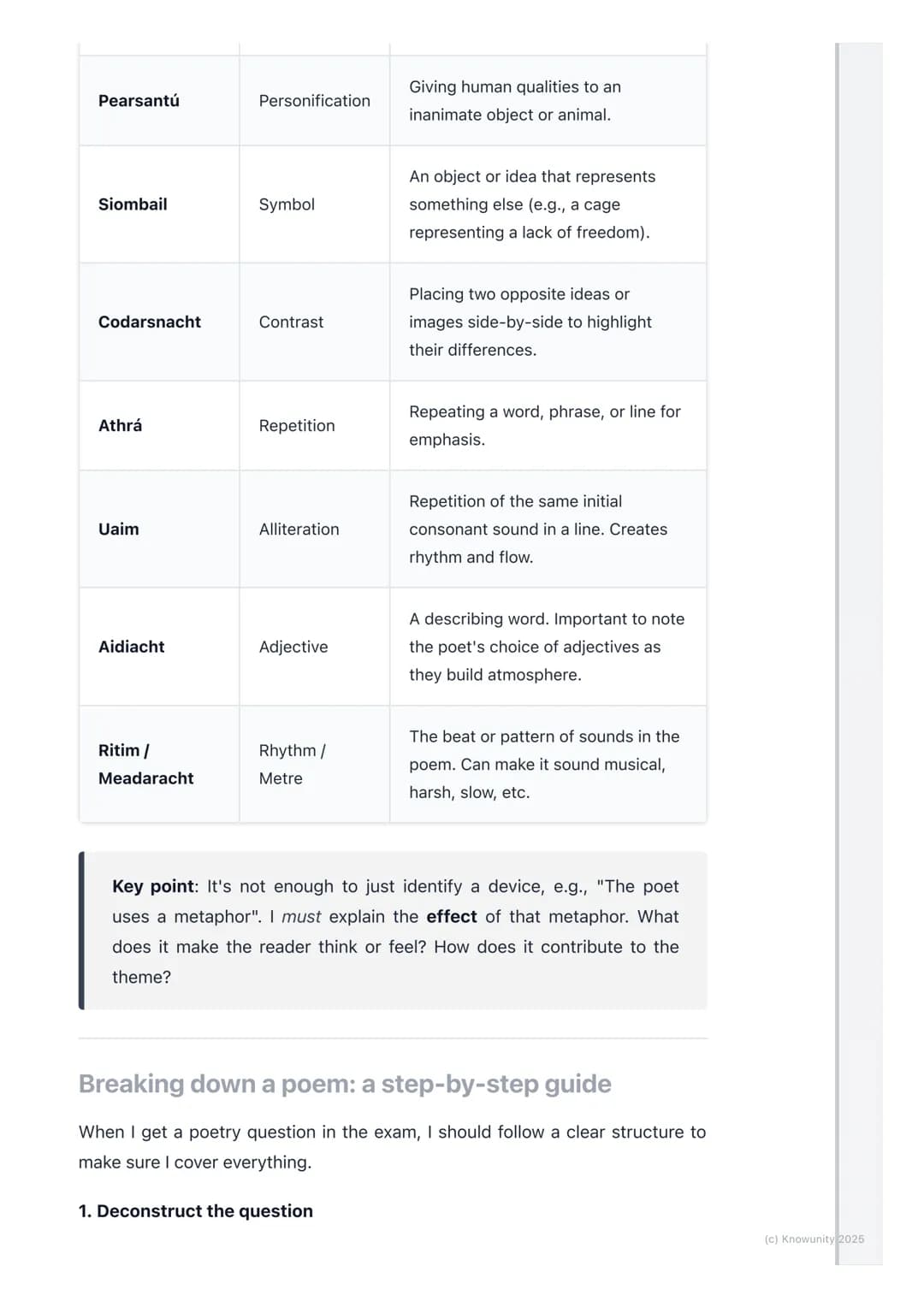
Essential Poetic Devices and Their Effects
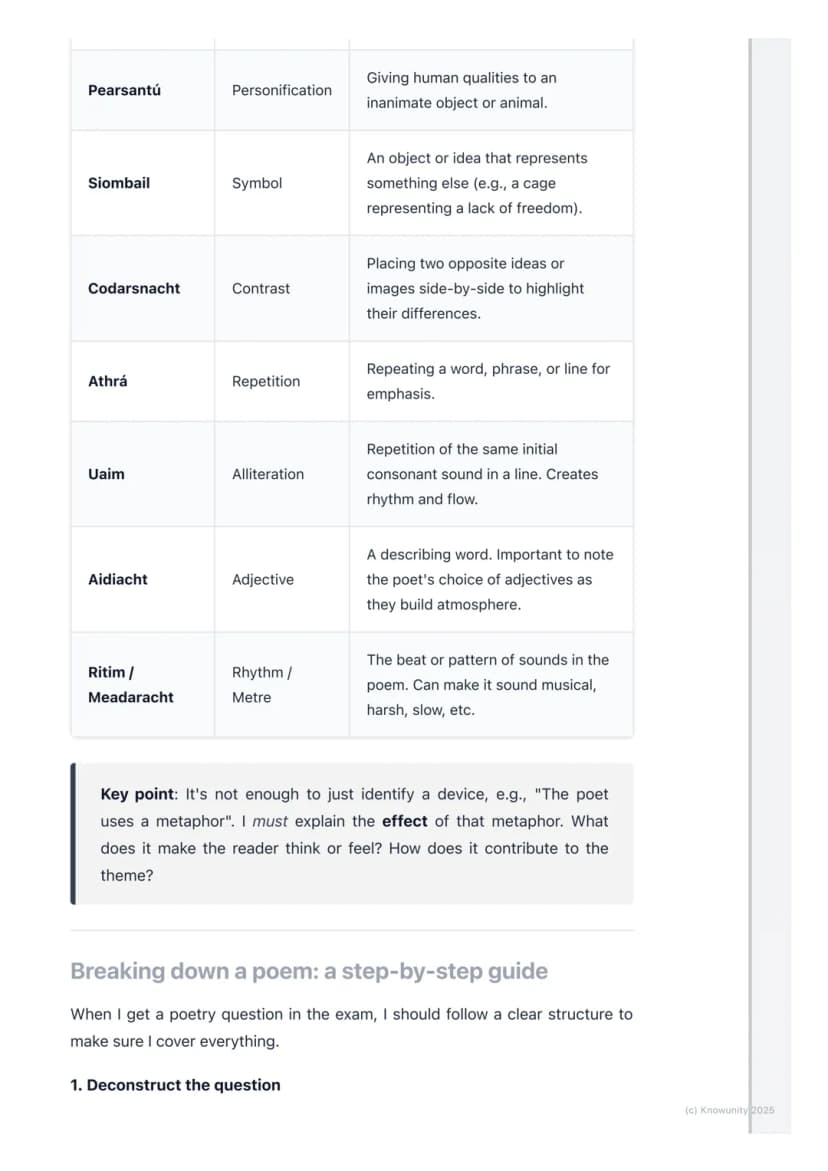
Understanding poetic devices is like having a toolkit for analysis. Pearsantú (personification) gives human qualities to objects, whilst siombail (symbols) represent deeper meanings - like a cage symbolising lost freedom.
Codarsnacht (contrast) places opposite ideas side-by-side to create powerful effects, and athrá (repetition) emphasises key points. Sound devices like uaim (alliteration) create rhythm and atmosphere that can make a poem feel musical or harsh.
Don't forget about aidiachtaí (adjectives) - poets choose describing words very carefully to build specific moods. The ritim (rhythm) and meadaracht (metre) also shape how a poem feels when you read it aloud.
Top Tip: Never just identify a device - always explain its impact. Instead of saying "the poet uses a metaphor," explain what that metaphor achieves in the poem.
3
of 6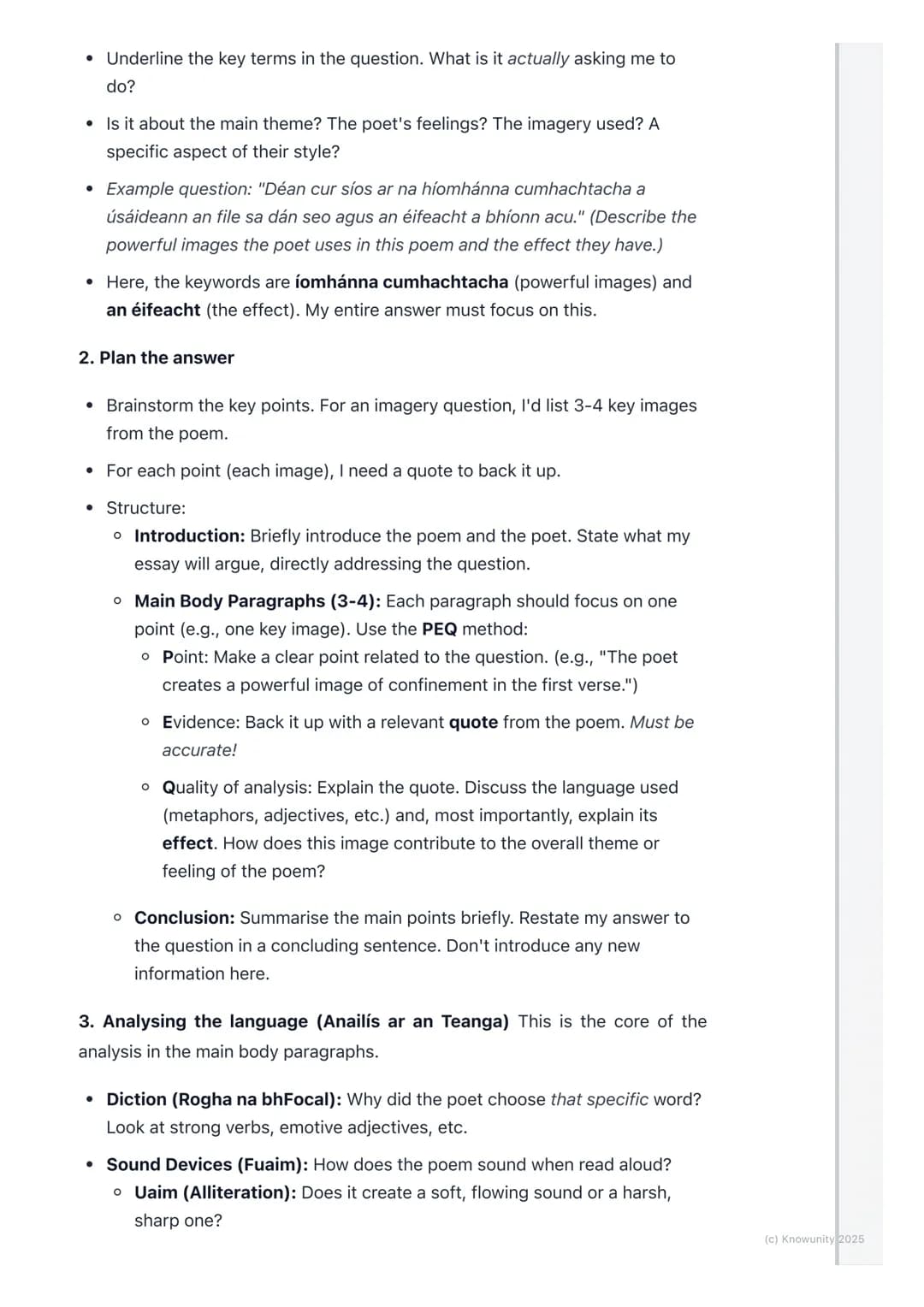
Breaking Down Poetry Questions Step-by-Step
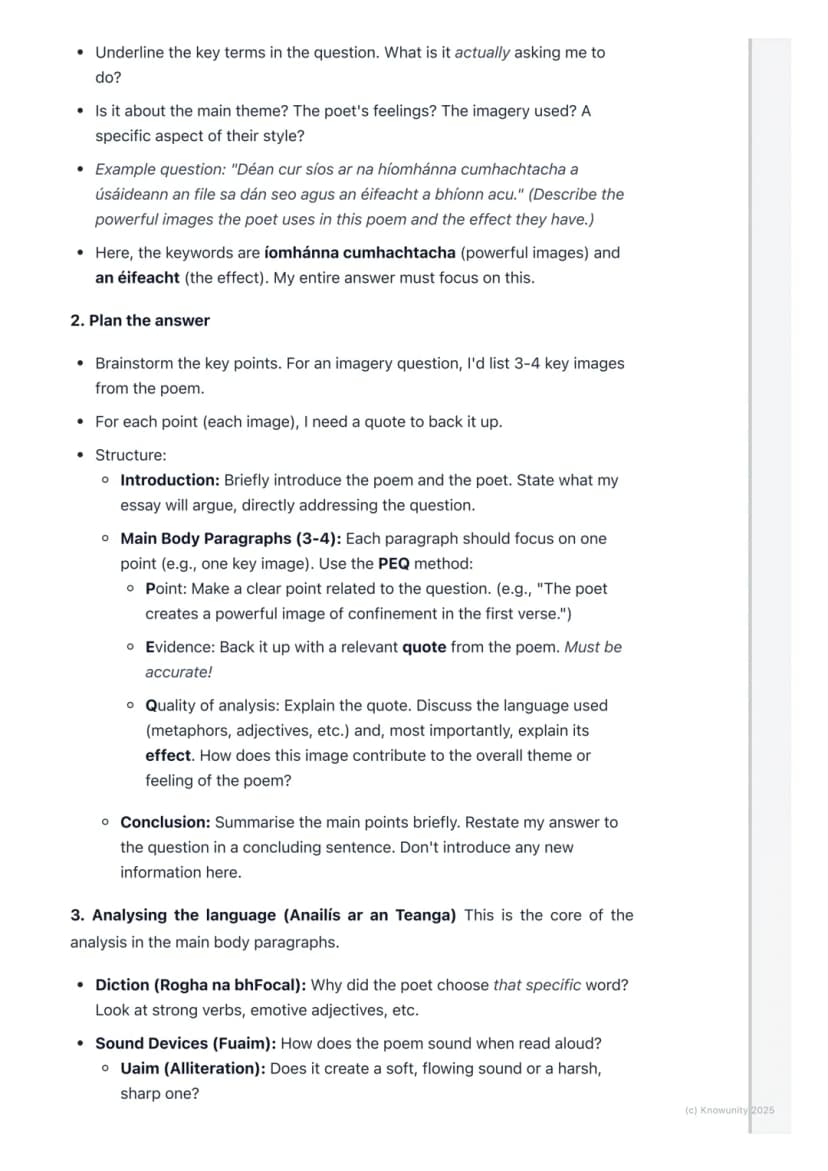
Start by deconstructing the question properly. Underline key terms and identify exactly what you're being asked to discuss - is it about themes, imagery, or the poet's style? This focus will guide your entire answer.
Planning your response is absolutely vital. Brainstorm 3-4 key points that directly answer the question, find supporting quotes for each point, then structure your essay logically with a clear introduction, focused body paragraphs, and concise conclusion.
For your main body paragraphs, use the PEQ method: make a clear Point, provide Evidence (accurate quotes), then offer Quality analysis explaining the language choices and their effects. Each paragraph should focus on one main idea that supports your overall argument.
Your anailís ar an teanga (language analysis) should examine rogha na bhfocal (word choice), sound devices, and how the poem's struchtúr (structure) reinforces its message.
Key Strategy: Always link your analysis back to the question. After explaining a quote, add phrases like "This reinforces the theme of..." to stay on track.
4
of 6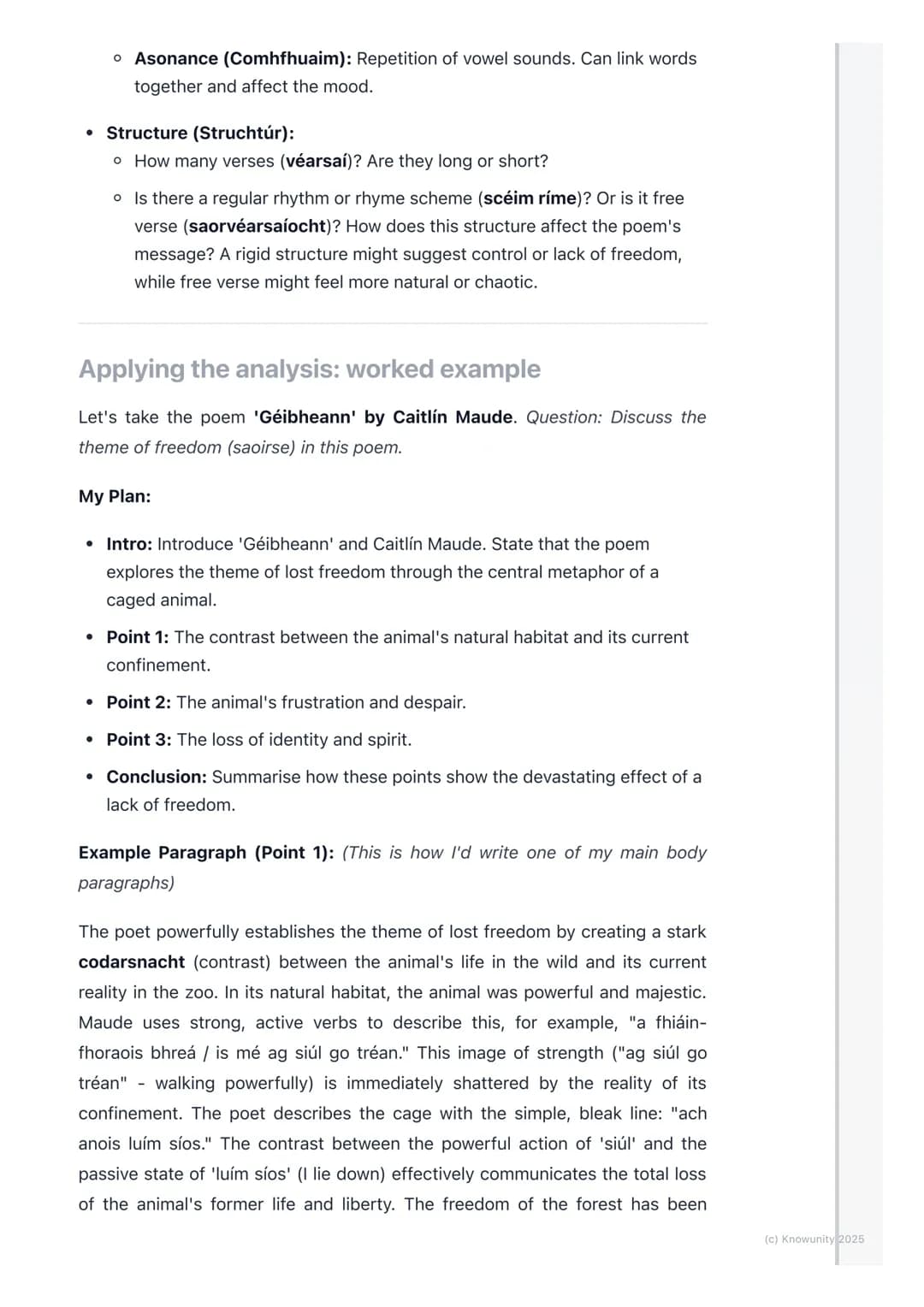
Practical Analysis Example
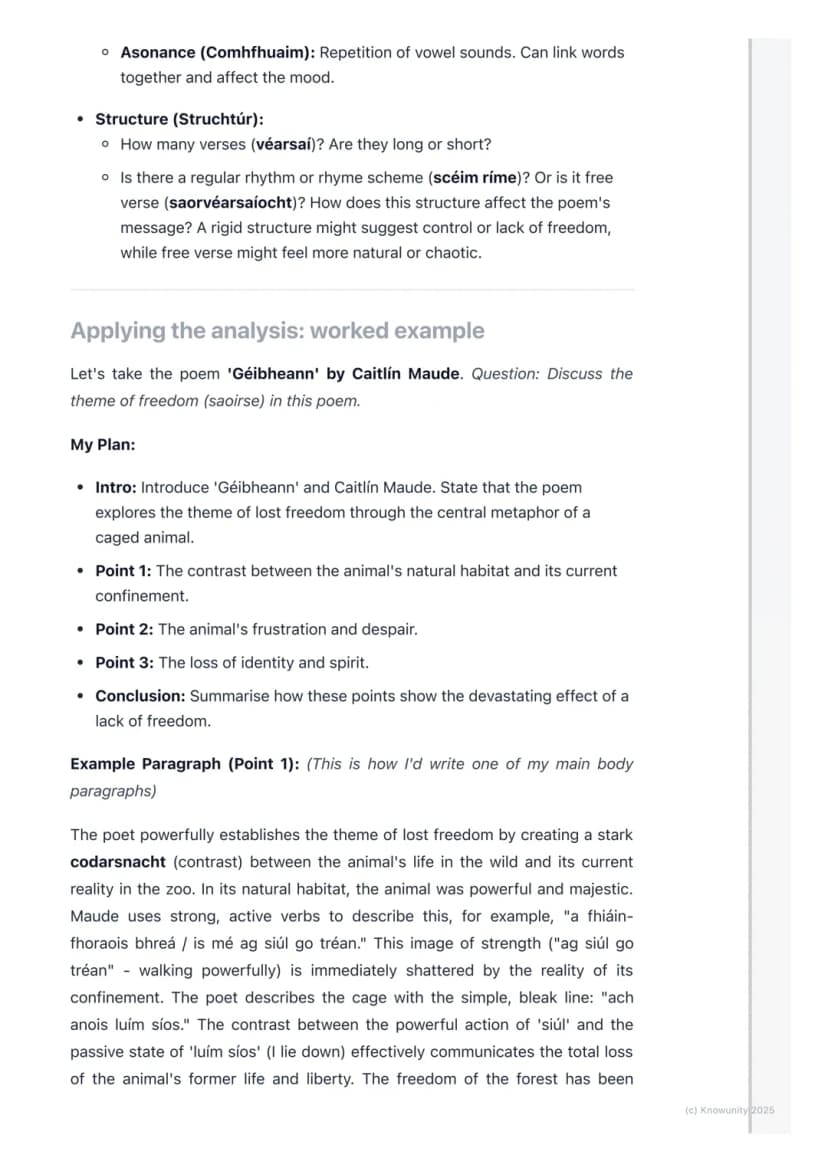
Let's look at 'Géibheann' by Caitlín Maude to see analysis in action. For a question about saoirse (freedom), you'd explore how the poem uses the central metaphor of a caged animal to examine lost liberty.
A strong paragraph might examine the codarsnacht between the animal's natural habitat and current confinement. The powerful verbs describing wild freedom ("ag siúl go tréan") contrast sharply with the passive despair of captivity ("ach anois luím síos").
This contrast between active "siúl" and passive "luím síos" effectively communicates the devastating loss of liberty. The freedom of the forest has been replaced by crushing inaction, perfectly highlighting the poem's central theme.
Notice how this analysis moves beyond simple description to explore how the poet creates meaning through specific language choices and their emotional impact on readers.
Analysis Focus: Quality beats quantity every time. One well-analysed point with a strong quote is worth more than vague paragraphs that just summarise the story.
5
of 6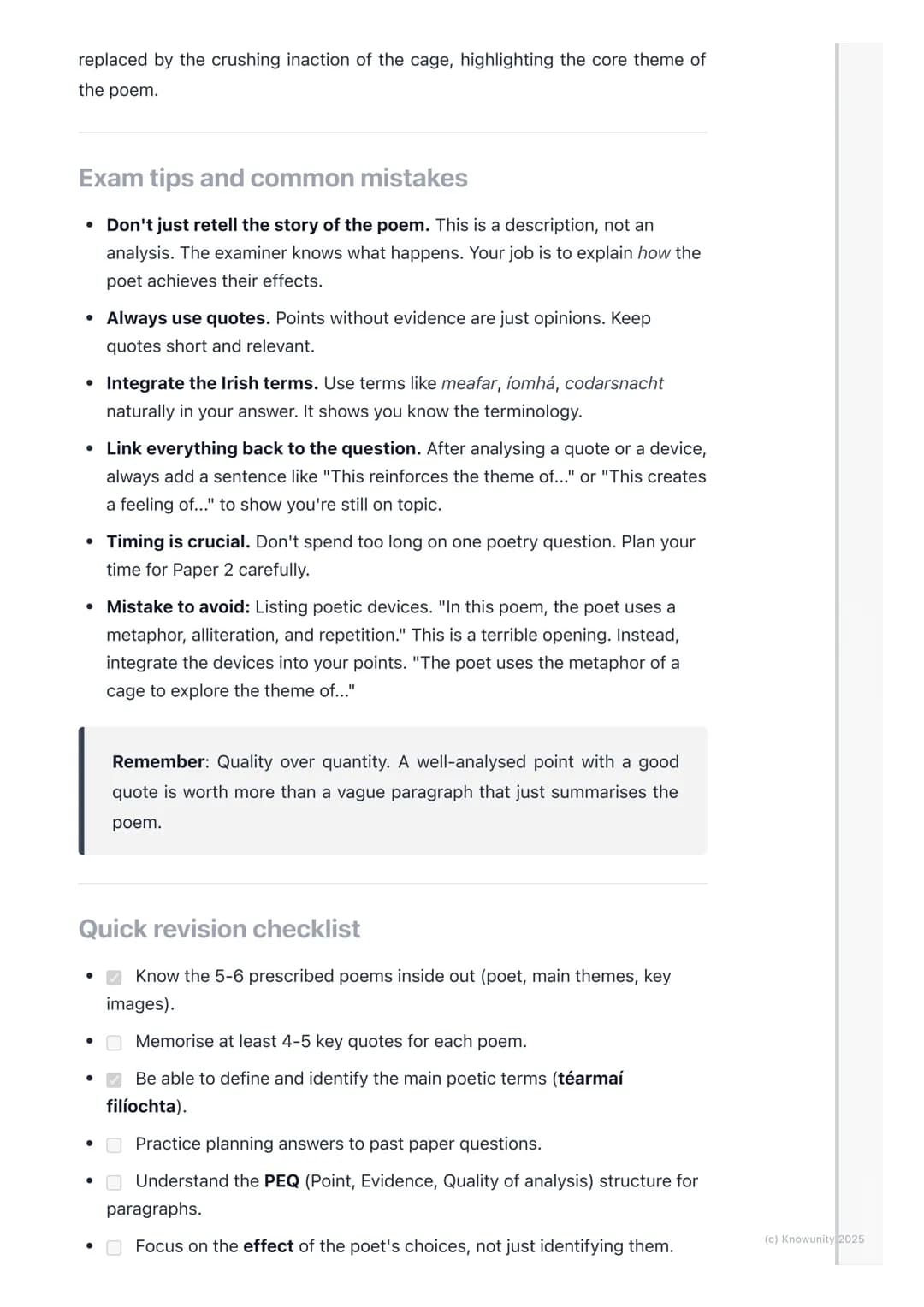
Exam Success and Common Pitfalls
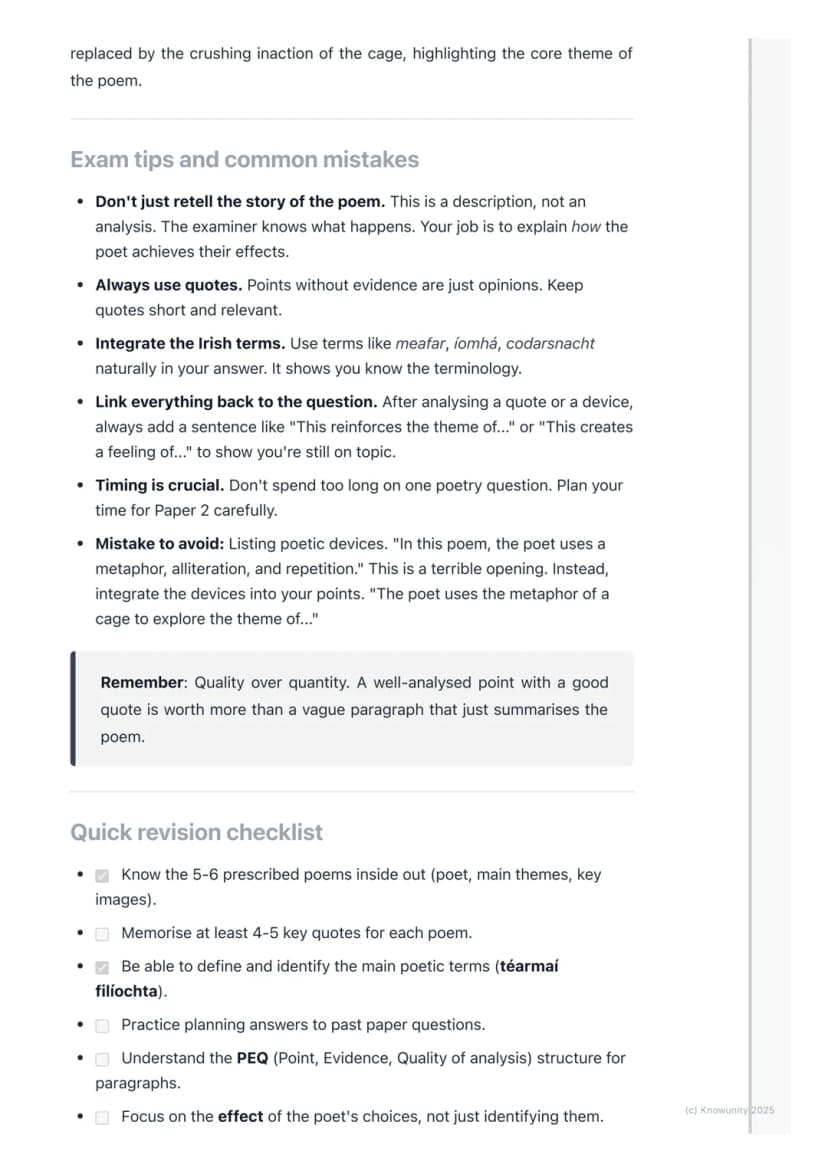
Avoid the classic mistake of simply retelling the poem's story - the examiner already knows what happens! Your job is explaining how the poet achieves their effects through specific techniques and language choices.
Always use quotes to support your points, but keep them short and relevant. Integrate téarmaí Gaeilge naturally throughout your answer to demonstrate your knowledge of poetic terminology.
Timing is absolutely crucial on Paper 2. Don't spend too long on one poetry question - plan your time carefully across all sections. Practice structuring answers quickly using the PEQ method for each paragraph.
Link everything back to your original question. After analysing any quote or device, explicitly connect it to the theme or effect you're discussing to maintain focus throughout your response.
Revision Strategy: Master 4-5 key quotes from each prescribed poem, understand their context, and practice explaining their effects under exam conditions.
6
of 6
Mysleli sme si, že sa už nikdy neopýtaš...
Čo je Knowunity AI companion?
Náš AI Companion je AI nástroj zameraný na študentov, ktorý ponúka viac ako len odpovede. Postavený na miliónoch zdrojov Knowunity poskytuje relevantné informácie, personalizované študijné plány, kvízy a obsah priamo v chate, prispôsobujúc sa tvojej individuálnej ceste učenia.
Kde si môžem stiahnuť aplikáciu Knowunity?
Aplikáciu si môžeš stiahnuť z Google Play Store a Apple App Store.
Je Knowunity naozaj zadarmo?
Presne tak! Užívaj si bezplatný prístup k študijnému obsahu, spájaj sa s ostatnými študentmi a získaj okamžitú pomoc – všetko na dosah ruky.
Najobľúbenejší obsah v predmete Irish
9IrishIrish oral questions and answers
Questions and answers for the leaving cert oral
5th Year4264
IrishIrish oral questions
Outline of oral questions
5th Year2055
IrishIrish poetry 2027
Iníon + Dínit an Bhróin
5th Year1133
IrishIníon- le hÁine Durkin
Aine Durkin’s poem, Iníon: Themes & summary
5th Year850
IrishLC HL notes- Iníon (poem)
Includes poem in English and Irish, theme, key words & phrases
5th Year2284
IrishMo Ghrá-sa (Idir Lúibíní)
Notes on mo ghrá-sa
5th Year380
IrishGaeilge Grammar Office
All the basics you need to know on Irish grammar.
6th Year1063
IrishAn Gaeilge Aiste
Irish Language essay
6th Year1320
IrishMé Féin & Mo Chlann (Myself & My Family)
Students will learn vocabulary to describe themselves, their family members, and daily routines. This helps in personal introductions and discussions.
TY291
Najobľúbenejší obsah
9IrishIrish oral questions and answers
Questions and answers for the leaving cert oral
5th Year4264
 English
Key Quotes : Sive
Key Quotes and explanations: Sive
6th Year2842
IrishIrish oral questions
Outline of oral questions
5th Year2055
IrishIníon- le hÁine Durkin
Aine Durkin’s poem, Iníon: Themes & summary
5th Year850
IrishIrish poetry 2027
Iníon + Dínit an Bhróin
5th Year1133
IrishLC HL notes- Iníon (poem)
Includes poem in English and Irish, theme, key words & phrases
5th Year2284
EnglishCultural Context : Shawshank Redemption : Sive : Small Things Like These
Comparative Study : Cultural Context : Shawshank Redemption, Sive and Small Things Like These
6th Year1430
IrishMo Ghrá-sa (Idir Lúibíní)
Notes on mo ghrá-sa
5th Year380
IrishAn Gaeilge Aiste
Irish Language essay
6th Year1320
Nenašiel si, čo hľadáš? Preskúmaj iné predmety.
Študenti nás milujú — a ty budeš tiež.
4.6/5App Store
4.7/5Google Play
Appka je veľmi jednoduchá na používanie a má super dizajn. Zatiaľ som našiel všetko, čo som hľadal, a naučil sa veľa z prezentácií! Určite ju použijem na školskú úlohu! A samozrejme mi to aj veľmi pomáha ako inšpirácia.
Stefan SiOS používateľ
Táto appka je naozaj skvelá. Je tu toľko študijných poznámok a pomoci [...]. Môj problémový predmet je napríklad francúzština a appka má toľko možností pomoci. Vďaka tejto appke som si zlepšil francúzštinu. Odporúčal by som ju každému.
Samantha KlichAndroid používateľka
Wow, som naozaj ohromený. Vyskúšal som túto appku, lebo som ju videl mnohokrát inzerovať a bol som úplne ohromený. Táto appka je TÁ POMOC, ktorú chceš do školy a hlavne ponúka toľko vecí, ako cvičenia a faktové listy, ktoré mi osobne VEĽMI pomohli.
AnnaiOS používateľka
Irish2 zobrazenia·Aktualizované Jun 8, 2026·6 stránkyEolas ar Fhilíocht: Dioscúrsa Téamaí agus Íomháineachas
Poetry analysis is a major component of your Leaving Cert Irish Paper 2, and it's about far more than just understanding what happens in the poem. You'll need to master the art of discussing how poets create meaning through their...
1
of 6
Zaregistruj sa, aby si videl obsah. Je to zadarmo!
- Prístup ku všetkým dokumentom
- Zlepši si známky
- Pridaj sa k miliónom študentov
Getting Started with Poetry Analysis
Poetry questions make up a significant chunk of Paper 2, so getting comfortable with analysis is absolutely crucial for your Leaving Cert success. The key shift you need to make is moving beyond simple translation to discussing ceardaíocht an fhile (the poet's craft).
Your job isn't just to say what the poem means, but to explore how the poet creates those meanings and emotions. Think of yourself as a detective uncovering the techniques that make a poem work.
You'll need to master essential téarmaí filíochta (poetic terms) like téama (theme), mothúcháin (emotions), and íomháineachas (imagery). But here's the crucial bit - simply spotting a meafar (metaphor) or samhail (simile) isn't enough.
Remember: Always explain the effect of each poetic device. What does that metaphor make the reader think or feel? How does it strengthen the poem's central theme?
2
of 6Zaregistruj sa, aby si videl obsah. Je to zadarmo!
- Prístup ku všetkým dokumentom
- Zlepši si známky
- Pridaj sa k miliónom študentov
Essential Poetic Devices and Their Effects
Understanding poetic devices is like having a toolkit for analysis. Pearsantú (personification) gives human qualities to objects, whilst siombail (symbols) represent deeper meanings - like a cage symbolising lost freedom.
Codarsnacht (contrast) places opposite ideas side-by-side to create powerful effects, and athrá (repetition) emphasises key points. Sound devices like uaim (alliteration) create rhythm and atmosphere that can make a poem feel musical or harsh.
Don't forget about aidiachtaí (adjectives) - poets choose describing words very carefully to build specific moods. The ritim (rhythm) and meadaracht (metre) also shape how a poem feels when you read it aloud.
Top Tip: Never just identify a device - always explain its impact. Instead of saying "the poet uses a metaphor," explain what that metaphor achieves in the poem.
3
of 6Zaregistruj sa, aby si videl obsah. Je to zadarmo!
- Prístup ku všetkým dokumentom
- Zlepši si známky
- Pridaj sa k miliónom študentov
Breaking Down Poetry Questions Step-by-Step
Start by deconstructing the question properly. Underline key terms and identify exactly what you're being asked to discuss - is it about themes, imagery, or the poet's style? This focus will guide your entire answer.
Planning your response is absolutely vital. Brainstorm 3-4 key points that directly answer the question, find supporting quotes for each point, then structure your essay logically with a clear introduction, focused body paragraphs, and concise conclusion.
For your main body paragraphs, use the PEQ method: make a clear Point, provide Evidence (accurate quotes), then offer Quality analysis explaining the language choices and their effects. Each paragraph should focus on one main idea that supports your overall argument.
Your anailís ar an teanga (language analysis) should examine rogha na bhfocal (word choice), sound devices, and how the poem's struchtúr (structure) reinforces its message.
Key Strategy: Always link your analysis back to the question. After explaining a quote, add phrases like "This reinforces the theme of..." to stay on track.
4
of 6Zaregistruj sa, aby si videl obsah. Je to zadarmo!
- Prístup ku všetkým dokumentom
- Zlepši si známky
- Pridaj sa k miliónom študentov
Practical Analysis Example
Let's look at 'Géibheann' by Caitlín Maude to see analysis in action. For a question about saoirse (freedom), you'd explore how the poem uses the central metaphor of a caged animal to examine lost liberty.
A strong paragraph might examine the codarsnacht between the animal's natural habitat and current confinement. The powerful verbs describing wild freedom ("ag siúl go tréan") contrast sharply with the passive despair of captivity ("ach anois luím síos").
This contrast between active "siúl" and passive "luím síos" effectively communicates the devastating loss of liberty. The freedom of the forest has been replaced by crushing inaction, perfectly highlighting the poem's central theme.
Notice how this analysis moves beyond simple description to explore how the poet creates meaning through specific language choices and their emotional impact on readers.
Analysis Focus: Quality beats quantity every time. One well-analysed point with a strong quote is worth more than vague paragraphs that just summarise the story.
5
of 6Zaregistruj sa, aby si videl obsah. Je to zadarmo!
- Prístup ku všetkým dokumentom
- Zlepši si známky
- Pridaj sa k miliónom študentov
Exam Success and Common Pitfalls
Avoid the classic mistake of simply retelling the poem's story - the examiner already knows what happens! Your job is explaining how the poet achieves their effects through specific techniques and language choices.
Always use quotes to support your points, but keep them short and relevant. Integrate téarmaí Gaeilge naturally throughout your answer to demonstrate your knowledge of poetic terminology.
Timing is absolutely crucial on Paper 2. Don't spend too long on one poetry question - plan your time carefully across all sections. Practice structuring answers quickly using the PEQ method for each paragraph.
Link everything back to your original question. After analysing any quote or device, explicitly connect it to the theme or effect you're discussing to maintain focus throughout your response.
Revision Strategy: Master 4-5 key quotes from each prescribed poem, understand their context, and practice explaining their effects under exam conditions.
6
of 6Zaregistruj sa, aby si videl obsah. Je to zadarmo!
- Prístup ku všetkým dokumentom
- Zlepši si známky
- Pridaj sa k miliónom študentov
Mysleli sme si, že sa už nikdy neopýtaš...
Čo je Knowunity AI companion?
Náš AI Companion je AI nástroj zameraný na študentov, ktorý ponúka viac ako len odpovede. Postavený na miliónoch zdrojov Knowunity poskytuje relevantné informácie, personalizované študijné plány, kvízy a obsah priamo v chate, prispôsobujúc sa tvojej individuálnej ceste učenia.
Kde si môžem stiahnuť aplikáciu Knowunity?
Aplikáciu si môžeš stiahnuť z Google Play Store a Apple App Store.
Je Knowunity naozaj zadarmo?
Presne tak! Užívaj si bezplatný prístup k študijnému obsahu, spájaj sa s ostatnými študentmi a získaj okamžitú pomoc – všetko na dosah ruky.
Najobľúbenejší obsah v predmete Irish
9IrishIrish oral questions and answers
Questions and answers for the leaving cert oral
5th Year4264
IrishIrish oral questions
Outline of oral questions
5th Year2055
IrishIrish poetry 2027
Iníon + Dínit an Bhróin
5th Year1133
IrishIníon- le hÁine Durkin
Aine Durkin’s poem, Iníon: Themes & summary
5th Year850
IrishLC HL notes- Iníon (poem)
Includes poem in English and Irish, theme, key words & phrases
5th Year2284
IrishMo Ghrá-sa (Idir Lúibíní)
Notes on mo ghrá-sa
5th Year380
IrishGaeilge Grammar Office
All the basics you need to know on Irish grammar.
6th Year1063
IrishAn Gaeilge Aiste
Irish Language essay
6th Year1320
IrishMé Féin & Mo Chlann (Myself & My Family)
Students will learn vocabulary to describe themselves, their family members, and daily routines. This helps in personal introductions and discussions.
TY291
Najobľúbenejší obsah
9IrishIrish oral questions and answers
Questions and answers for the leaving cert oral
5th Year4264
EnglishKey Quotes : Sive
Key Quotes and explanations: Sive
6th Year2842
IrishIrish oral questions
Outline of oral questions
5th Year2055
IrishIníon- le hÁine Durkin
Aine Durkin’s poem, Iníon: Themes & summary
5th Year850
IrishIrish poetry 2027
Iníon + Dínit an Bhróin
5th Year1133
IrishLC HL notes- Iníon (poem)
Includes poem in English and Irish, theme, key words & phrases
5th Year2284
EnglishCultural Context : Shawshank Redemption : Sive : Small Things Like These
Comparative Study : Cultural Context : Shawshank Redemption, Sive and Small Things Like These
6th Year1430
IrishMo Ghrá-sa (Idir Lúibíní)
Notes on mo ghrá-sa
5th Year380
IrishAn Gaeilge Aiste
Irish Language essay
6th Year1320
Nenašiel si, čo hľadáš? Preskúmaj iné predmety.
Študenti nás milujú — a ty budeš tiež.
4.6/5App Store
4.7/5Google Play
Appka je veľmi jednoduchá na používanie a má super dizajn. Zatiaľ som našiel všetko, čo som hľadal, a naučil sa veľa z prezentácií! Určite ju použijem na školskú úlohu! A samozrejme mi to aj veľmi pomáha ako inšpirácia.
Stefan SiOS používateľ
Táto appka je naozaj skvelá. Je tu toľko študijných poznámok a pomoci [...]. Môj problémový predmet je napríklad francúzština a appka má toľko možností pomoci. Vďaka tejto appke som si zlepšil francúzštinu. Odporúčal by som ju každému.
Samantha KlichAndroid používateľka
Wow, som naozaj ohromený. Vyskúšal som túto appku, lebo som ju videl mnohokrát inzerovať a bol som úplne ohromený. Táto appka je TÁ POMOC, ktorú chceš do školy a hlavne ponúka toľko vecí, ako cvičenia a faktové listy, ktoré mi osobne VEĽMI pomohli.
AnnaiOS používateľka