
Learning Irish verb conjugations might seem daunting, but it's actually...
 Irish3 zobrazenia·Aktualizované Jun 4, 2026·6 stránky
Irish Verb Conjugations Explained: First and Second Types
1 / 6
1
of 6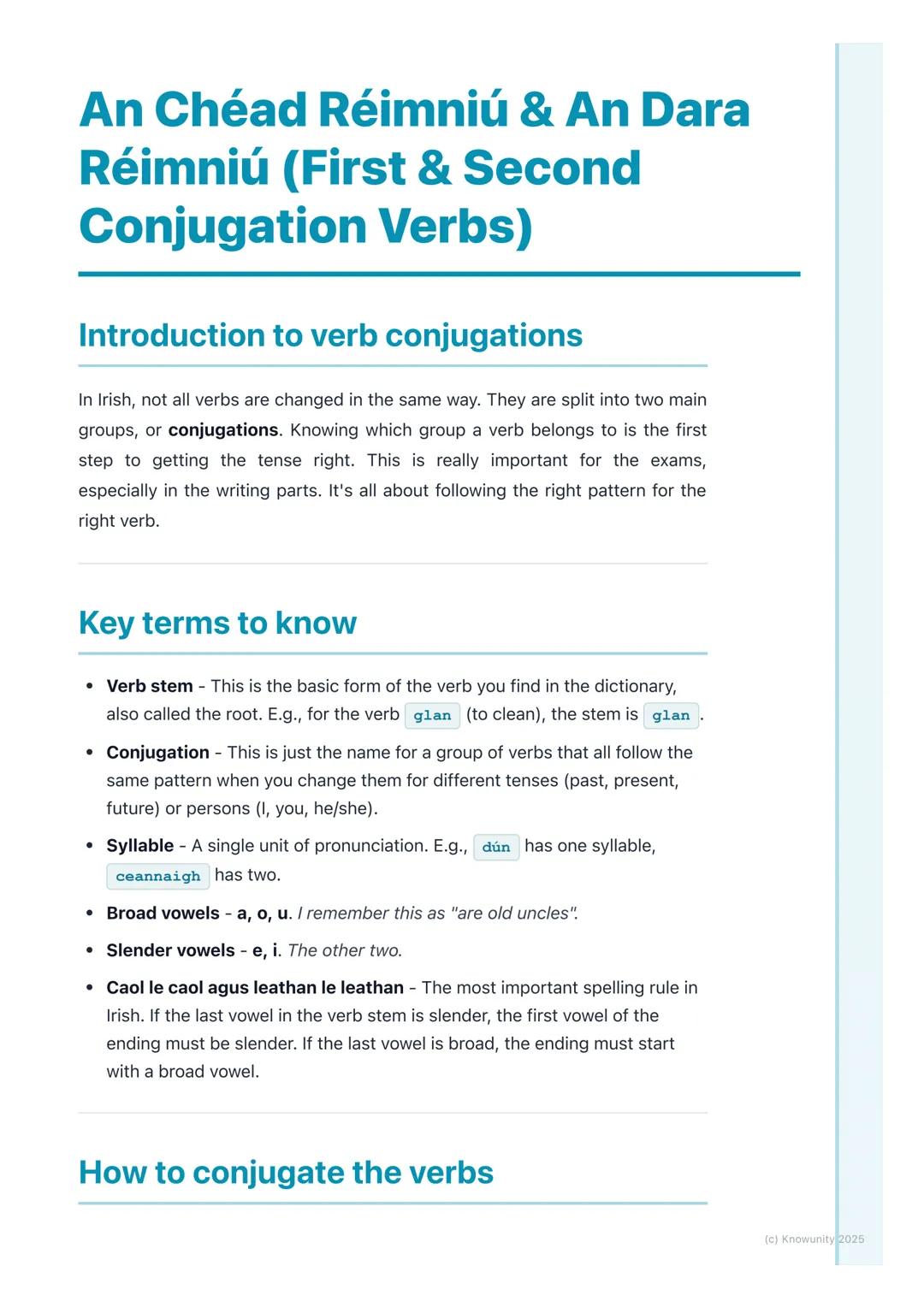
Understanding Irish Verb Conjugations
Getting your head around Irish verb conjugations is absolutely crucial for your exams, especially in the writing sections. The good news? Once you crack the system, it becomes much easier than you think.
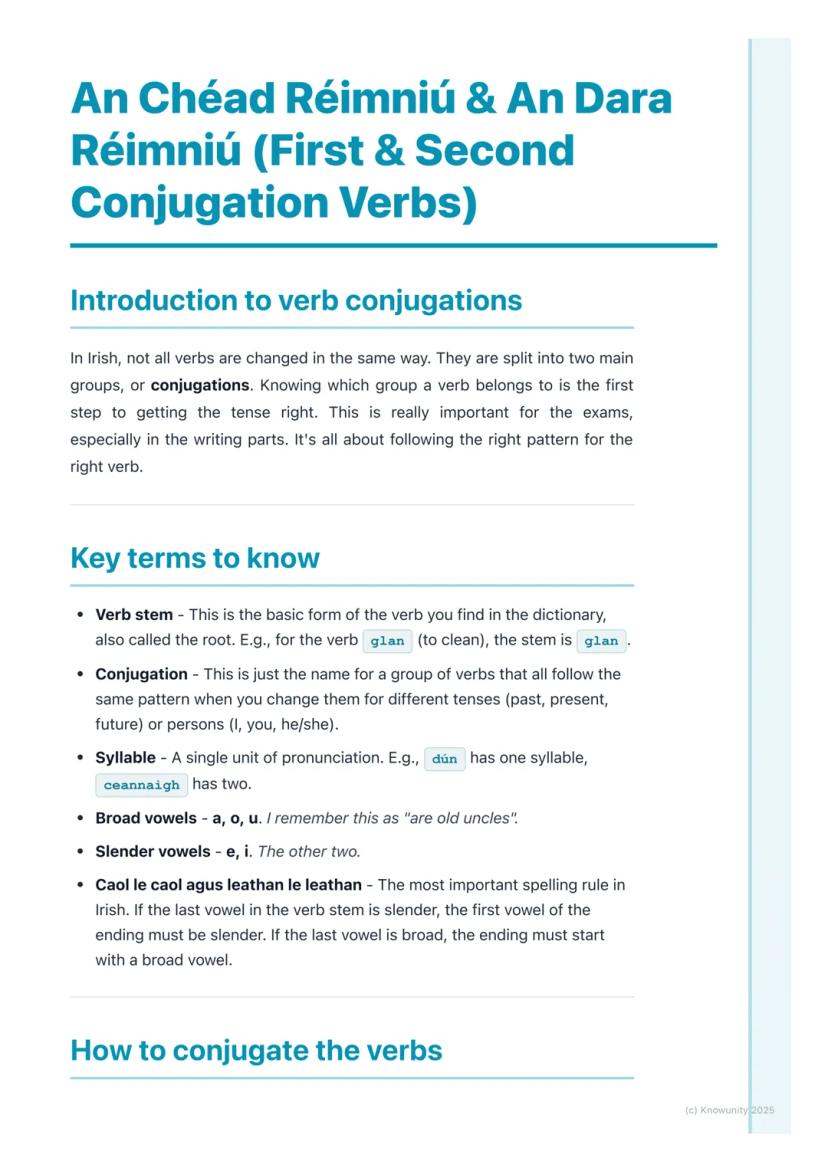
Irish verbs are split into two main groups called conjugations. Think of these as different teams that follow their own playbook. The verb stem is just the basic dictionary form of the verb - like glan (to clean) or dún (to close).
Here's a game-changer: caol le caol agus leathan le leathan is the most important spelling rule you'll ever learn in Irish. If the last vowel in your verb stem is slender (e, i), your ending must start with a slender vowel. If it's broad (a, o, u), your ending must start with a broad vowel.
Quick tip: Remember broad vowels as "are old uncles" - a, o, u. The slender vowels are just e and i!
2
of 6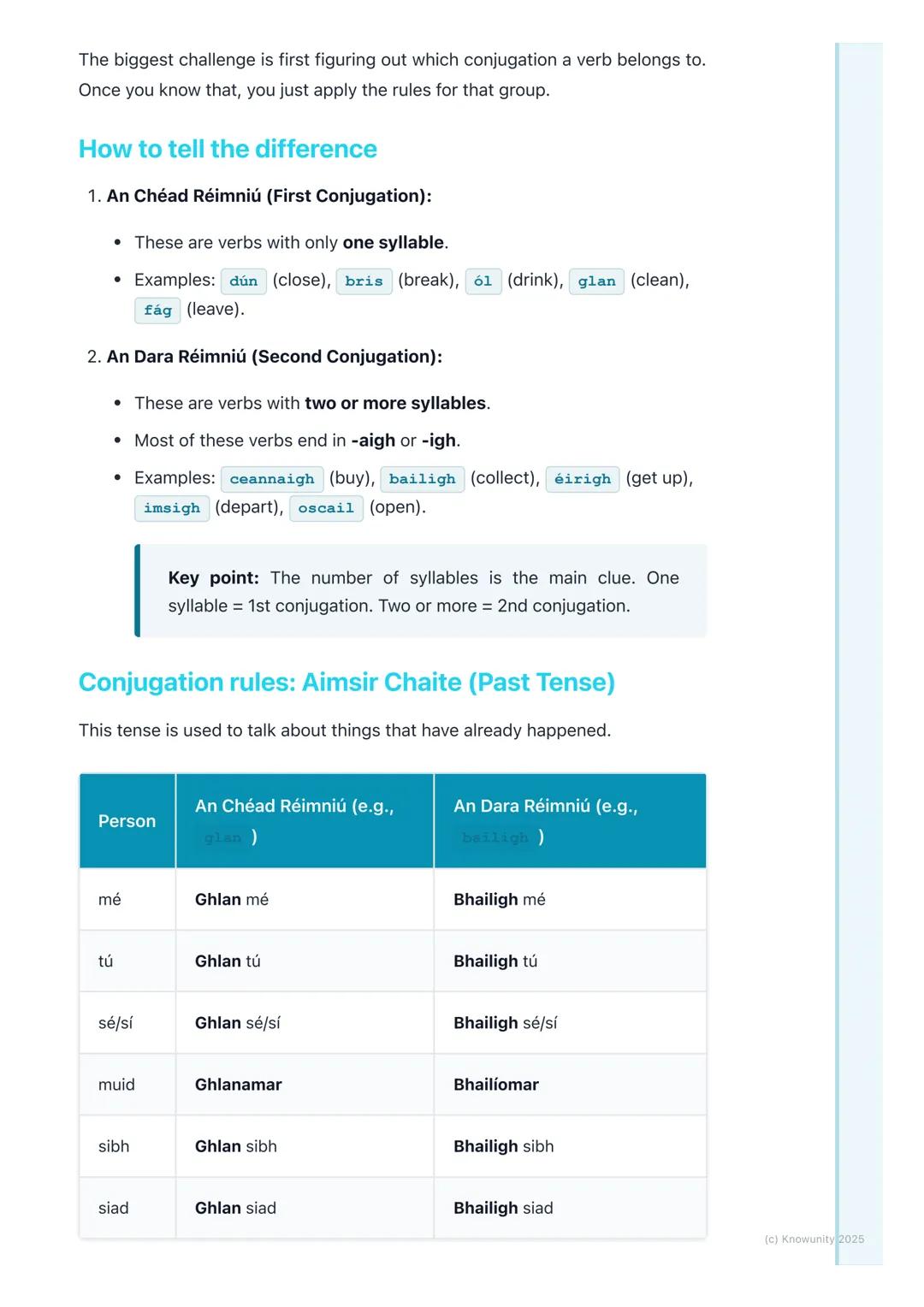
Telling the Conjugations Apart
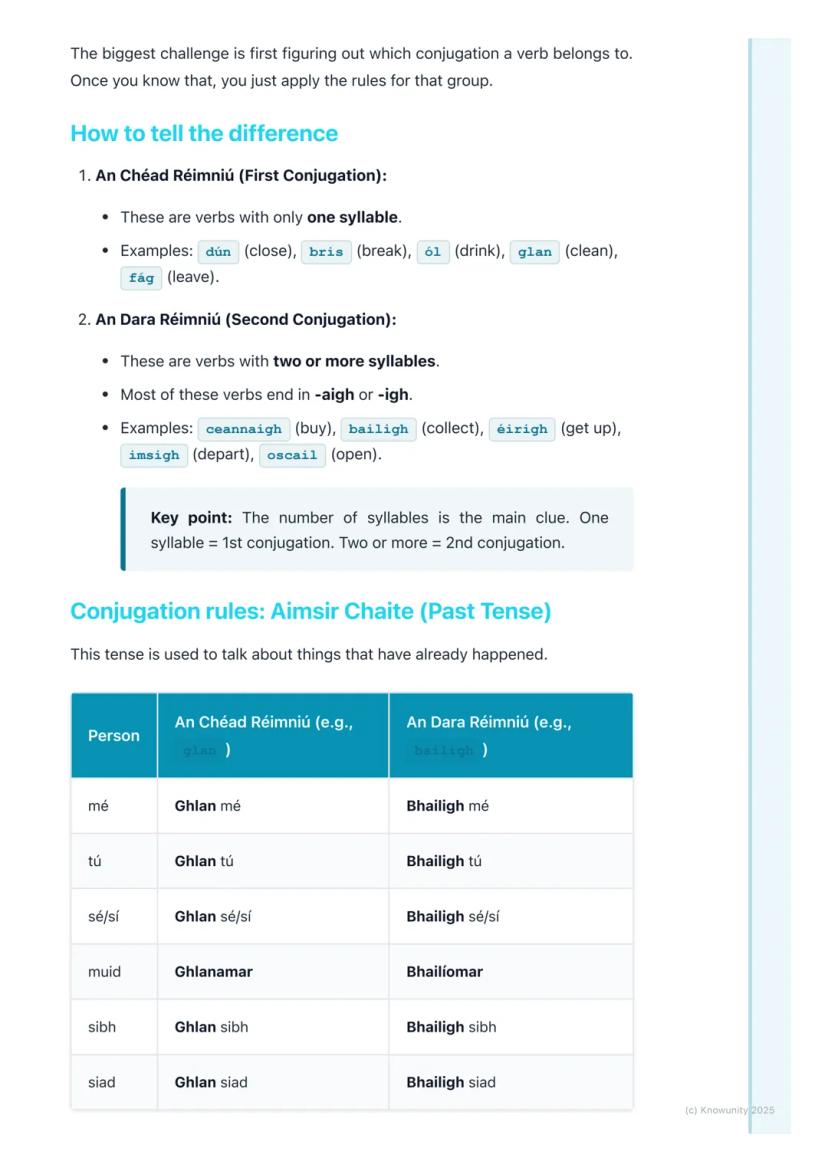
The secret to mastering first conjugation and second conjugation verbs is surprisingly simple - just count the syllables! It's honestly that straightforward.
An Chéad Réimniú (First Conjugation) includes all verbs with just one syllable. Think of verbs like dún (close), bris (break), ól (drink), and glan (clean). These are your short, snappy verbs.
An Dara Réimniú (Second Conjugation) covers verbs with two or more syllables. Most of these end in -aigh or -igh, like ceannaigh (buy), bailigh (collect), éirigh (get up), and oscail (open).
Remember: One syllable = first conjugation, two or more = second conjugation. Count those syllables and you're halfway there!
3
of 6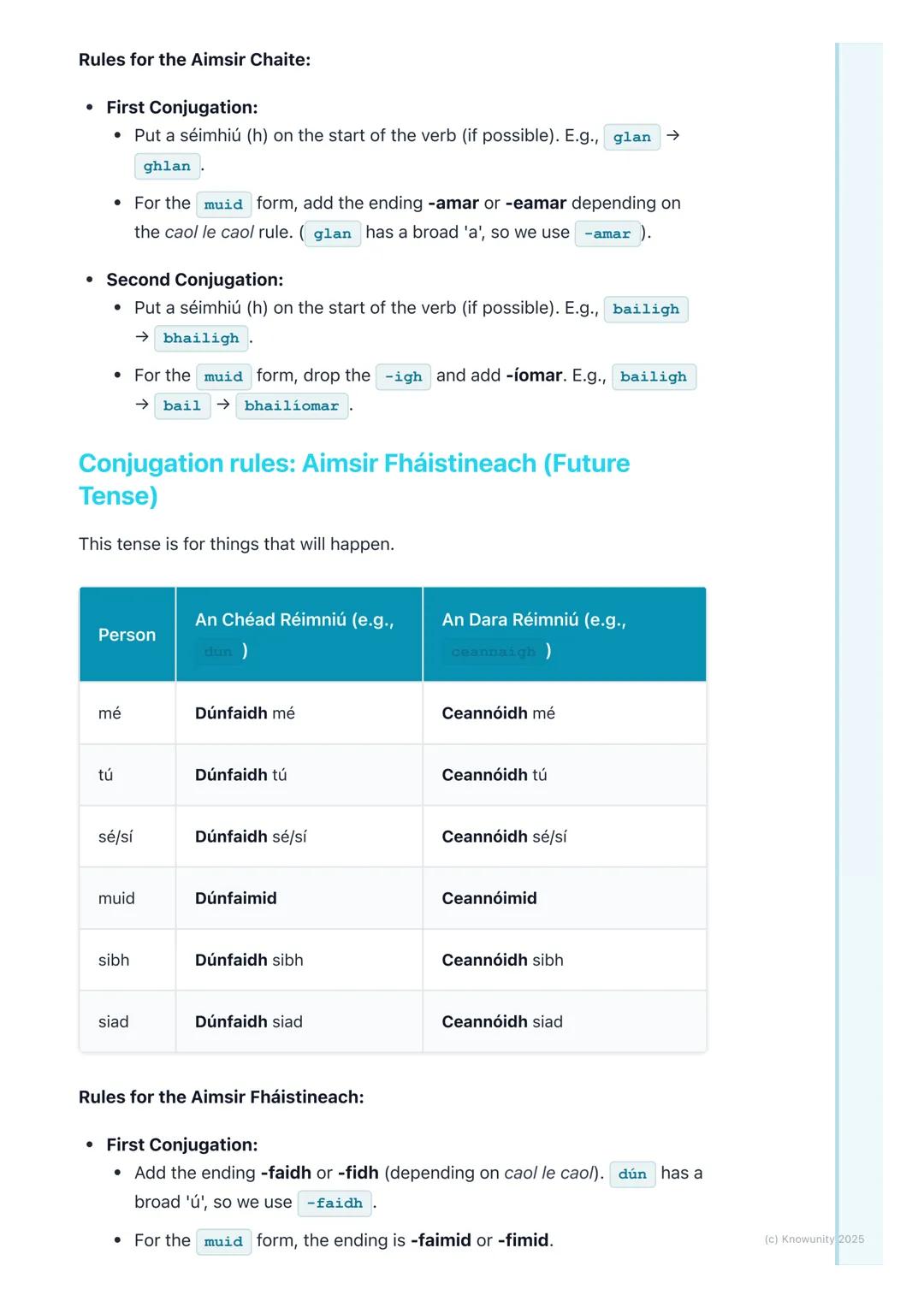
Past Tense (Aimsir Chaite)
The past tense is your go-to for describing things that have already happened, and the patterns are actually quite predictable once you get the hang of them.
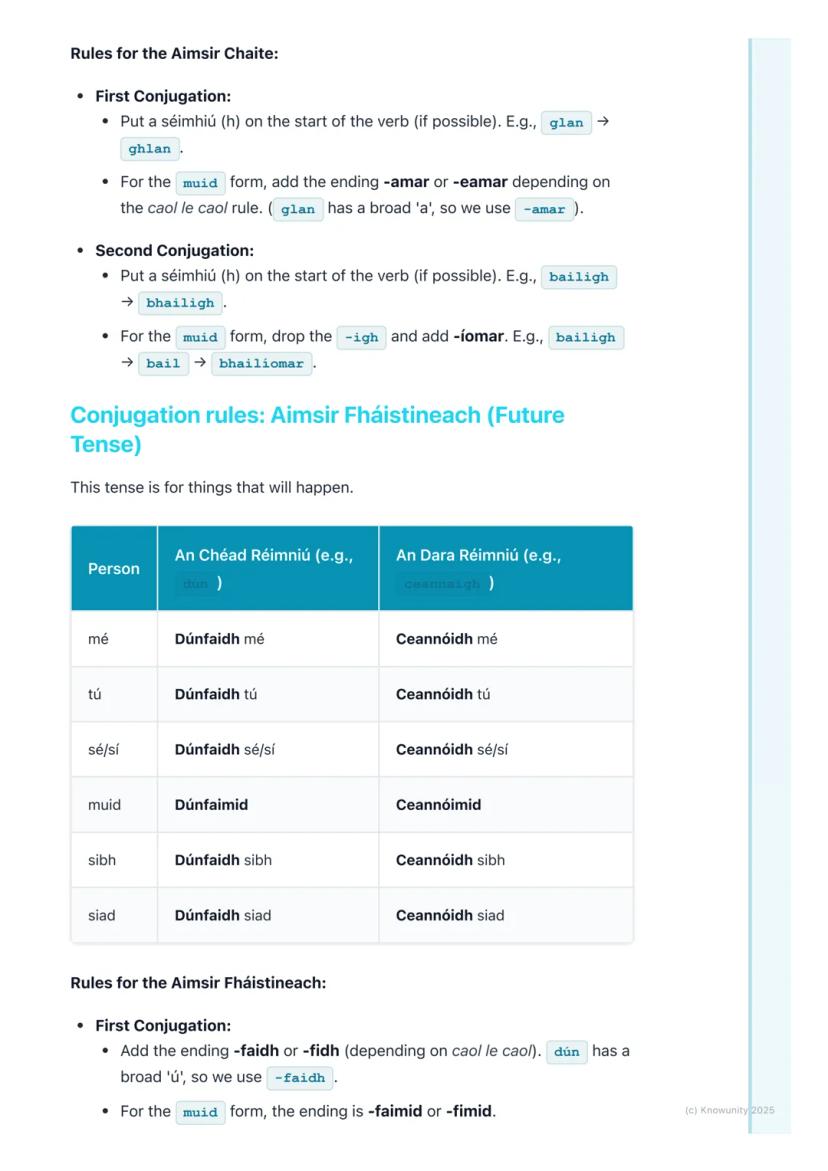
For first conjugation verbs, you add a séimhiú (that's the 'h' after the first letter) to the start. So glan becomes ghlan. For the muid form, you tack on -amar or -eamar depending on that golden rule - ghlanamar in this case.
Second conjugation verbs also get the séimhiú treatment - bailigh becomes bhailigh. But here's where it gets interesting: for the muid form, you drop the -igh and add -íomar. So bailigh becomes bhailíomar.
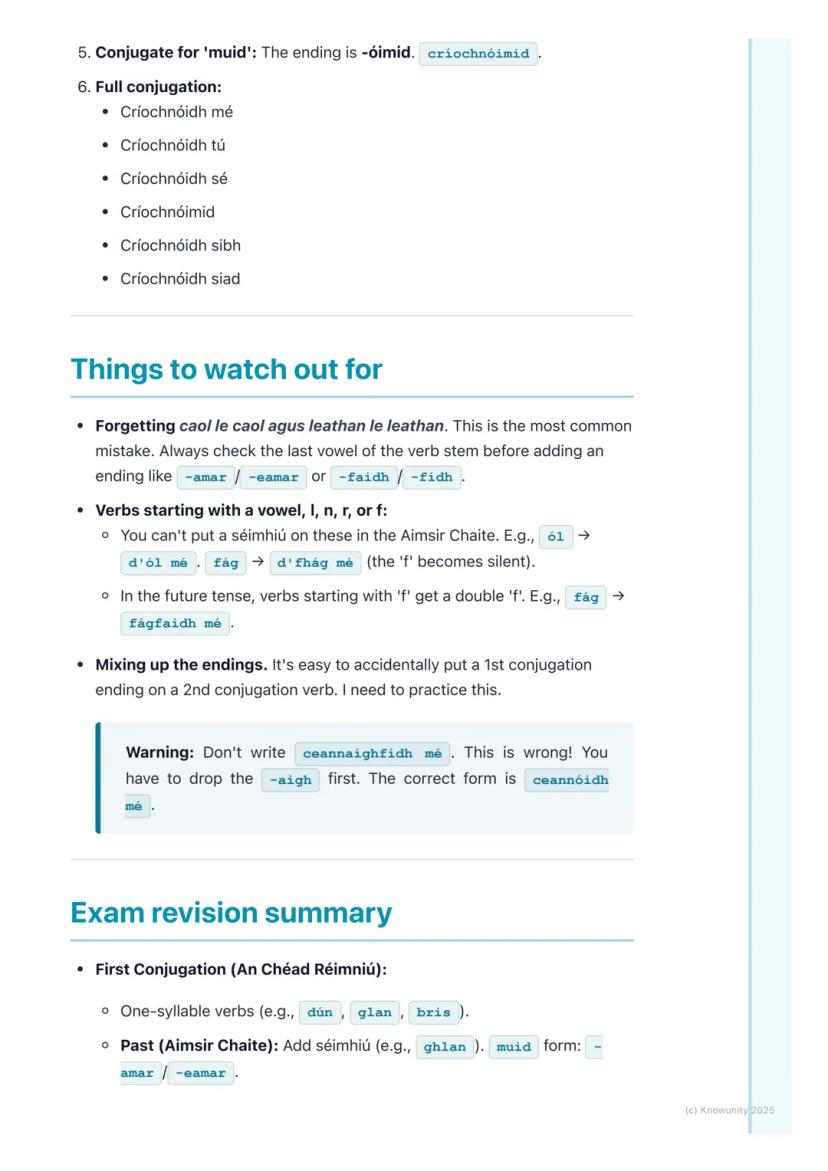
Watch out: Verbs starting with vowels, l, n, r, or f can't take a séimhiú. Instead, you might need to add d' before them, like d'ól mé.
4
of 6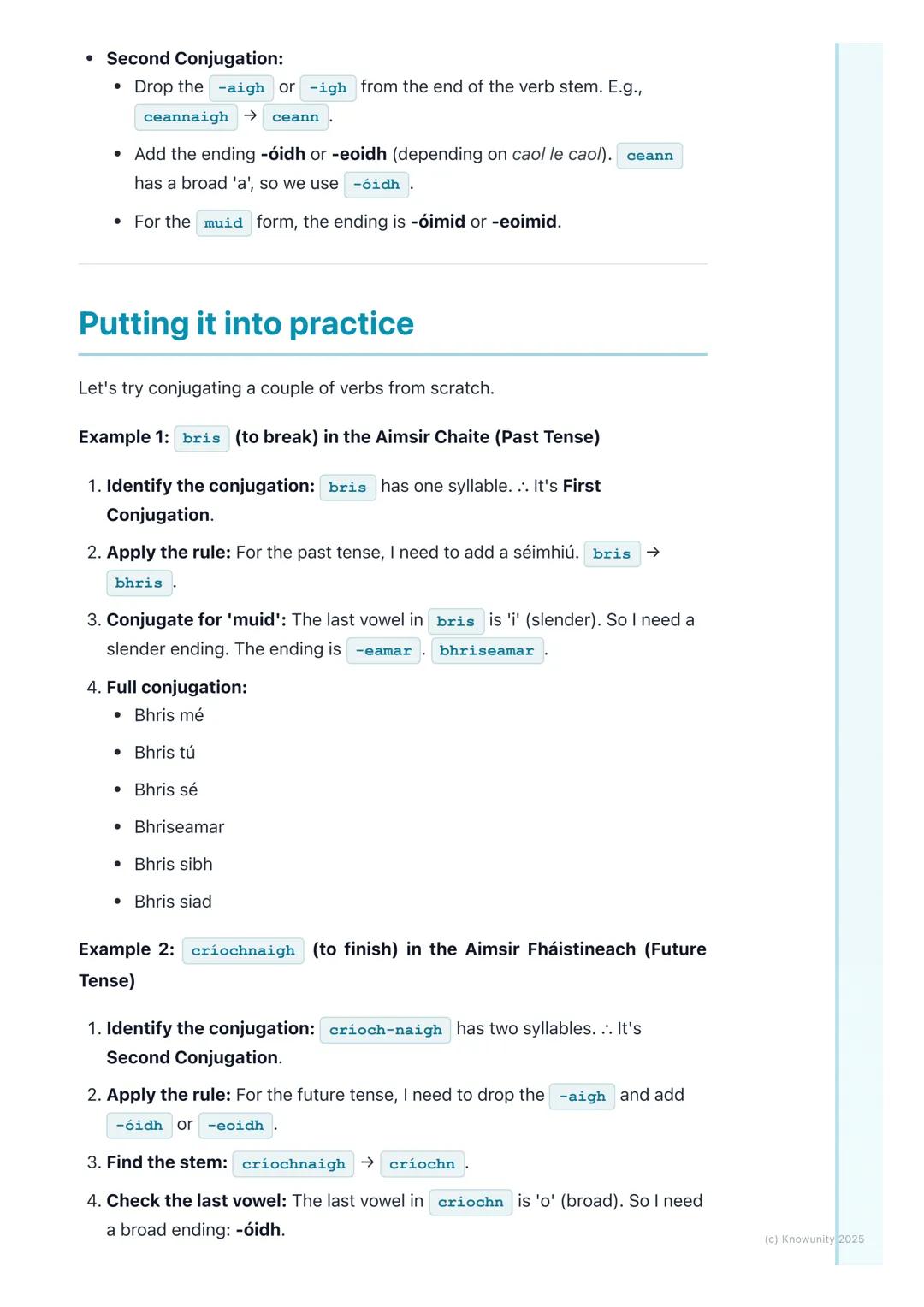
Future Tense (Aimsir Fháistineach)
The future tense is brilliant for talking about what's going to happen, and it follows some really clear patterns that'll make your life easier.
First conjugation verbs get -faidh or -fidh added to the end, following our caol le caol rule. So dún becomes dúnfaidh. For the muid form, use -faimid or -fimid - giving you dúnfaimid.
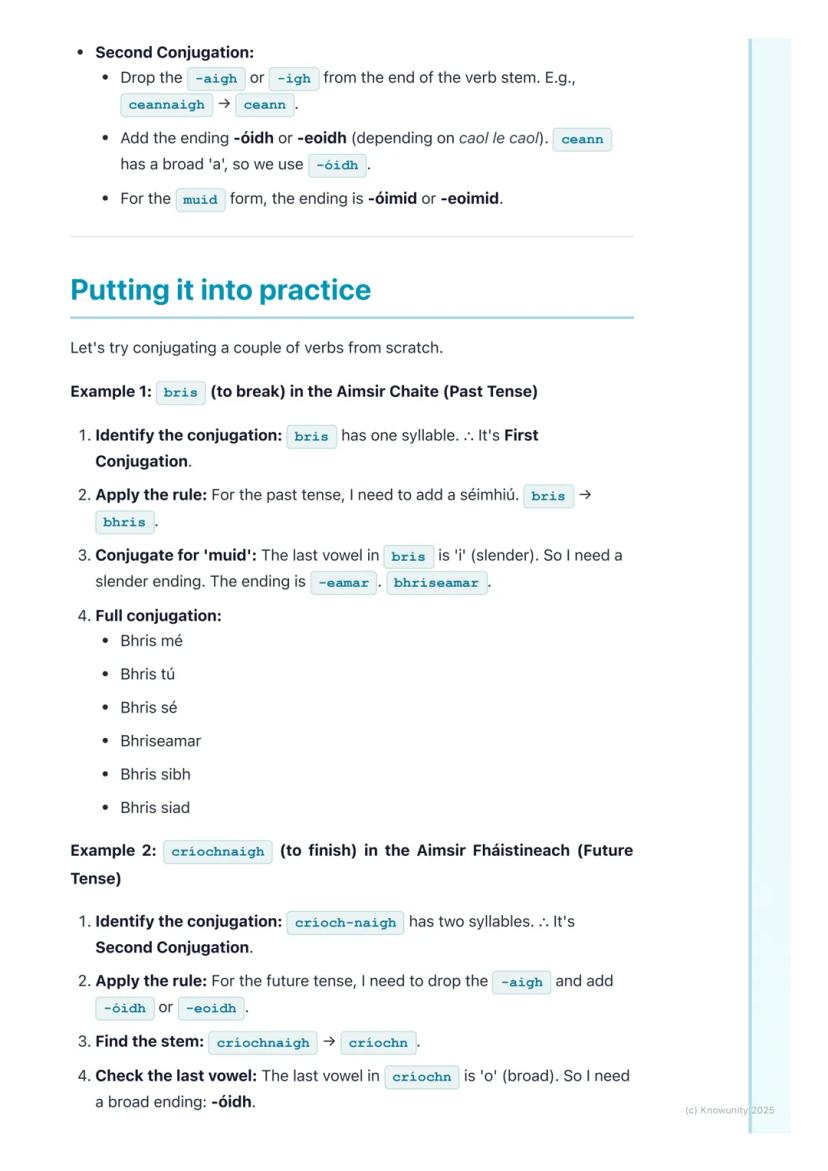
Second conjugation verbs need a bit more work. First, drop that -aigh or -igh from the end - ceannaigh becomes ceann. Then add -óidh or -eoidh depending on whether the last vowel is broad or slender. Since ceann ends with broad 'a', we get ceannóidh.
Critical mistake to avoid: Never write ceannaighfidh! You must drop the -aigh first, then add the future ending.
5
of 6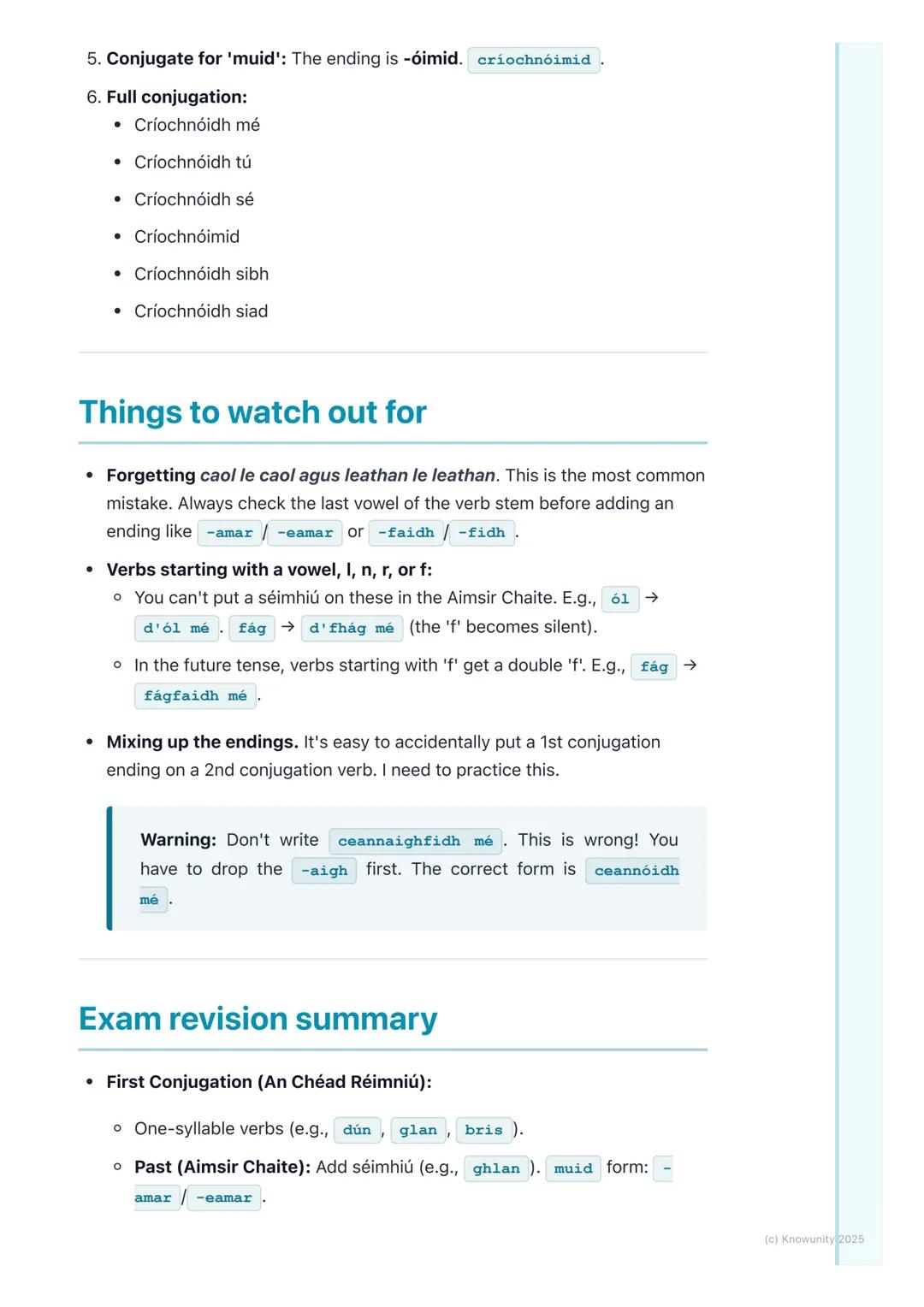
Working Through Examples
Let's put this into practice with some real examples that'll show you exactly how this works in action.
Take bris (to break) in the past tense. It's one syllable, so it's first conjugation. Add the séimhiú to get bhris, and for muid, the 'i' is slender so we need -eamar: bhriseamar. Simple as that!
Now try críochnaigh (to finish) in the future tense. Two syllables means second conjugation. Drop the -aigh to get críochn, then since the 'o' is broad, add -óidh: críochnóidh. The muid form becomes críochnóimid.
The key is following the steps methodically - identify the conjugation, apply the right rule, check your vowels, and you're sorted. Practice with different verbs and you'll spot the patterns quickly.
Pro tip: Always identify which conjugation you're dealing with before you start changing anything. This one step will save you from most mistakes!
6
of 6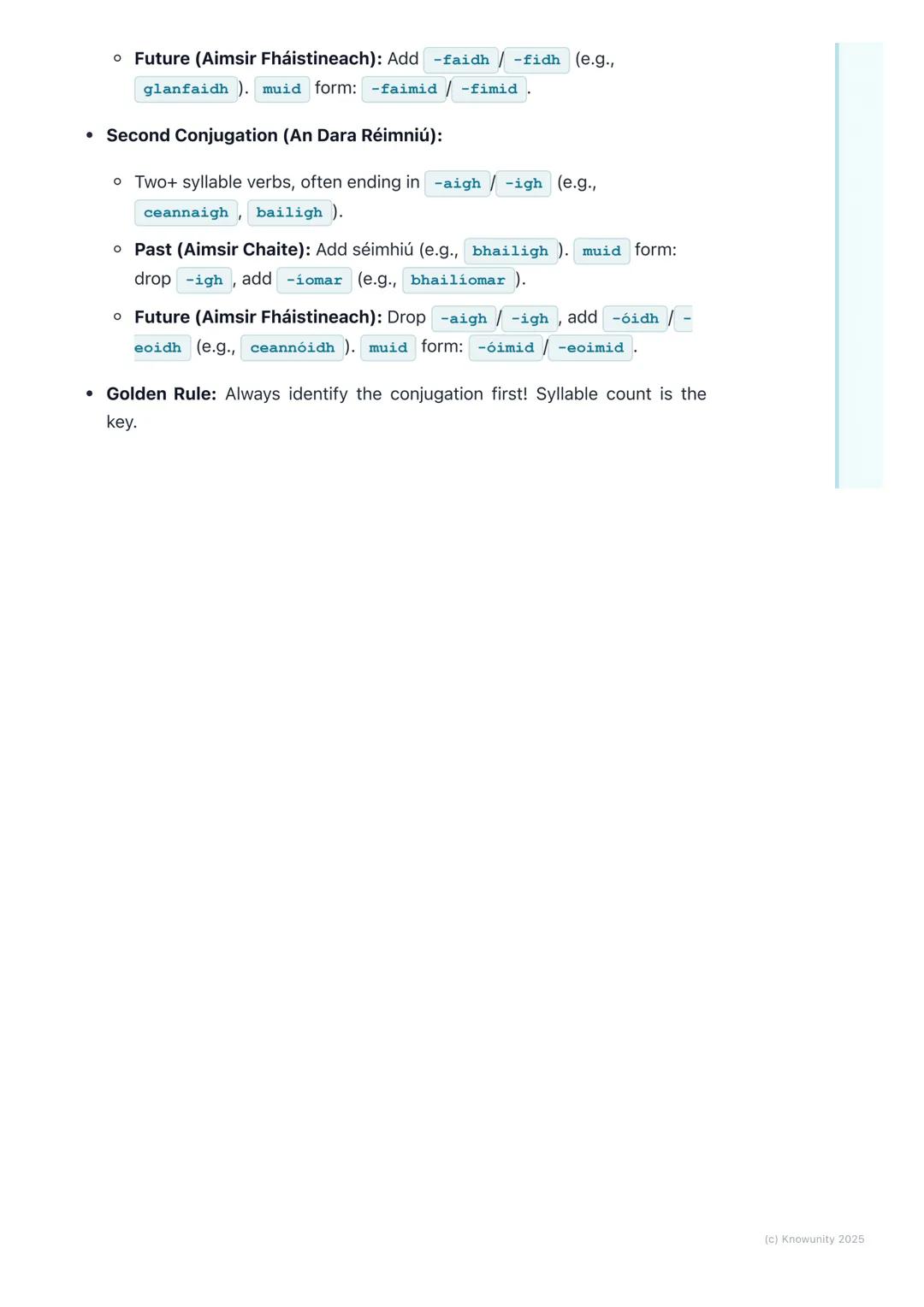
Exam Success Summary
Here's everything you need to remember for your exams, broken down into bite-sized chunks that'll stick in your memory.
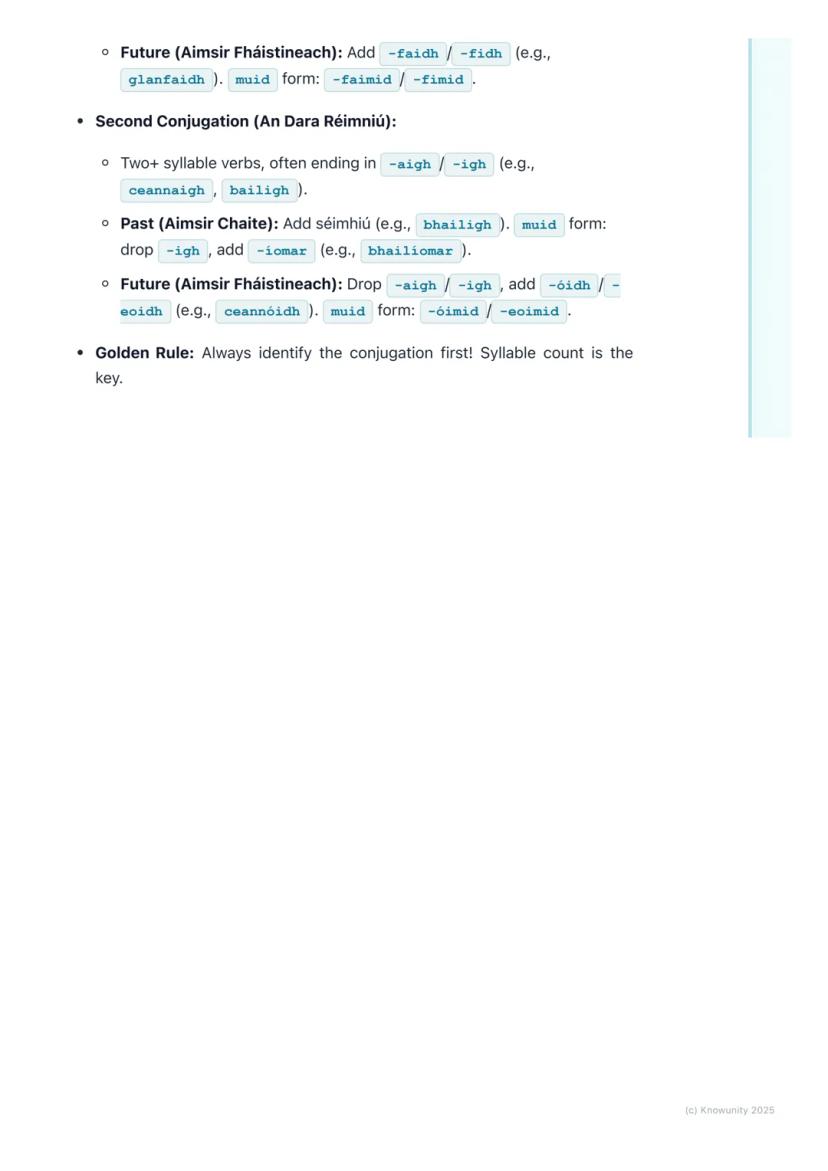
First conjugation verbs have one syllable (like dún, glan, bris). In the past tense, add séimhiú and use -amar/-eamar for muid. In the future, add -faidh/-fidh and -faimid/-fimid for muid.
Second conjugation verbs have two or more syllables, often ending in -aigh/-igh (like ceannaigh, bailigh). Past tense gets séimhiú, with muid dropping -igh and adding -íomar. Future tense drops -aigh/-igh and adds -óidh/-eoidh, with muid getting -óimid/-eoimid.
Remember: count syllables first, follow the pattern for that conjugation, and always check your caol le caol rule. You've absolutely got this!
Final reminder: The syllable count is your compass - it'll always point you in the right direction for which conjugation to use.
Mysleli sme si, že sa už nikdy neopýtaš...
Čo je Knowunity AI companion?
Náš AI Companion je AI nástroj zameraný na študentov, ktorý ponúka viac ako len odpovede. Postavený na miliónoch zdrojov Knowunity poskytuje relevantné informácie, personalizované študijné plány, kvízy a obsah priamo v chate, prispôsobujúc sa tvojej individuálnej ceste učenia.
Kde si môžem stiahnuť aplikáciu Knowunity?
Aplikáciu si môžeš stiahnuť z Google Play Store a Apple App Store.
Je Knowunity naozaj zadarmo?
Presne tak! Užívaj si bezplatný prístup k študijnému obsahu, spájaj sa s ostatnými študentmi a získaj okamžitú pomoc – všetko na dosah ruky.
Najobľúbenejší obsah v predmete Irish
9IrishIrish oral questions and answers
Questions and answers for the leaving cert oral
5th Year4264
IrishIrish oral questions
Outline of oral questions
5th Year2055
IrishIrish poetry 2027
Iníon + Dínit an Bhróin
5th Year1133
IrishIníon- le hÁine Durkin
Aine Durkin’s poem, Iníon: Themes & summary
5th Year850
IrishLC HL notes- Iníon (poem)
Includes poem in English and Irish, theme, key words & phrases
5th Year2284
IrishMo Ghrá-sa (Idir Lúibíní)
Notes on mo ghrá-sa
5th Year380
IrishGaeilge Grammar Office
All the basics you need to know on Irish grammar.
6th Year1063
IrishAn Gaeilge Aiste
Irish Language essay
6th Year1320
IrishMé Féin & Mo Chlann (Myself & My Family)
Students will learn vocabulary to describe themselves, their family members, and daily routines. This helps in personal introductions and discussions.
TY291
Najobľúbenejší obsah
9IrishIrish oral questions and answers
Questions and answers for the leaving cert oral
5th Year4264
 English
Key Quotes : Sive
Key Quotes and explanations: Sive
6th Year2842
IrishIrish oral questions
Outline of oral questions
5th Year2055
IrishIníon- le hÁine Durkin
Aine Durkin’s poem, Iníon: Themes & summary
5th Year850
IrishIrish poetry 2027
Iníon + Dínit an Bhróin
5th Year1133
IrishLC HL notes- Iníon (poem)
Includes poem in English and Irish, theme, key words & phrases
5th Year2284
EnglishCultural Context : Shawshank Redemption : Sive : Small Things Like These
Comparative Study : Cultural Context : Shawshank Redemption, Sive and Small Things Like These
6th Year1430
IrishMo Ghrá-sa (Idir Lúibíní)
Notes on mo ghrá-sa
5th Year380
IrishAn Gaeilge Aiste
Irish Language essay
6th Year1320
Nenašiel si, čo hľadáš? Preskúmaj iné predmety.
Študenti nás milujú — a ty budeš tiež.
4.6/5App Store
4.7/5Google Play
Appka je veľmi jednoduchá na používanie a má super dizajn. Zatiaľ som našiel všetko, čo som hľadal, a naučil sa veľa z prezentácií! Určite ju použijem na školskú úlohu! A samozrejme mi to aj veľmi pomáha ako inšpirácia.
Stefan SiOS používateľ
Táto appka je naozaj skvelá. Je tu toľko študijných poznámok a pomoci [...]. Môj problémový predmet je napríklad francúzština a appka má toľko možností pomoci. Vďaka tejto appke som si zlepšil francúzštinu. Odporúčal by som ju každému.
Samantha KlichAndroid používateľka
Wow, som naozaj ohromený. Vyskúšal som túto appku, lebo som ju videl mnohokrát inzerovať a bol som úplne ohromený. Táto appka je TÁ POMOC, ktorú chceš do školy a hlavne ponúka toľko vecí, ako cvičenia a faktové listy, ktoré mi osobne VEĽMI pomohli.
AnnaiOS používateľka
Irish3 zobrazenia·Aktualizované Jun 4, 2026·6 stránkyIrish Verb Conjugations Explained: First and Second Types
Learning Irish verb conjugations might seem daunting, but it's actually quite straightforward once you know the patterns. All Irish verbs fall into two main groups based on how many syllables they have, and each group follows its own set of...
1
of 6
Zaregistruj sa, aby si videl obsah. Je to zadarmo!
- Prístup ku všetkým dokumentom
- Zlepši si známky
- Pridaj sa k miliónom študentov
Understanding Irish Verb Conjugations
Getting your head around Irish verb conjugations is absolutely crucial for your exams, especially in the writing sections. The good news? Once you crack the system, it becomes much easier than you think.
Irish verbs are split into two main groups called conjugations. Think of these as different teams that follow their own playbook. The verb stem is just the basic dictionary form of the verb - like glan (to clean) or dún (to close).
Here's a game-changer: caol le caol agus leathan le leathan is the most important spelling rule you'll ever learn in Irish. If the last vowel in your verb stem is slender (e, i), your ending must start with a slender vowel. If it's broad (a, o, u), your ending must start with a broad vowel.
Quick tip: Remember broad vowels as "are old uncles" - a, o, u. The slender vowels are just e and i!
2
of 6Zaregistruj sa, aby si videl obsah. Je to zadarmo!
- Prístup ku všetkým dokumentom
- Zlepši si známky
- Pridaj sa k miliónom študentov
Telling the Conjugations Apart
The secret to mastering first conjugation and second conjugation verbs is surprisingly simple - just count the syllables! It's honestly that straightforward.
An Chéad Réimniú (First Conjugation) includes all verbs with just one syllable. Think of verbs like dún (close), bris (break), ól (drink), and glan (clean). These are your short, snappy verbs.
An Dara Réimniú (Second Conjugation) covers verbs with two or more syllables. Most of these end in -aigh or -igh, like ceannaigh (buy), bailigh (collect), éirigh (get up), and oscail (open).
Remember: One syllable = first conjugation, two or more = second conjugation. Count those syllables and you're halfway there!
3
of 6Zaregistruj sa, aby si videl obsah. Je to zadarmo!
- Prístup ku všetkým dokumentom
- Zlepši si známky
- Pridaj sa k miliónom študentov
Past Tense (Aimsir Chaite)
The past tense is your go-to for describing things that have already happened, and the patterns are actually quite predictable once you get the hang of them.
For first conjugation verbs, you add a séimhiú (that's the 'h' after the first letter) to the start. So glan becomes ghlan. For the muid form, you tack on -amar or -eamar depending on that golden rule - ghlanamar in this case.
Second conjugation verbs also get the séimhiú treatment - bailigh becomes bhailigh. But here's where it gets interesting: for the muid form, you drop the -igh and add -íomar. So bailigh becomes bhailíomar.
Watch out: Verbs starting with vowels, l, n, r, or f can't take a séimhiú. Instead, you might need to add d' before them, like d'ól mé.
4
of 6Zaregistruj sa, aby si videl obsah. Je to zadarmo!
- Prístup ku všetkým dokumentom
- Zlepši si známky
- Pridaj sa k miliónom študentov
Future Tense (Aimsir Fháistineach)
The future tense is brilliant for talking about what's going to happen, and it follows some really clear patterns that'll make your life easier.
First conjugation verbs get -faidh or -fidh added to the end, following our caol le caol rule. So dún becomes dúnfaidh. For the muid form, use -faimid or -fimid - giving you dúnfaimid.
Second conjugation verbs need a bit more work. First, drop that -aigh or -igh from the end - ceannaigh becomes ceann. Then add -óidh or -eoidh depending on whether the last vowel is broad or slender. Since ceann ends with broad 'a', we get ceannóidh.
Critical mistake to avoid: Never write ceannaighfidh! You must drop the -aigh first, then add the future ending.
5
of 6Zaregistruj sa, aby si videl obsah. Je to zadarmo!
- Prístup ku všetkým dokumentom
- Zlepši si známky
- Pridaj sa k miliónom študentov
Working Through Examples
Let's put this into practice with some real examples that'll show you exactly how this works in action.
Take bris (to break) in the past tense. It's one syllable, so it's first conjugation. Add the séimhiú to get bhris, and for muid, the 'i' is slender so we need -eamar: bhriseamar. Simple as that!
Now try críochnaigh (to finish) in the future tense. Two syllables means second conjugation. Drop the -aigh to get críochn, then since the 'o' is broad, add -óidh: críochnóidh. The muid form becomes críochnóimid.
The key is following the steps methodically - identify the conjugation, apply the right rule, check your vowels, and you're sorted. Practice with different verbs and you'll spot the patterns quickly.
Pro tip: Always identify which conjugation you're dealing with before you start changing anything. This one step will save you from most mistakes!
6
of 6Zaregistruj sa, aby si videl obsah. Je to zadarmo!
- Prístup ku všetkým dokumentom
- Zlepši si známky
- Pridaj sa k miliónom študentov
Exam Success Summary
Here's everything you need to remember for your exams, broken down into bite-sized chunks that'll stick in your memory.
First conjugation verbs have one syllable (like dún, glan, bris). In the past tense, add séimhiú and use -amar/-eamar for muid. In the future, add -faidh/-fidh and -faimid/-fimid for muid.
Second conjugation verbs have two or more syllables, often ending in -aigh/-igh (like ceannaigh, bailigh). Past tense gets séimhiú, with muid dropping -igh and adding -íomar. Future tense drops -aigh/-igh and adds -óidh/-eoidh, with muid getting -óimid/-eoimid.
Remember: count syllables first, follow the pattern for that conjugation, and always check your caol le caol rule. You've absolutely got this!
Final reminder: The syllable count is your compass - it'll always point you in the right direction for which conjugation to use.
Mysleli sme si, že sa už nikdy neopýtaš...
Čo je Knowunity AI companion?
Náš AI Companion je AI nástroj zameraný na študentov, ktorý ponúka viac ako len odpovede. Postavený na miliónoch zdrojov Knowunity poskytuje relevantné informácie, personalizované študijné plány, kvízy a obsah priamo v chate, prispôsobujúc sa tvojej individuálnej ceste učenia.
Kde si môžem stiahnuť aplikáciu Knowunity?
Aplikáciu si môžeš stiahnuť z Google Play Store a Apple App Store.
Je Knowunity naozaj zadarmo?
Presne tak! Užívaj si bezplatný prístup k študijnému obsahu, spájaj sa s ostatnými študentmi a získaj okamžitú pomoc – všetko na dosah ruky.
Najobľúbenejší obsah v predmete Irish
9IrishIrish oral questions and answers
Questions and answers for the leaving cert oral
5th Year4264
IrishIrish oral questions
Outline of oral questions
5th Year2055
IrishIrish poetry 2027
Iníon + Dínit an Bhróin
5th Year1133
IrishIníon- le hÁine Durkin
Aine Durkin’s poem, Iníon: Themes & summary
5th Year850
IrishLC HL notes- Iníon (poem)
Includes poem in English and Irish, theme, key words & phrases
5th Year2284
IrishMo Ghrá-sa (Idir Lúibíní)
Notes on mo ghrá-sa
5th Year380
IrishGaeilge Grammar Office
All the basics you need to know on Irish grammar.
6th Year1063
IrishAn Gaeilge Aiste
Irish Language essay
6th Year1320
IrishMé Féin & Mo Chlann (Myself & My Family)
Students will learn vocabulary to describe themselves, their family members, and daily routines. This helps in personal introductions and discussions.
TY291
Najobľúbenejší obsah
9IrishIrish oral questions and answers
Questions and answers for the leaving cert oral
5th Year4264
EnglishKey Quotes : Sive
Key Quotes and explanations: Sive
6th Year2842
IrishIrish oral questions
Outline of oral questions
5th Year2055
IrishIníon- le hÁine Durkin
Aine Durkin’s poem, Iníon: Themes & summary
5th Year850
IrishIrish poetry 2027
Iníon + Dínit an Bhróin
5th Year1133
IrishLC HL notes- Iníon (poem)
Includes poem in English and Irish, theme, key words & phrases
5th Year2284
EnglishCultural Context : Shawshank Redemption : Sive : Small Things Like These
Comparative Study : Cultural Context : Shawshank Redemption, Sive and Small Things Like These
6th Year1430
IrishMo Ghrá-sa (Idir Lúibíní)
Notes on mo ghrá-sa
5th Year380
IrishAn Gaeilge Aiste
Irish Language essay
6th Year1320
Nenašiel si, čo hľadáš? Preskúmaj iné predmety.
Študenti nás milujú — a ty budeš tiež.
4.6/5App Store
4.7/5Google Play
Appka je veľmi jednoduchá na používanie a má super dizajn. Zatiaľ som našiel všetko, čo som hľadal, a naučil sa veľa z prezentácií! Určite ju použijem na školskú úlohu! A samozrejme mi to aj veľmi pomáha ako inšpirácia.
Stefan SiOS používateľ
Táto appka je naozaj skvelá. Je tu toľko študijných poznámok a pomoci [...]. Môj problémový predmet je napríklad francúzština a appka má toľko možností pomoci. Vďaka tejto appke som si zlepšil francúzštinu. Odporúčal by som ju každému.
Samantha KlichAndroid používateľka
Wow, som naozaj ohromený. Vyskúšal som túto appku, lebo som ju videl mnohokrát inzerovať a bol som úplne ohromený. Táto appka je TÁ POMOC, ktorú chceš do školy a hlavne ponúka toľko vecí, ako cvičenia a faktové listy, ktoré mi osobne VEĽMI pomohli.
AnnaiOS používateľka